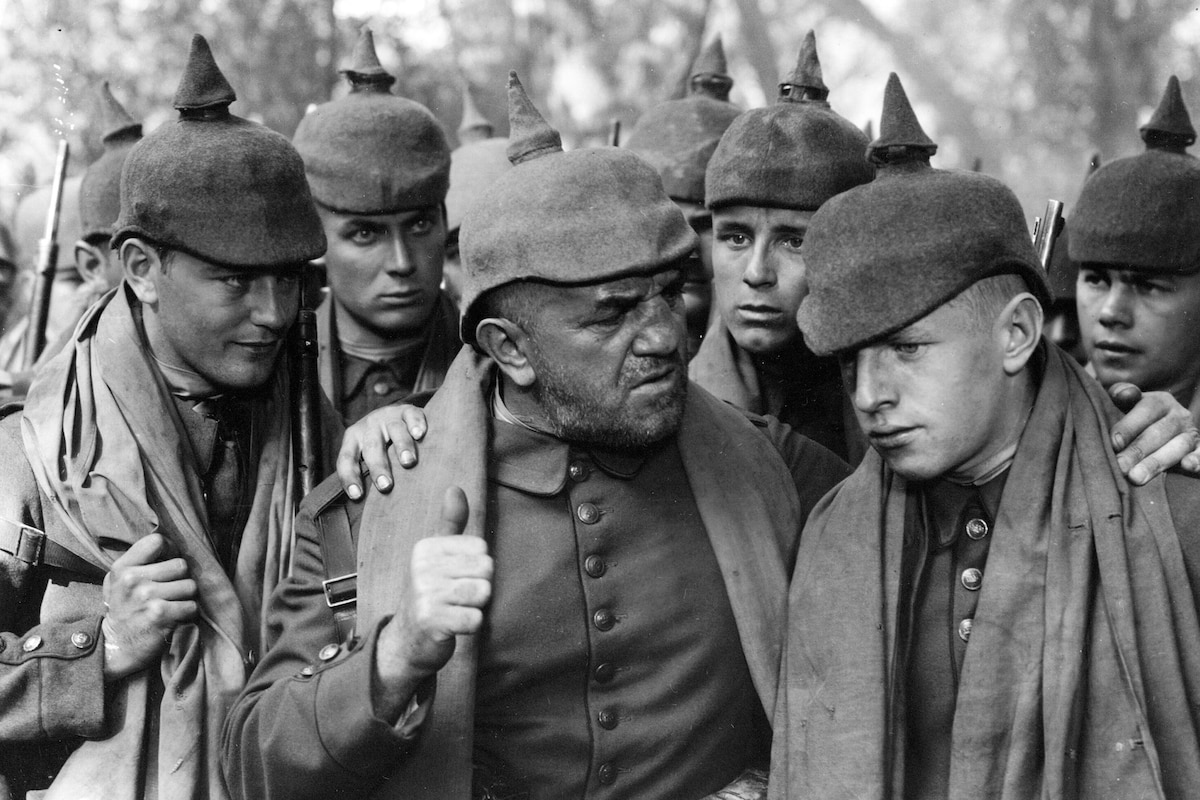
"The League of Nations could make no better investment than to buy the master print, reproduce it in every nation to show every year until the word 'war' is taken out of the dictionary."
- Variety
"Often the scenes are of such excellence that if they were not audible one might believe that they were actual motion pictures of activities behind the lines, in the trenches and in No Man's Land. It is an expansive production with views that never appear to be cramped. In looking at a dugout one readily imagines a long line of such earthy abodes. When shells demolish these underground quarters, the shrieks of fear, coupled with the rat-tat-tat of machine guns, the bang-ziz of the trench mortars and the whining of shells, it tells the story of the terrors of fighting better than anything so far has done in animated photography coupled with the microphone."
- Mordaunt Hall, The New York Times.
"The movie follows the book, aimlessly but sincerely, and as a result it has little direction or point...It takes in so much territory and loses itself so often in the trenches that you never do get any feeling of relationship with the hero...There are so many detached scenes, so many repetitious tragedies in the movie, the death of the hero comes as an anti-climax."
- Pare Lorentz, “Lorentz on Film”
"...an anti-war declaration of power and realism which has scarcely diminished with the passage of time...It is also remarkably effective in the staging of grimly impressive sequences of trench-warfare: this was probably the first time that the general public had been made vividly aware of the conditions under which men lived and fought in the trenches."
- “The Oxford Companion to Film”
"A magnificent cinematic equivalent of the book...The sound and image mediums blend as one, as a form of artistic expression that only the motion screen can give."
- “National Board of Review”
“....it's a tough experience these days, in great part because the audience has to face its own defiant appetite for ‘war scenes’ no matter the logic of pacifism. The single temptation of war on film is to make it look easy. Sooner or later, most war films become recruiting material."
- David Thomson, “Have You Seen....?”
"The film's strength now derives less from its admittedly powerful but highly simplistic utterances about war as waste, than from a generally excellent set of performances (Ayres especially) and an almost total reluctance to follow normal plot structure. It is in fact the often relentless depiction of unflagging warfare and suffering that eventually pummels one into feeling, rather than understanding, the film's message."
- Geoff Andrew, Time Out
"Over a hundred million people have gone to theatres to see it and have—perhaps—responded to its pacifist message. One could be cynical about the results, but the film itself does not invite cynical reactions, and the fact that it has frequently been banned in countries preparing for war suggests that it makes militarists uncomfortable. Except for Louis Wolheim, who is capable of creating a character with a minimum of material, the actors are often awkward, uncertain, and overemphatic, but this doesn't seem to matter very much. The point of the film gets to you, and though you may wince at the lines Maxwell Anderson wrote (every time he opens his heart, he sticks his poetic foot in it), you know what he means."
- Pauline Kael, “5,001 Nights at the Movies”
"Without diluting or denying any...criticisms, it should be said that from World War I to Korea, Milestone could put the viewer into the middle of a battlefield, and make the hellish confusion of it seem all too real to the viewer. Steven Spielberg noted as much when he credited Milestone's work as partial inspiration for Saving Private Ryan [1998] ...Lewis Milestone made significant contributions to [the genre of] the war film."
Mike Mayo, “War Movies: Classic Conflict on Film"
Additionally, this film has received the following awards and/or honors:
All Quiet on the Western Front was nominated for four Academy Awards: Best Director, Best Picture, Best Cinematography and Best Screenplay. It won the first two, the first Oscars ever for a Universal picture. In presenting Carl Laemmle with the film's Best Picture Oscar, MGM president Louis B. Mayer said, "I hear there's talk that the motion picture we honor tonight may win a Nobel Peace Prize."
The film was voted a place in the National Film Registry in 1990.