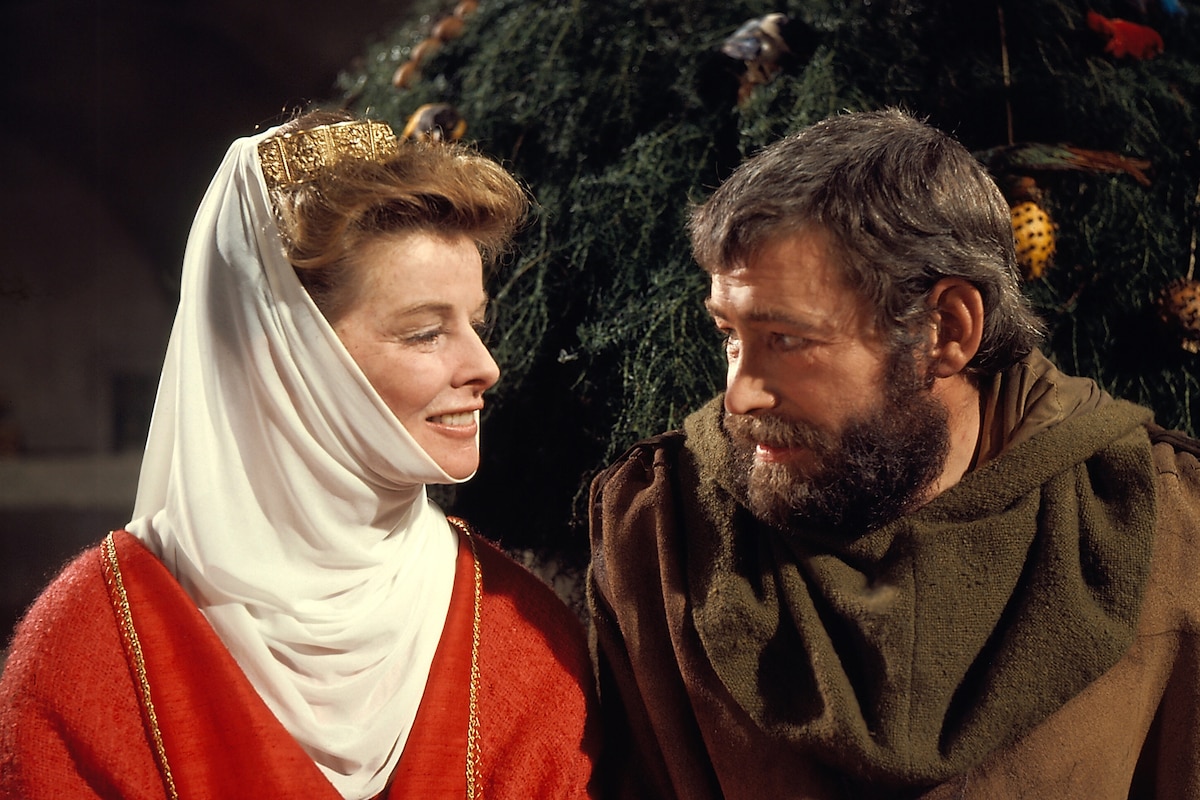
When The Lion in Winter was voted Best Picture by the New York Film Critics Circle, Life magazine critic Richard Schickel hit the roof and accused fellow members of being "deadwood" for picking the historical drama over John Cassavetes Faces (1968). Schickel and three others resigned in protest but rejoined the following year.
"The most literate movie of the year." - Charles Champlin, Los Angeles Times, 1968
"Miss Hepburn certainly crowns her career as Eleanor, triumphant in her creation of a complete and womanly queen, a vulture mother who sees her sons too clearly, an aging beauty who can look her image in the eye, a sophisticate whose shrewdness is matched only by her humor." - Judith Crist, New York, 1968
"This film is most importantly a great duet, superbly rendered." - John Russell Taylor, London Times, 1968.
"This is Mr. O'Toole's second portrayal of Henry II on film. The contrast between the limp, ineffectual king in “Becket” and the bold dynamism of the crowned head in The Lion in Winter emphasizes the range of Mr. O'Toole's talents." - John Allen, Christian Science Monitor, 1968.
"There is a fusion, a merging of identities that makes this perhaps the finest characterization of [Hepburn's] career." - Saturday Review, 1968.
"An intense, fierce, personal drama put across by outstanding performances." - Variety, October 23, 1968.
"Outdoorsy and fun, full of the kind of plotting and action people used to go to just plain movies for." -Renata Adler, The New York Times, October 31, 1968.
"Henry and Eleanor are reduced to a TV-sized version of the sovereigns next door, their epic struggle shrunk to sitcom squabbles." - Time, 1968.
"Imitation wit and imitation poetry at the 12th-century court of the Plantagenets...it was brought to the screen as if were poetic drama of a very high order, and the point of view is too limited and anachronistic to justify all this howling and sobbing and carrying on....Goldman's dialogue can't bear the weight of the film's aspirations to grandeur, and, as Eleanor of Aquitaine, Katharine Hepburn does a gallant-ravaged-great-lady number. She draws upon our feelings for her, not for the character she's playing, and the self-exploitation is hard to take." - Pauline Kael, “5001 Nights at the Movies.”
Additionally, this film has received the following awards and/or honors:
The Lion in Winter won Academy Awards for Best Actress (Katharine Hepburn), Best Original Music (John Barry) and Best Adapted Screenplay (James Goldman). It earned nominations for Best Picture, Actor (Peter O'Toole), Director (Anthony Harvey) and Costume Design (Margaret Furse).
It won British Academy Awards for Hepburn and John Barry (Music) in addition to nominations for screenplay, cinematography, costumes, soundtrack and supporting actor (Anthony Hopkins).
- Golden Globes for Best Motion Picture Drama, Actor in a Drama (O'Toole). Nominations for Best Actress, Supporting Actress (Jane Merrow), Director, Screenplay, Original Score
- New York Film Critics Best Film Award
- Writers Guilds of America and Britain awards to James Goldman.
- Directors Guild of America Award to Anthony Harvey and Assistant Director Kip Gowans
- British Society of Cinematographers Award to Douglas Slocombe.
- David Di Donatello Award (Italy's main film award) for Best Foreign Production
- Winner of the Worst Film of the Year Award presented annually by the Harvard Lampoon.
Hepburn's Oscar for this film made her the first performer to have won three times in a Best Actor or Actress category (Walter Brennan won three times as Best Supporting Actor). Her win for On Golden Pond (1981) gave her the all-time record of four. Having won the year before for Guess Who's Coming to Dinner (1967), Hepburn became the third performer to win in consecutive years (including Spencer Tracy and Luise Rainer). Since then Tom Hanks has joined the list of consecutive winners.
Hepburn tied for Best Actress with Barbra Streisand for Funny Girl (1968), the only time that has ever happened in this category. There has been one tie in the Best Actor category between Wallace Beery in The Champ (1931) and Fredric March in Dr. Jekyll and Mr. Hyde (1931). Oddly enough, there were then only three nominees in the acting categories that year, making Alfred Lunt (in The Guardsman, 1931) the sole "loser."
O'Toole's nomination in this role made him the only actor to be nominated twice for playing the same character in two completely different films (Al Pacino has two nominations for playing Michael Corleone in the Godfather movies, but the second was for a sequel by the same writers and director).