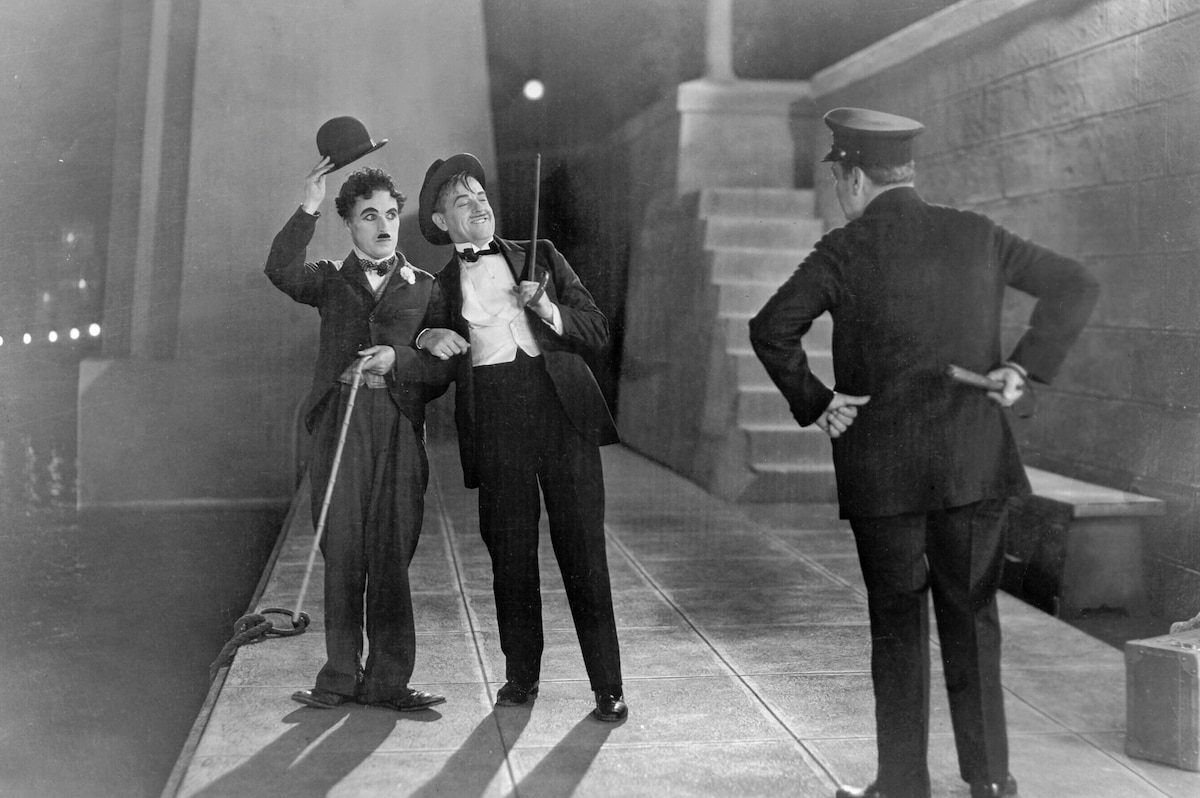
"Charlie Chaplin, master of screen mirth and pathos, presented at the George M. Cohan last night before a brilliant gathering his long-awaited non-dialogue picture, City Lights, and proved so far as he is concerned the eloquence of silence...It is a film worked out with admirable artistry, and while Chaplin stoops to conquer, as he has invariably done, he achieves success."
- The New York Times
"It's not Chaplin's best picture, because the comedian has sacrificed speed to pathos, and plenty of it...But the British comic is still the consummate pantomimist, unquestionably one of the greatest the stage or screen has ever known. Certain sequences in City Lights are hilarious. Perhaps the high spot is a burlesque prize fight which in rehearsal time alone must have taken weeks to shoot...Cast support is minor other than in Myers, who does exceptionally well in foiling the star. Miss Cherrill is very fair of face but demands upon her are not enough to permit rating other than expected. Chaplin making a silent is merely sticking to his last. He never talked on the stage when in vaudeville before going into pictures, and, having made himself the foremost exponent of pantomime the world knows today, there doesn't appear any reason why he should talk. With his ability to create and take familiar situations to make them look differently he can go on making successful silent films until he chooses to retire--so long as they entertain. Talkers have not affected Chaplin and neither will he affect talkers. There will always be room for a Chaplin...There was no one like him before in pictures, and since sound came in that is doubly true. The only thing sound can do to a silent Chaplin is, perhaps, make him slightly less important in the general public eye as time goes on."
- Variety
"If only one of Charles Chaplin's films could be preserved, City Lights would come the closest to representing all the different notes of his genius. It contains the slapstick, the pathos, the pantomime, the effortless physical coordination, the melodrama, the bawdiness, the grace, and, of course, the Little Tramp--the character said, at one time, to be the most famous image on earth."
- Roger Ebert
"Chaplin's masterpiece tells story of his love for blind flower girl, and his hot-and-cold friendship with a drunken millionaire. Eloquent, moving and funny. One of the all-time greats."
- Leonard Maltin, “Movie and Video Guide”
"Chaplin's most masterful blend of pathos and comedy...You can't leave the planet without seeing this movie at least once."
- The San Francisco Chronicle
"The most wistfully Chaplinesque of Chaplin features. The final shot is among the most celebrated in movies."
-- J. Hoberman, The Village Voice
Additionally, this film has received the following awards and/or honors:
In 1991, City Lights was added to the National Film Registry for preservation.
City Lights was named one of the ten best films of 1931 by The New York Times.
The National Board of Review named City Lights the best film of 1931.
In 2007, City Lights was ranked number 11 on the American Film Institute's 10th Anniversary list of the 100 greatest American films of all time.
In 2003, Chaplin's Tramp character in City Lights was ranked number 38 on the American Film Institute's list of the top 100 movie heroes of all time.
In 2000, the American Film Institute ranked City Lights number 38 on its list of the top 100 funniest American movies of all time.
In 2006, the American Film Institute ranked City Lights number 33 on its list of the top 100 most inspiring American films of all time.
In 2002, the American Film Institute ranked City Lights number 10 on its list of the top 100 greatest love stories ever made.
The American Film Institute currently ranks City Lights as the number one romantic comedy of all time.
Time magazine critics Richard Corliss and Richard Schickel included City Lights on their list of the top 100 films ever made.