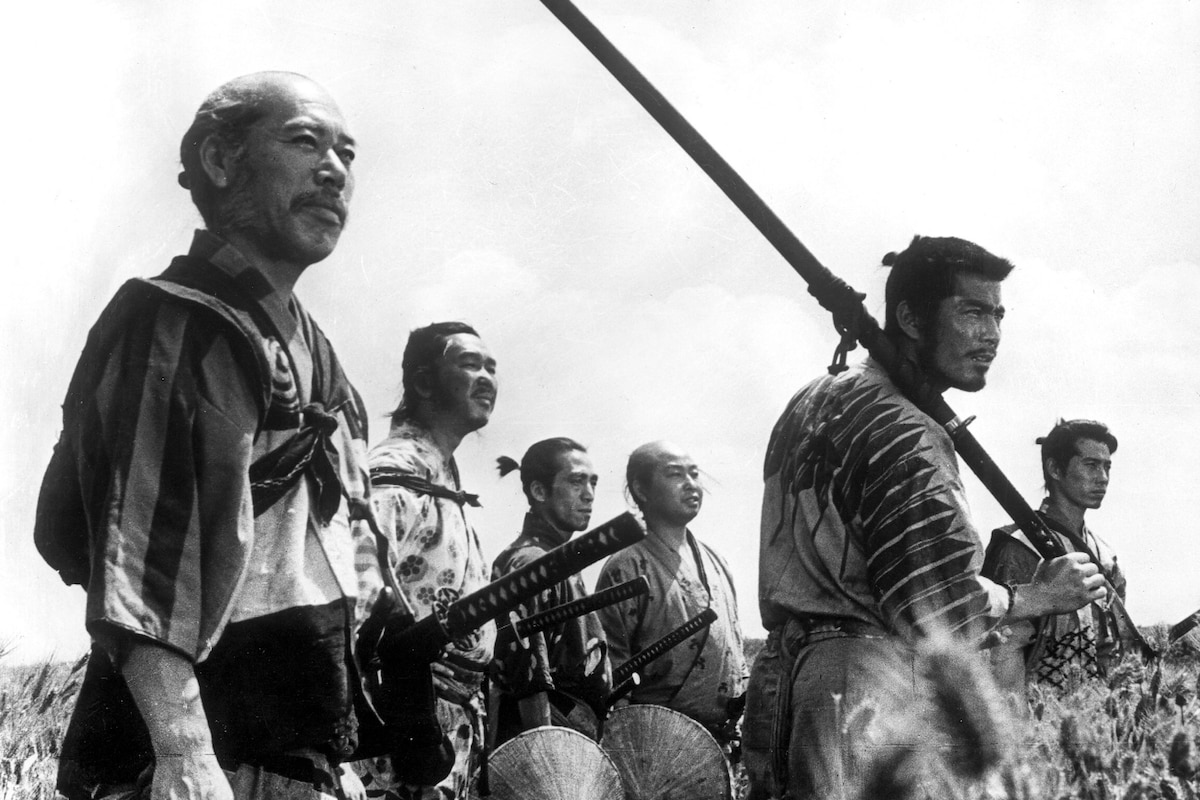
"On [a] simple framework, Kurosawa has plastered a wealth of rich detail, which brilliantly illuminates his characters and the kind of action in which they are involved. He has loaded his film with unusual and exciting physical incidents and made the whole thing graphic in a hard, realistic western style."
- Bosley Crowther, The New York Times, November 20, 1956
"Seven Samurai is long; it is brutal; it is not always easy to follow. But it is magnificent."
- Dilys Powell, “Sunday Times” (London), 1955.
"Though the narrative concentrates on action, it does not preclude many delicate touches of irony: the invincible master swordsman is killed by a shot from a primitive musket. And although the film is as savage as the times in which it is set, there are many moments of humor. ... The acting throughout is magnificent. Outstanding is Takashi Shimura, who makes the old samurai leader a wonderfully human figure."
- Peter Barnes, “Films and Filming,” April 1955.
"Kurosawa has given it all the internal pace, beauty, precision and fluidity of ballet–a medium which, even in moments of wild comedy, cruelty, carnage and confusion, the film's action insistently recalls."
- Paul Dehn, “News Chronicle” (London), 1955
"Entertaining it certainly is: convincing, thrilling, meaningful, compelling. It remains (along with Ikiru [1952]) the director's own favorite. At the same time, it is completely serious."
- Donald Richie, “The Films of Akira Kurosawa.”
"In the battle scenes of Seven Samurai [Mifune] seems as powerful and as elemental as the great rain...Its leading characters are distinct and appealing; the situation is contrived but compelling; the action is shot with virtuoso skill. But it is almost twice as long as a good Western, and its social theme–that the samurai are disapproved of by the village they protect–is made monotonously."
- David Thomson, “A Biographical Dictionary of Film.”
"Widely imitated, but no one has come near it." - Pauline Kael, “5001 Nights at the Movies.”
"Kurosawa's masterpiece...Despite the caricatured acting forms of Noh and Kabuki which Kurosawa adopted in his period films, the individual characterizations are precise and memorable, none more so than that by Takashi Shimura...The epic action scenes involving cavalry and samurai are still without peer."
- Rod McShane, TimeOut Film Guide
"Superbly strange, vivid and violent medieval adventure..."
- Halliwell's Film & Video Guide
"It is as sheer narrative, rich in imagery, incisiveness and sharp observation, that it makes its strongest impact...It provides a fascinating display of talent, and places its director in the forefront of creative film-makers of his generation."
- Gavin Lambert, “Sight and Sound”
"This, on the surface, is a work of relentless, unmitigated action, as epic as any film ever made, and, again on the surface, sheer entertainment. Yet, it is also an unquestionable triumph of art."
- John Simon
"The astonishing vitality of this true jidai-geki is largely due to its narrative economy, athletic camerawork, and the tempo of the editing."
- “The Oxford Companion to Film”
"...[A] fully coherent work of art, an epic in every respect....To merely call it a classic is glib - but it is a classic, because it continues to provoke, to impassion....That dust, that mud, are part of what separates Seven Samurai from all its imitators...The natural world is always part of the film, and the characters inseparable from nature."
- John Anderson, “The A List”
"...Kurosawa has constructed a superb narrative, bursting with incident that is by turns exciting, absorbing, moving and funny. Carefully and lovingly reconstructing medieval Japan, he reveals the entire spectrum of human strength and weakness with absolute clarity of vision."
- Ronald Bergan & Robyn Karney, “The Faber Companion to Foreign Films."
Additionally, this film has received the following awards and/or honors:
A panel of Japanese critics and artists voted The Seven Samurai the third best film released in 1954. A similar group in 1979 voted it the best Japanese film of all time.
Academy Award nominations were given to So Matsuyama's art direction and Kohei Ezaki's costume design.
The Seven Samurai was the Silver prize winner at the Venice Film Festival 1954.
Kurosawa's film also received British Academy Award nominations for Best Film from Any Source and Best Foreign Actor (Mifune and Shimura).
The Seven Samurai won Jussi Awards (Finland) for Best Foreign Actor (Mifune) and Best Foreign Director and the Mainichi Film Concours Award (Japan) for Best Supporting Actor Seiji Miyaguchi (master swordsman Kyuzo).
The Seven Samurai has been on “Sight & Sound” magazine's list of the Top 10 films of all time, 1982 and 1992. In the same poll for 2002, it did not make the Critics' Top 10 but tied for ninth place with Renoir's La Regle du jeu (1939) and Kurosawa's own Rashomon (1950) in the Directors' Top 10 poll. Kurosawa also placed in the Top 10 Directors lists. The continuing admiration for him among filmmakers throughout the world is evident in his standing on those lists: sixth among critics but third among his fellow directors.
The Seven Samurai was voted 12th Greatest Film of all time by “Entertainment Weekly” and only one of two non-English-language films in the Top 20 list (along with Fellini's La Dolce Vita, 1960).