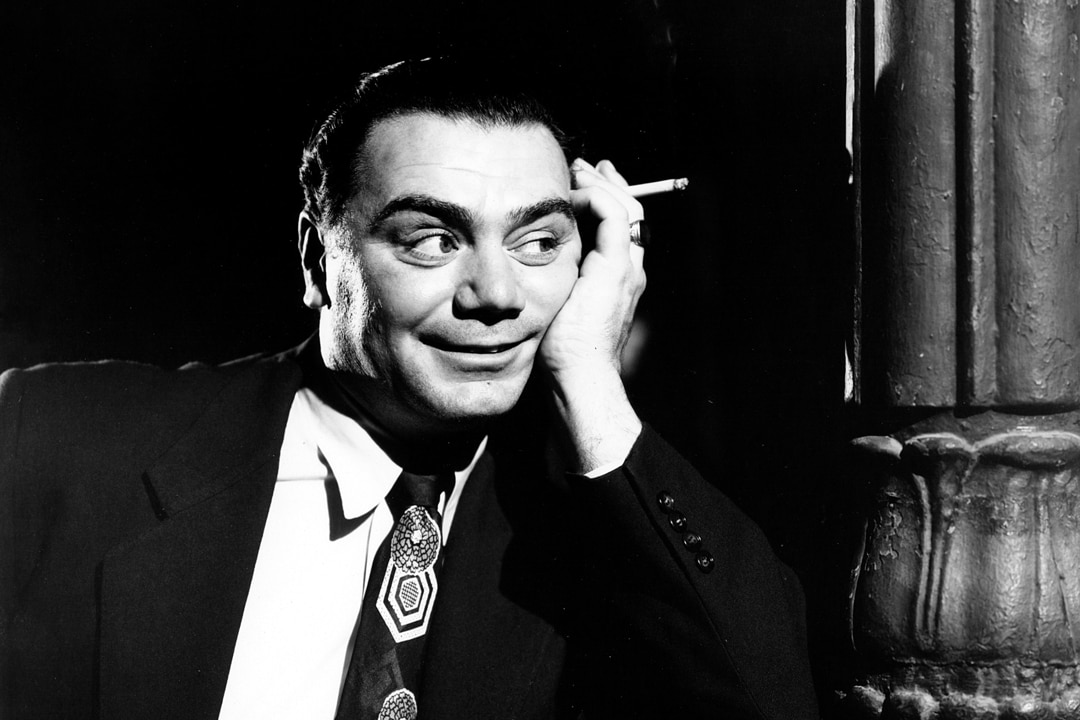
Marty Piletti (Ernest Borgnine) is the most famous butcher in film history. A simple guy from the Bronx who knows that "whatever it is that women like, I don't got it," he's facing a lifetime of loneliness living with his mother and hanging out with his unmarried friends every night. Then he forces himself to attend a dance at the Stardust Ballroom, where he meets Clara (Betsy Blair), a Brooklyn schoolteacher who's been dumped by her date. As they commiserate, he discovers a warm, caring heart in this rejected woman, only to find his mother and friends don't think she's good enough for him. Can he stand up for the woman he cares for, or will he sacrifice his future to comply with peer pressure?
Marty started production in October 1954, with location shooting in The Bronx. Among the local landmarks used in the film are The Grand Concourse and the IRT Third Avenue El. The scene behind the opening credits is Arthur Avenue in The Bronx, in front of the Arthur Avenue Retail Market. Interiors were shot in December at the Samuel Goldwyn Studios on Santa Monica Blvd. in West Hollywood.
Director Delbert Mann cast the film’s screenwriter Paddy Chayefsky to play the three-line role of Leo. The director claimed they didn't have time to hire an extra for the role. Chayefsky, who adapted the film from his teleplay starring Rod Steiger in the lead, would later complain that the $140 he had to pay to join the Screen Actors Guild to play the role was higher than the $67 union scale he was paid for it.
Actor Burt Lancaster and his agent Harold Hecht produced the film through their company Hecht-Lancaster Productions. Partway through production, United Artists threatened to pull the plug because other Hecht-Lancaster films were over budget. According to Ernest Borgnine, the studio’s accountants saved the film by pointing out that under new tax laws they had to complete Marty and show it at least once before they could write it off as a tax loss. With no major stars in the film, Lancaster decided to appear in the theatrical trailer so that audiences would be introduced to the picture by a major box-office name.
The film’s tagline highlighted its positive reviews: “EVERYBODY’S RAVING ABOUT MARTY…The year’s BIG entertainment surprise [sic] a warm and human story with characters you’ll love and remember!”
United Artists was willing to burn the film off as a second feature, but Chayefsky insisted it have some kind of first-run engagement, so it premiered at the Sutton Theatre in New York, normally a venue for art films. Hecht-Lancaster's New York publicity chief, Bernie Kamber, conducted a personal campaign for the film, setting up private screenings and convincing major press outlets to feature it positively. His biggest coup was getting influential columnist Walter Winchell to hail the film as one of the biggest sleepers in Hollywood history. The slow build in viewership began with strong reviews.
Then the film won the Grand Prix at Cannes, generating more press and more box office. As a result, it played 39 weeks at the Sutton to mostly packed houses. For subsequent openings, United Artists scheduled two weeks of screenings in various markets for community leaders to generate positive word of mouth. The move paid off, for though the film could not compete with the major studios’ big blockbusters, it made a small profit in its initial release. That was helped by its success at the Academy Awards, which led United Artists to reissue it to 5,000 theatres. Marty holds the distinction of being one of the few films whose advertising budget ($400,000) exceeds its production cost ($343,000).
Director: Delbert Mann
Producer: Harold Hecht, Burt Lancaster
Screenplay: Paddy Chayefsky
Adapted from his television play
Cinematography: Joseph LaShelle
Editing: Alan Crosland, Jr.
Art Direction: Ted Haworth, Walter M. Simonds
Music: Roy Webb
Cast: Ernest Borgnine (Marty Piletti), Betsy Blair (Clara), Joe Mantell (Angie), Esther Minciotti (Mrs. Piletti), Karen Steele (Virginia), Jerry Paris (Tommy), Augusta Ciolli (Aunt Catherine), Paddy Chayefsky (Leo), Jerry Orbach (Ballroom Extra), Glenn Strange (Bit), Minerva Urecal (Mrs. Rosari)
BW -90 m