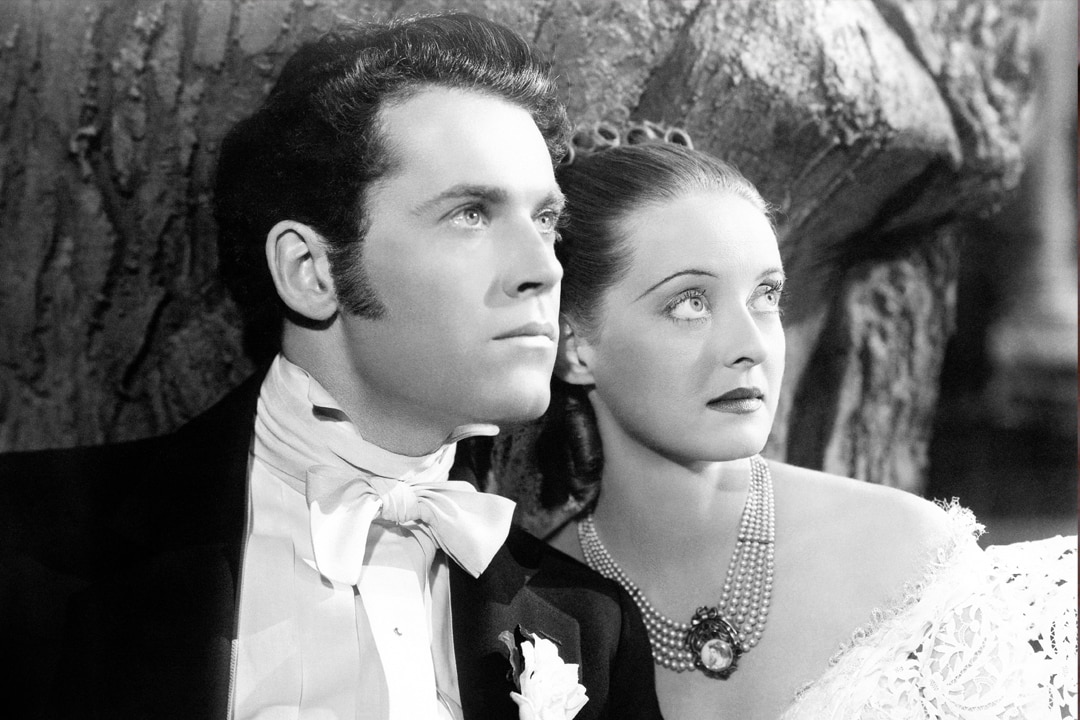
In the decade before the Civil War, Julie Marsden defies the standards of New Orleans society by refusing to play the conventional southern belle. She consistently flaunts social etiquette by doing as she pleases instead of following a tradition of subservience. She thinks nothing of playing the aggressor in her romance with Pres, attends her own party in a riding habit and—worst of all—wears a red dress to the Olympus Ball, an action she knows will create controversy. When her audacity ruins her relationship with Pres, she determines to win him back, even after he returns to New Orleans with a new wife.
Filming on Jezebel started on October 25, 1937. Humphrey Bogart, who had just worked with director William Wyler on Dead End (1937), warned Davis that she would hate working with him because of his habit of doing extensive retakes without suggesting anything for the actors to change. On her first day of shooting, he took 28 takes to get one simple scene in the dress shop. She found the situation frustrating, but when she watched the rushes, she realized that her performance had gotten better with each successive take.
Wyler never said how he felt about a take after he printed it, which drove Davis mad with insecurity. When she finally told him she needed more approval from her director, Wyler started saying "Marvelous, Miss Davis, just marvelous!" after each take. Davis finally laughed and told him to go back to his usual ways. Throughout filming, Wyler kept at Davis to drop her nervous mannerisms, yelling at her for wiggling her hips or moving her head too much. At one point, he even threatened to tie a chain around her neck to make her hold her head still. As a result, the gestures she kept in were much more powerful than in previous performances.
Eventually, Davis and Wyler embarked on an affair. Crew members often saw him leaving her dressing room with his face covered with lipstick. With her husband, Ham Nelson, working mostly in New York (their marriage was breaking up), Davis spent many nights at Wyler's home, cooking dinner, discussing the film and making love.
Wyler was torn between a contractual need to finish Fonda's scenes by December and his knowledge that Davis would give her best performance if he shot her role in sequence. As the film fell behind schedule, Wallis and Warner fumed that the director had spent two days on a scene with only Davis and co-star George Brent. Following a quarrel with Wyler, Davis embarked on an affair with Fonda that greatly increased tensions on the set. After a phone call from Fonda's pregnant wife, she called things off.
Further slowing down the production was a pimple that erupted on Davis's nose in November, as Fonda's departure date neared. For a week and a half, Wyler couldn't shoot any close-ups of her. By the time it healed, the film was 13-1/2 days behind schedule. The Olympus Ball scene was only a few sentences in the script, and the film's assistant director scheduled half a day of shooting. Wyler, however, developed it into one of the film's most important scenes, spending five days filming a series of long takes and camera moves.
Fonda finally finished his scenes a day before the final date stipulated in his contract. This left Davis playing close-ups without her leading man present, a situation that preyed on the high-strung actress's nerves. Davis' father died on New Year's Day, 1938. With the production 24 days behind schedule, there was no question of her taking time off to attend the funeral.
Wallis and Warner considered replacing Wyler with William Dieterle. When Davis found out about this, she went to see Warner to convince him to keep Wyler on for the good of her performance. When he countered that it wouldn't do any good if the film was too expensive to break even, she offered to work until midnight every night and still show up ready to shoot at nine the next morning if he would just keep Wyler on, which he did.
Wyler was not very impressed with actress Margaret Lindsay, who played Fonda's wife. Feeling she couldn't convincingly convey strength in her final confrontation with Davis, he shot their scene on a staircase, keeping Lindsay a few steps higher than Davis the entire time so that she was visually dominant. In her memoirs, Davis claimed he also inserted a shot of Lindsay's hand on the banister, with the character's wedding ring prominently featured, but there is no such shot in the film.
To keep from falling further behind on schedule, writer John Huston was asked to direct the duel scene in Jezebel. It was his first time directing. Shooting was scheduled to end on Saturday, January 15, 1938, but Davis was too ill to work (some have suggested she was upset that the end of production would mean the end of her affair with Wyler). They finally got the last shot on Monday, January 17, 29 days over schedule and about $400,000 over budget. Davis cried for days after finishing Jezebel and with good reason. Not only had she finished one of the most rewarding artistic experiences in her career, but she was pregnant with Wyler's child.
After an advanced screening of the film, producer David O. Selznick wrote Warner complaining about the film's similarities to Gone with the Wind (1939), particularly citing Davis' pinching her cheeks to give them color, which Scarlett O'Hara does in the book, and a dining room scene in which the male characters discuss the differences between the North and the South and the possibility of war. Warner countered that the dining room scene was faithful to the scene in the original play, which had appeared a few years before Margaret Mitchell's novel.
Producers: Henry Blanke, Hal B. Wallis, William Wyler
Director: William Wyler
Screenplay: Clements Ripley, Abem Finkel, John Huston, Robert Buckner (based on the play by Owen Davis, Sr.)
Cinematography: Ernest Haller
Music: Max Steiner
Film Editing: Warren Low
Art Direction: Robert M. Haas
Costume Design: Orry-Kelly
Cast: Bette Davis (Julie Marsden), Henry Fonda (Preston Dillard), George Brent (Buck Cantrell), Margaret Lindsay (Amy Bradford Dillard), Donald Crisp (Dr. Livingstone), Fay Bainter (Aunt Belle Massey), Richard Cromwell (Ted Dillard), Henry O'Neill (General Bogardus), Spring Byington (Mrs. Kendrick).
BW-105m. Closed captioning. Descriptive Video.