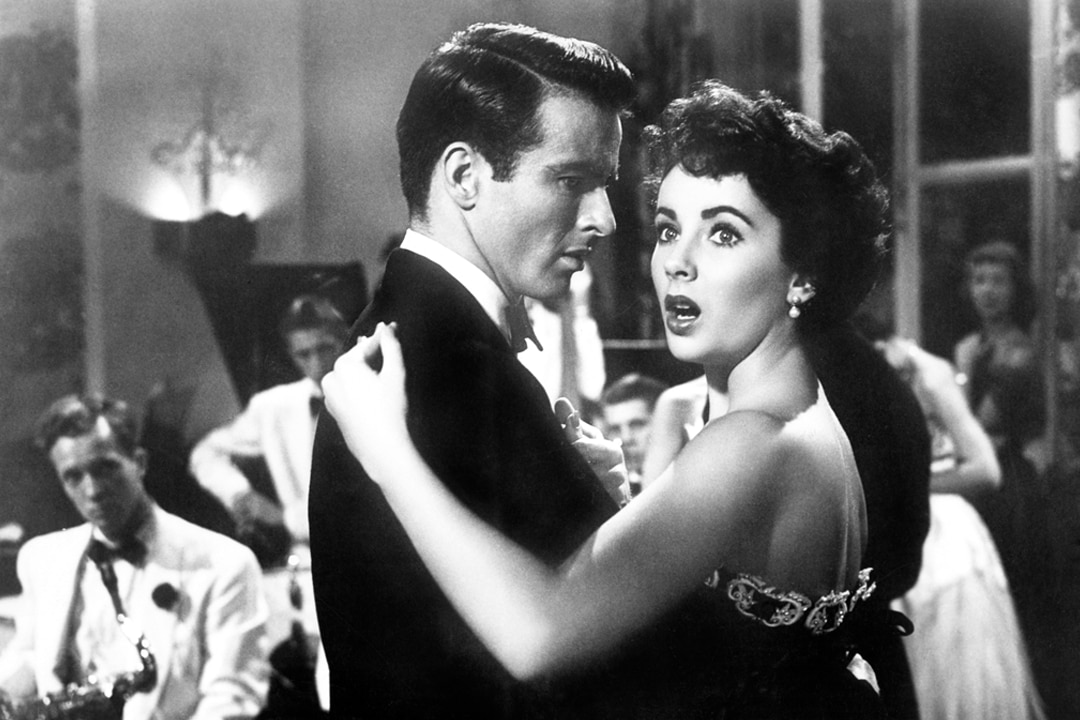
George Eastman has hitchhiked from Chicago to meet up with his wealthy uncle Charles Eastman, the owner of a bathing suit manufacturing concern. At his meeting in the palatial Eastman family home, George glimpses the beautiful, rich Angela Vickers. Meanwhile, George ambitiously works on the assembly line of his uncle’s factory, where he drifts into a relationship with factory girl Alice Tripp. After Charles invites George to an increasing number of social functions at his home, George tentatively forges a relationship with Angela. George tries to break up with Alice, but she demands marriage when she learns that she is pregnant. George stalls for time so that he can join Angela and the Eastman family on a vacation to Loon Lake. As pressure from Alice intensifies, George weighs his options in an attempt to make a clean break to join Angela and the lifestyle she represents.
Filming on A Place in the Sun began in October 1949. Exteriors were shot on location at Lake Tahoe as well as on Cascade Lake in Nevada. It was already cold in the Sierras, and before Montgomery Clift and Elizabeth Taylor could frolic on the lakeside, the crew had to use hoses to spray snow off the ground and from any tree branches that appeared in the shots. Following this excursion, shooting continued on the soundstages at Paramount Pictures.
A George Stevens set was typically a very quiet set, so that the actors could concentrate and not be distracted; even the technicians and crewmen tried to move equipment, sets and lights as silently as possible. Stevens also liked to play music on the set between takes to keep actors in the mood. Franz Waxman had already written several cues and themes for A Place in the Sun, so on the Paramount stages Stevens would play portions of his score, particularly the "party theme." While not a taskmaster, Stevens was a methodical, careful director and admitted to being detail-oriented: "I'm one of those directors who believes every element that goes into a picture affects the viewer, although the viewer may not realize the impact of tiny, minor things."
In her autobiography, “Shelley: Also Known as Shirley,” Shelley Winters described Stevens' way of working: "He would discuss the scene, but not the lines, and would photograph the second or third rehearsal so the scene had an almost improvisatory quality. ...Stevens would print the first take, then spend the next three hours minutely rehearsing the scene, then film it again. He explained to me that in this way, he often got actors' unplanned reactions that were spontaneous and human and often exactly right. And often when actors overintellectualize or plan their reactions, they aren't as good." Stevens was also a firm believer in running rushes at night and having the actors in attendance. As Winters said, "Stevens would print several takes of each scene and then explain to us why one was better than the other. The whole experience was a joy."
With A Place in the Sun, Elizabeth Taylor found herself in the most demanding role of her career. Stevens asked much of her in take after take, but Taylor appreciated the challenge. She was quoted in Donald Spoto's “A Passion for Life,” saying "[Stevens] didn't make me feel like a puppet. He was an insinuating director. He gave indications of what he wanted but didn't tell you specifically what to do or how to move. He would just say, ‘No, stop – that's not quite right,' and make you get it from your insides and do it again until it was the way he wanted it." Stevens himself saw what Taylor was up against: "If she thought I was more severe than needed, she'd spit fire. But the following morning she had forgotten it completely....She had enormous beauty, but she wasn't charmed by it. It was there. It was a handicap, and she discouraged people being overimpressed with it. She was seventeen, and she had been an actress all her life. The only thing was to prod her a bit into realizing her dramatic potential."
Taylor was also initially intimidated by the intense scenes she had to play with Montgomery Clift,"...because Monty was the New York stage actor and I felt very much the inadequate teenage Hollywood sort of puppet that had just worn pretty clothes and hadn't really acted except with horses and dogs." Clift put her at ease, and the two began a lifelong friendship on the set of A Place in the Sun.
Clift showed up for the shoot with his drama coach, Mira Rostova. This did not cause friction on the set because Stevens simply barred Rostova from the premises, so Clift had to consult with her well out of Stevens' sight. Clift kept up such intensity as George; he would find himself drenched in sweat at the end of a scene. He told Taylor that "that's the worst part about acting – your body doesn't know you're acting. It sweats and makes adrenaline just as though your emotions were real."
The well-known initial love scene between George and Angela was filmed in extreme close-up, using a six-inch lens. Stevens rewrote the dialogue for the sequence at the last moment and surprised Clift and Taylor with the revised pages. Stevens later said, "I wanted the words to be rushed – staccato. Monty had to let loose – he was so enormously moved by her. Elizabeth must be compelled to tell him how wonderful and exciting and interesting he is all in the space of a few seconds. ...Anyway, it had to be like nothing they had ever said to anyone before." Taylor bristled when she saw that the lines she was to say included the words "Tell mama, tell mama all." As Stevens recalled, "She thought it was outrageous she had to say that—she was jumping into a sophistication beyond her time." Taylor may have also objected because her own mother, Sara Taylor, was chaperoning her relentlessly on the set, and Elizabeth may have winced at the idea of calling herself "mama." Stevens prevailed, of course, convincing Taylor that "I wanted to get the feeling of them both being totally lost in each other." In editing, Stevens first viewed the actors' uninterrupted close-ups side-by-side on a screen, so that he could time the cuts so that they flowed from one face to another.
While Taylor and Winters had nothing but praise for Stevens as a director, Clift found him lacking and unimaginative, labeling him a mere "craftsman." Biographer Patricia Bosworth quotes him as having said that "George preconceives everything through a viewfinder." Clift's biggest disagreement with Stevens did not deal with the character of George, but with Winters' character, Alice Tripp. He thought that Alice should be much more sympathetic and that Winters was playing her all wrong. As quoted by Bosworth, Clift said, "She played her tragedy from the minute you see her on screen. She is downbeat, blubbery, irritating." Stevens and Winters went ahead with their interpretation, of course. Apparently, Stevens relished the contrast between Alice and Angela; he later said that he was interested in "...the relationship of opposing images. ...Shelley Winters busting at the seams with sloppy melted ice cream... as against Elizabeth Taylor in a white gown with blue ribbons floating down from the sky... Automatically, there's an imbalance of images which creates drama."
Theodore Dreiser’s original 1925 novel, “An American Tragedy,” contains a scene in which Alice goes to a country doctor and tentatively asks about an abortion. Winters relates in her autobiography that Stevens initially planned to drop the scene because "it's rather censorable, but I think if we handle it delicately, it will illuminate the factory girl's terrible plight." Winters was given the new script pages one morning and asked to memorize the lines; Stevens planned to rehearse once, then immediately film the scene for spontaneity. "When he called, ‘Action!' I was already crying," Winters wrote. "I twisted my white handkerchief into a shredded ball. The scene was nine minutes long. A full camera load. Boy, did I ever act!" Stevens had Winters do the scene again after letting her realize that tears would only frighten the doctor, and that Alice must try and refrain from crying. "Of course, when we saw the two takes the next day, the one in which I followed his exact direction was remarkable, even if I say so myself. ...Every time I've seen that scene in a theater, every man in the audience groans and every woman weeps. George had taught me another lifelong acting lesson: don't indulge yourself–make the audience weep."
Shooting on A Place in the Sun wrapped in March 1950. The painstaking methods of director Stevens resulted in a final budget of $2.3 million and more than 400,000 feet of film to edit. Stevens and editor William Hornbeck worked on cutting the footage for more than a year. The film premiered in Los Angeles on August 14, 1951. Unlike their experience with the 1931 pre-Code adaptation of the book, on this occasion, Paramount saw not only an enormous critical success, but a financial one as well–the picture earned $3.5 million on its initial release alone.
Producer/Director: George Stevens
Screenplay: Michael Wilson, Harry Brown, based on the novel An American Tragedy by Theodore Dreiser, and the play by Patrick Kearney
Editor: William Hornbeck
Cinematography: William C. Mellor
Costume Design: Edith Head
Art Direction: Hans Dreier, Walter Tyler
Music: Franz Waxman
Cast: Montgomery Clift (George Eastman), Elizabeth Taylor (Angela Vickers), Shelley Winters (Alice Tripp), Anne Revere (Hannah Eastman), Keefe Brasselle (Earl Eastman), Fred Clark (Bellows), Raymond Burr (Marlowe)
BW-122m.