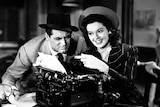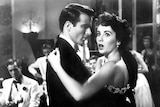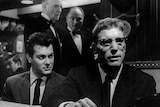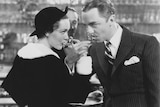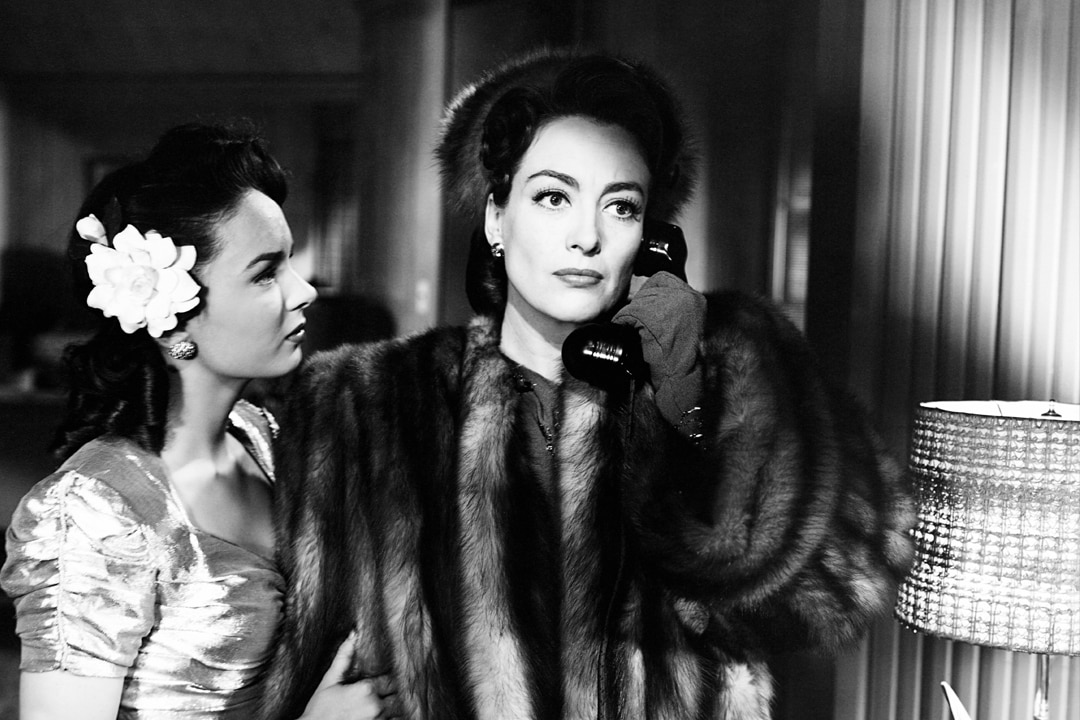
Mildred Pierce is a working-class woman struggling to make ends meet after she splits from her unemployed husband. To care for her two young daughters, she takes a day job as a waitress and moonlights as an independent baker, selling cakes and pies to local restaurants. When her youngest child, the sweet-natured Kay, dies of pneumonia, Mildred devotes all her time and energy to her spoiled teenage daughter Veda. With the help of local businessman Wally Fay and down-on-his-luck playboy Monty Beragon, Mildred opens her own restaurant. It proves to be such a success that she soon expands it into a string of eateries in the Los Angeles area. But nothing she does pleases the willful Veda, not even marrying Beragon for his family name. It all comes crashing down on the night of Veda's 18th birthday, when Mildred loses her empire and Monty is mysteriously murdered. And Mildred is faced with having to make one last sacrifice.
By late September of 1944, screenwriter-producer Jerry Wald had a director and a script adaptation of James M. Cain’s 1941 novel but no actress to play Mildred. According to screenwriter Catherine Turney, no actress wanted to play the mother of a teenager (even though Mildred's line, "I married Bert when I was 17," places her in her early 30s at the film's opening). Bette Davis claimed she never saw a script, but that seems unlikely, given her status as Queen of the Warner Lot with first refusal on all A projects. One actress who did want the role was Barbara Stanwyck, who had memorably portrayed the coldhearted Phyllis Dietrichson in Billy Wilder's film version of Double Indemnity (1944), adapted from another Cain novel. "I knew what a role it was, and I knew I could handle every facet of Mildred," Stanwyck said. "I laid my cards on the table with Jerry Wald. After all, I'd done a dozen pictures at Warners by then...I'd paid my dues, and I felt Mildred was me."
Director Michael Curtiz favored Stanwyck, too, and when Wald suggested Crawford, the director fumed that she was a "has-been" and he wouldn't work with "her high-hat airs and her goddammed shoulder pads." Unexpectedly, after nearly 20 years in the business and more than 60 films, Crawford humbled herself and agreed to do a screen test. Curtiz liked what he saw and cautiously went with the casting decision, but he put his foot down when Wald wanted Shirley Temple for the part of Veda. "Vonderful!" Curtiz yelled. "And who do ve get to play Mildred's lover? Mickey Rooney?" Crawford agreed to test with a number of young actresses, and Ann Blyth, who got the part, remembered her as "the kindest, most helpful human being I've ever worked with. We remained friends for many years after the film. I never knew that other Joan Crawford that people wrote about."
Ironically, Mildred Pierce was made around the time studio head Jack Warner asked the studio's cinematographers and art directors to "devise new means of cutting corners without losing any of the quality." Apparently, there was concern that too much detail was being used in sets (by Anton Grot), which in turn, took more time to light and thus slowed up production. Despite this proclamation, Mildred Pierce suffered no loss of set detail. Beneath its noir lighting lay strikingly complex settings like the Beragon beach house. So essential to the plot that it opens the film, Beragon's home is a twisting maze of rooms and staircases that perfectly represent Grot's desire to build "menace into the sets."
Mildred Pierce began filming December 7, 1944. Within the week, Curtiz wanted Crawford canned, claiming she was altering the look and interpretation of the character to make her more glamorous. There were the inevitable arguments over shoulders, with Crawford tearfully (and not altogether truthfully) claiming her dowdy off-the-rack Sears dresses were unpadded. Curtiz started referring to her as "Phony Joanie" and "the rotten bitch," laying into her mercilessly in front of the cast and crew. Crawford wanted the director fired and replaced "with a human being."
"I had to be the referee," Wald said later. "We had several meetings filled with blood, sweat, and tears. Then everything started to settle down. Mike restricted himself to swearing only in Hungarian, and Joan stopped streamlining the apron strings around her figure and let them hang." Crawford claimed Curtiz gained respect for her after she stood up to his "post-graduate course in humiliation," and she admitted that once they reached detente, "he started training me."