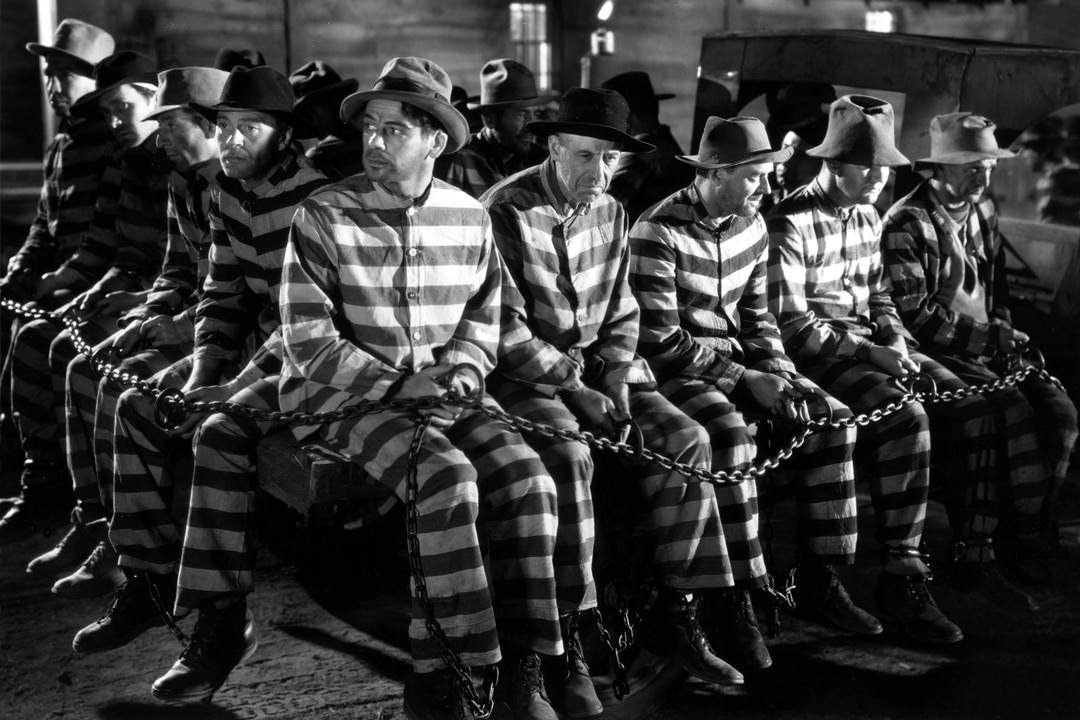
It is the end of the "War to End All Wars," a conflict that was also known as World War I. One soldier, James Allen (Paul Muni), returns to the United States fully invested with the promise of a new life, a new career, and a new direction that was impossible before victory in Europe and the advent of the "Roaring Twenties." So, Allen refuses his family's advice of returning to his stable, but dull factory job, and strikes out on his own, with the hopes of becoming an engineer. But from town to town, year to year, success eludes him and unemployment takes its toll. Penniless and destitute in the Deep South, Allen becomes implicated in a crime that he did not commit and is sentenced to 10 years of hard labor on a chain gang. He spends years being treated like an animal by the inhumane prison system. But he waits, biding his time for the perfect moment to make a break for freedom.
Despite Jack Warner and Darryl Zanuck's personal interest in a film version of I Am a Fugitive From a Chain Gang, the Warner Bros. story department voted against it with a report that concluded: "this book might make a picture if we had no censorship, but all the strong and vivid points in the story are certain to be eliminated by the present censorship board." The story editor listed specific reasons for not recommending the book for a picture, most of them having to do with the violence of the story and the uproar that was sure to explode in the Deep South. In the end, Warner and Zanuck had the final say and approved the project.
During the pre-production phase of I Am a Fugitive From a Chain Gang, Robert Elliot Burns was asked to travel to Hollywood to serve as an advisor to the production. Burns smuggled himself into Los Angeles and onto the Warner Bros. studio lot, using the name Richard M. Crane. Burns not only suggested ideas for the script but also reportedly helped write dialogue. Playwright Sheridan Gibney, who was hired to co-write the screenplay, found the experience of working with Burns nerve-wracking. Several times, Burns would jump upon hearing gunfire emanating from productions shooting on nearby sets. When Burns heard police sirens, he hid behind furniture and cowered against a wall. Gibney calmed him with the assurance that "They're shooting, but only a film." After the film was completed, Burns disappeared. There was one report that he was captured again and extradited back to Georgia just after the film was released, but all records indicate that he was never caught. However, in 1945, Burns returned to Georgia on the assurance of the state governor, Ellis Arnall. The Georgia Pardon and Parole Board commuted Burns' sentence and restored his civil rights, but he was refused a full pardon because he had originally admitted his guilt in the holdup. Burns died in 1955.
Warners' highest-paid director, Roy Del Ruth, was assigned to direct I Am a Fugitive From a Chain Gang, but the contract director refused the assignment. In a lengthy memo to supervising producer Hal B. Wallis, Del Ruth explained his decision: "This subject is terribly heavy and morbid...there is not one moment of relief anywhere." Del Ruth further argued that the story "lacks box-office appeal," and that offering a depressing story to the public seemed ill-timed, given the harsh reality of the Great Depression outside the walls of the local neighborhood cinema.
Mervyn LeRoy was assigned to helm I Am a Fugitive From a Chain Gang, even though he was then preparing to direct the musical 42nd Street (1933). LeRoy agreed to abandon 42nd Street temporarily (Lloyd Bacon eventually took over directing the milestone musical), and immediately took a train to New York City to see potential star Paul Muni in the stage play Counselor-at-Law. After Muni's performance, LeRoy wired the studio executives: "This is our man!" But Muni was not as impressed with LeRoy upon first meeting him in Jack Warner's Burbank office. Warner made the introductions, but Muni did not say anything to LeRoy. Instead, he turned to Warner and said, "Is he the director, that kid?" Despite that inauspicious beginning, the director and the star became close friends. When Muni died in 1967, the only two people from the film industry present at his funeral were LeRoy and Muni's agent.
Once Muni was hired for the lead role in I Am a Fugitive From a Chain Gang, he booked passage on an ocean liner through the Panama Canal to Los Angeles. Aboard the ship, Muni spent much of the thirteen days of the voyage in his stateroom, memorizing his lines. This was not the last measure of Muni's role preparation. He conducted several intensive meetings with Robert Burns in Burbank in order to capture the way the real fugitive walked and talked, in essence, to catch "the smell of fear." Muni also set the Warner Bros. research department on a quest to procure every available book and magazine article about the penal system.
Muni also met with several California prison guards, even one who had worked in a Southern chain gang. Muni fancied the idea of meeting with a guard or warden still working in Georgia, but Warner studio executives quickly rejected his suggestion. Nevertheless, Muni's insistence on realism enhanced his performance; during the grueling rock quarry scenes, Muni refused to allow the use of a double, despite the punishing 5 a.m. start time and the midday July sun. The intense sun was so severe that nearly the entire company suffered from eyestrain, blisters, and sunburn.
The haunting and memorable ending was a happy accident for the film's production. The script called for the scene to suddenly go black, but before that could happen, a klieg light blew a fuse and gradually dimmed the entire scene. LeRoy immediately recognized that the accident actually worked better for the film's final shot. However, many have claimed credit for the final scene. Zanuck, then in charge of production at Warner Bros., claimed that after the first sneak preview, he personally wrote the ending dialogue and added it to the picture. But the truth is that this scene can be found in writer Sheridan Gibney's first draft screenplay. Still, Zanuck deserves some credit because he demanded that the stark, unhappy ending not be replaced or softened in the editing stage by more timid studio executives.
Even though the final credits attribute Howard J. Green and Brown Holmes as the primary authors of I Am a Fugitive From a Chain Gang, most film historians agree that Sheridan Gibney was the primary screenwriter. He had had a dispute with one of the studio heads, so for punishment, the studio exec took Gibney's name off the credits before the film's release.
The state of Georgia was not as sweet as a peach towards the producers of I Am a Fugitive From a Chain Gang. Though the filmmakers omitted the name of Georgia from the working title and never mentioned the state in the entire film, the indictment of that specific state's cruel penal system was obvious. A typhoon of protest, in the form of newspaper editorials, reform committees, petitions, and letters and telegrams to congressmen, resulted in the abolishment of some of the prison system's cruel practices. However, the film was banned in Georgia, and a libel suit on Georgia's behalf was filed against Warner Bros. Two prison wardens in Georgia also filed million-dollar lawsuits against the studio. All of this legal wrangling came to nothing, but the state of Georgia remained relentless in its attempts to recapture Robert Elliot Burns, while LeRoy and Jack Warner were barred from entering the state of Georgia for years. Upon finally trekking to the peach state to help John Wayne direct The Green Berets in 1968, LeRoy said in his autobiography that the Georgians were full of "good old southern hospitality and there wasn't a lynch rope in sight."
Producer: Hal B. Wallis
Director: Mervyn LeRoy
Screenplay: Howard J. Green & Brown Holmes, Sheridan Gibney (uncredited), based on the autobiography by Robert E. Burns.
Film Editing: William Holmes
Cinematography: Sol Polito
Art Direction: Jack Okey
Original Music: Leo F. Forbstein, Bernhard Kaun
Cast: Paul Muni (James Allen), Glenda Farrell (Marie Woods), Preston Foster (Pete), Helen Vinson (Helen), David Landau (Warden), Allen Jenkins (Barney Sykes), Noel Francis (Linda), Berton Churchill (Judge).
BW-93m. Closed captioning.