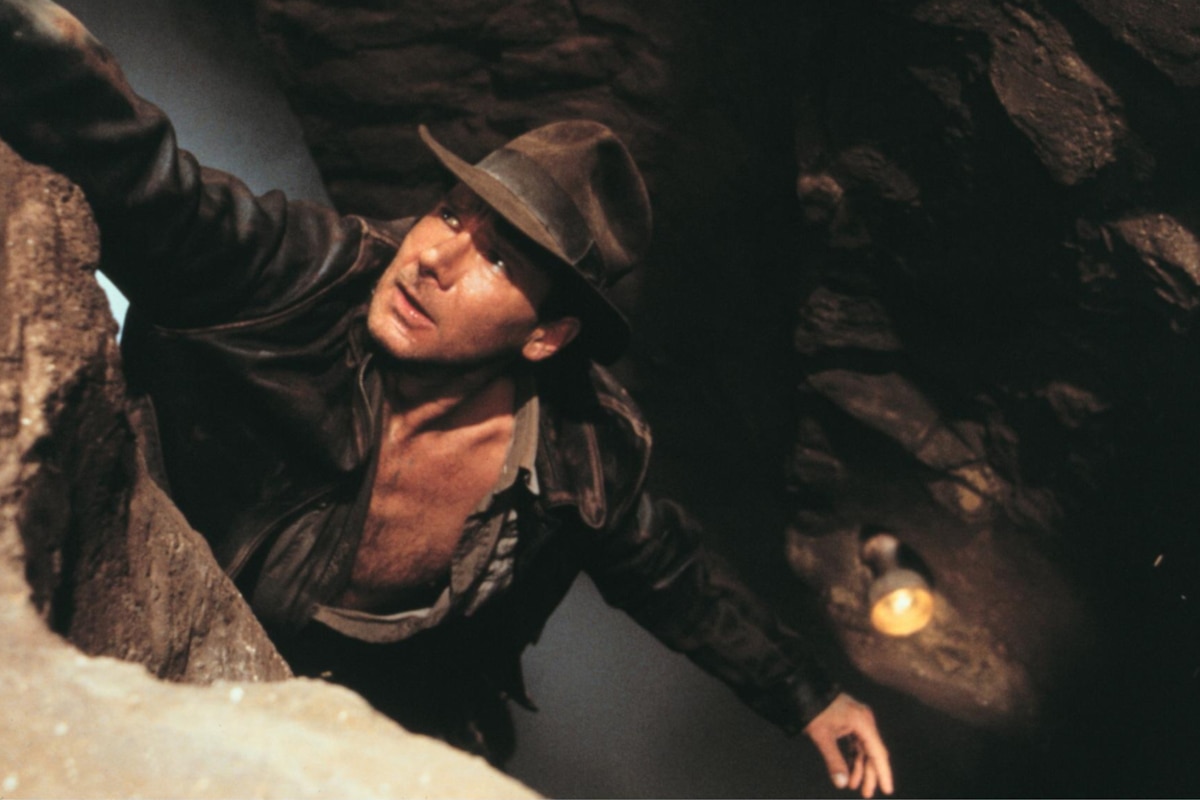

The blockbuster success of the original Indiana Jones trilogy, both in terms of dollars and endless imitations, seemingly dimmed when the "final" chapter The Last Crusade debuted in 1989, but its legacy has remained ripe for mining in the decades since. With the release of Indiana Jones and the Kingdom of the Crystal Skull (2008) and Indiana Jones and the Dial of Destiny in 2023, the continued adventures of the famed archaeologist have continued to spark the imaginations of new generations, making Indiana Jones an icon of American cinema. The first film in the series, Raiders of the Lost Ark, was released in May of 1981, shortly after executive producer George Lucas' sublime The Empire Strikes Back (1980) and director Steven Spielberg's titanic misfire, 1941 (1979). While basking in the radiant glow of their recent respective successes, Star Wars (1977) and Jaws (1975), Lucas and Spielberg dreamed up the Indiana Jones character, while vacationing in Hawaii.
Raiders of the Lost Ark introduces Indiana Jones (named Indiana Smith in earlier drafts of the script) as a renowned archaeologist, college professor and adventurer who is more adept at plunging into ancient, snake-infested tombs than in reacting to a smitten student's clever come-on. Indy is a nostalgic throwback to the hero of the Republic Studios serials that Lucas and Spielberg grew up on, as well as a postmodern statement on movie heroism. Indy is sort of an "anti-James Bond": rugged, rough and ready, but exasperated, professorial, and prone to groan and bleed when hurt.
Raiders of the Lost Ark finds Indy squaring off against the old-standby of cinematic heavies, the Nazis, in a relentless game of "keep-away" with God's long-lost box, the Ark of the Covenant. Indy is convinced the Ark belongs in a museum where it can be studied and marveled over, while the Nazis are bent on opening the ancient wonder and turning it into a Hopelessness Chest for the free world. The film has it all: Unbelievable stunt sequences that still have not been equaled for their sheer fun and inventiveness; a legendary, majestic score by John Williams that is still stuck in many moviegoers' heads; and superb performances that really have no business being in a popcorn escapist film. All of this, plus God showing the Nazis who's boss using practical effects to wipe away the Nazis in a maelstrom of Yahweh anger.
The worldwide success of Raiders of the Lost Ark in dollars and critical accolades, including the winning of several technical Academy Awards, including Best Sound, Effects, Art Direction and Editing. It even earned a nomination for Best Picture, which pressure-cooked the demand for a sequel, a demand that Spielberg and Lucas were already prepared for, having planned on making a trilogy anyway. But they still needed a story on which to hang their first sequel. Screenwriting team Willard Huyck and Gloria Katz were called in to develop a story set in India, since the twosome were familiar with the country and its culture. Using several set pieces that were carried over from Raiders of the Lost Ark (including the river rafting and the mine car sequences), they came up with Indiana Jones and the Temple of Doom (1984), a dark tale of the intrepid adventurer coming to the rescue of an impoverished Indian village that has suffered twin debilitating losses: their children and three sacred, life-giving rocks, all stolen by the Thugee killer cult that is spiritually poisoning the region under the legitimizing front of the Maharaja. Note the ingenuous way in which Indy gets out of a pickle on a suspension bridge in the film's thrilling climax. It's a potent, gutsy and shocking solution that isn’t seen much in action adventure films.
Lucas and Spielberg meant for the second Indy adventure to be darker in tone, a horror movie even, but it turned out to be much darker than either one of them thought. Lucas opines in the documentary on the making of the film that perhaps the darker tone had to do with the divorce he was going through at the time of production. This darker tone was practically pitch black, thanks to gruesome scenes of a character having his beating heart taken out of his chest, slave children put under the whip of Thugee henchmen and an over-the-top gross-out dinner scene, consisting of all sorts of macabre munchies. But perhaps the most disturbing plot point has Indy turning into a mindless Thugee zombie. It could be argued that many a serial's hero was temporarily placed under the spell of the villain, but in a film already surrounded by so much grimness, this plot point is wholly unnecessary. It's no wonder that Indiana Jones and the Temple of Doom and the malevolent, Spielberg-produced Gremlins (1984) were responsible for the motion picture rating, PG-13.
Less offensive than the darker tone is Kate Capshaw's character, Willie Scott (named after Spielberg's dog – Indy was named after Lucas' dog), whose character spurred major criticism from fans and critics. But to Capshaw's credit, she portrayed the whining, selfish, vain, screaming Willie as written by screenwriters Huyck and Katz, who also penned Howard the Duck in 1986. The documentary gamely addresses the screaming criticism, as well as the gripe that Willie Scott is just another stereotypical woman. That is all true, but her character is at least consistent. A bigger negative of the first and third films are the inconsistent characters. When we first meet the heroine Marion Ravenwood in Raiders of the Lost Ark, she is literally drinking a heavy oaf of a man under the table, portraying a gutsy femininity that would be a help to globe-trotting Indy, rather than an hindrance. And yet, when she is chased through the streets of Cairo by Nazi stooges, she's reduced to wielding a frying pan when not protesting loudly, "You can't do this to me. I'm an American!"
Stinging slightly from the criticism incurred from The Temple of Doom, Spielberg and Lucas came home again with the third film in the series, Indiana Jones and the Last Crusade. Originally intended to be a haunted castle adventure, the creators wisely got Indy back out in the open, hoping across the globe in places like Venice, instead of being cooped up in one setting, like the Thugee temple in the last film. Spielberg and Lucas came up with a quest for the Holy Grail, even though that search had been the basis of a legendary search by King Arthur and the Knights of the Round Table. The filmmaking duo reasoned that the search for the Holy Grail would really be a metaphor for Indy's search for redemption and reconciliation with his estranged father, Professor Henry Jones, Sr., played by a welcome Sean Connery. Back again were the Nazis, this time led by duplicitous American Walter Donovan (Julian Glover), an entrepreneur more interested in the Grail rather than Nazis ideology. Donovan is much like Belloq from Raiders of the Lost Ark, and this similarity along with the return-to-form narrative of the film made The Last Crusade unfairly criticized for being too much like Raiders of the Lost Ark. Admittedly, Crusade's well-done tank chase does seem derivative of Raiders of the Lost Ark’s truck chase, but the development of Indy's character through the lens of his troubled relationship with the Senior Jones makes for a compelling and entirely fresh Indiana Jones chapter.
All three segments of The Adventures of Indiana Jones are steeped in a wink-wink-nudge-nudge game of cinematic "allusionism." Aside from the obvious nods to the Republic serials that inspired the film series in the first place, homage to and inspiration from the films that made up Spielberg and Lucas' movie-going heritage are replete. The government bureaucrats who hire Indy to find the Ark in Raiders of the Lost Ark bear a suspicious resemblance to Stan Laurel and Oliver Hardy, while the ignominy of the Ark's fate quotes the famous ending to Citizen Kane (1941). Indiana's adversaries in The Temple of Doom are the Thugee cult, a malevolent tribe of religious zealots who also served as bloodthirsty villains for British soldiers Cary Grant, Douglas Fairbanks, Jr. and Victor McLaglen in the classic Gunga Din (1939).
The throwbacks to old Hollywood were especially helpful when it came time for Spielberg and Lucas to fill their cast. Karen Allen brought to the role of Marion Ravenwood a saltiness that Carole Lombard possessed, while Spielberg insisted that Ford instill Humphrey Bogart into his characterization of Indy. The lead villain, Frenchman Belloq (played by the fine Paul Freeman), may be a humorous nod to one of Spielberg's mentors, Francois Truffaut, while sniveling, sadistic SS agent Toht (Ronald Lacey) is creepy in the Peter Lorre tradition. As numerous as the allusions to old classics, there are just as many to Lucas' Star Wars (1977), which shares many of the same crew members with Raiders of the Lost Ark. An engraving of R2-D2 and C-3PO can be seen on a column in the Well of the Souls, and let us not forget Club Obi-Wan in The Temple of Doom.
Peter Coyote, Tim Matheson, and Tom Selleck all tested for Indiana Jones, even though Spielberg initially wanted Harrison Ford. Lucas was reluctant to cast Ford, since Ford had already been in three of Lucas' films. He didn't want Ford to be his "Bobby DeNiro," a reference to the frequent partnership between actor Robert DeNiro and director Martin Scorsese. But after Tom Selleck had to turn down the offered part due to commitments with his new television series, “Magnum, P.I.,” Ford was cast. Similarly, Spielberg really wanted Danny DeVito to play Sallah, but DeVito couldn't do it because of his role on the television series “Taxi.” Sean Young tested for Marion Ravenwood, but Karen Allen was the overwhelming favorite for Spielberg and Lucas.
During filming, the cast and crew had to work through tricky production problems, such as the realization that 2,000 snakes for the Well of the Souls scene were woefully inadequate. Solution: producer Frank Marshall wrangles 7,000 more slithering reptiles for the sequence. Also Indiana’s famous shooting of a sword-toting villain was an improvised moment. The cast and crew had suffered from food poisoning on the day of filming the scene in which Ford was supposed to use his whip to take away the sword. A weak Ford was unsuccessful in completing the scene and suggested he just “shoot the sucker,” to which Spielberg agreed. Stunt work played a major part in the success of the Indiana Jones trilogy as well. Vic Armstrong doubled for Ford in Raiders of the Lost Ark, served as Stunt Arranger for studio shooting in The Temple of Doom and was Stunt Coordinator for The Last Crusade. Stuntman Terry Leonard took the bumpy ride for Indy underneath the moving truck in Raiders of the Lost Ark, a stunt that was based on a maneuver pioneered by legendary stuntman Yakima Canutt, performed for director John Ford's Stagecoach (1939).