
Since its 1942 release, Casablanca has grown into such a legend that it almost transcends mere cinema. Its lines of dialogue can be quoted by people who have not seen the film: "Here's looking at you, kid," "I think this is the beginning of a beautiful friendship" and the oft-misquoted "Play it, Sam" have become known phrases within the English language. Even the production design of Casablanca has come to represent the aesthetics of romantic longing. Its smoky casino, fog-shrouded runway, trench coats, potted palms and gruff-voiced pianist repeatedly surface in contemporary films, commercials, television programs and even restaurant decor as respects are paid to this quintessential Hollywood classic.
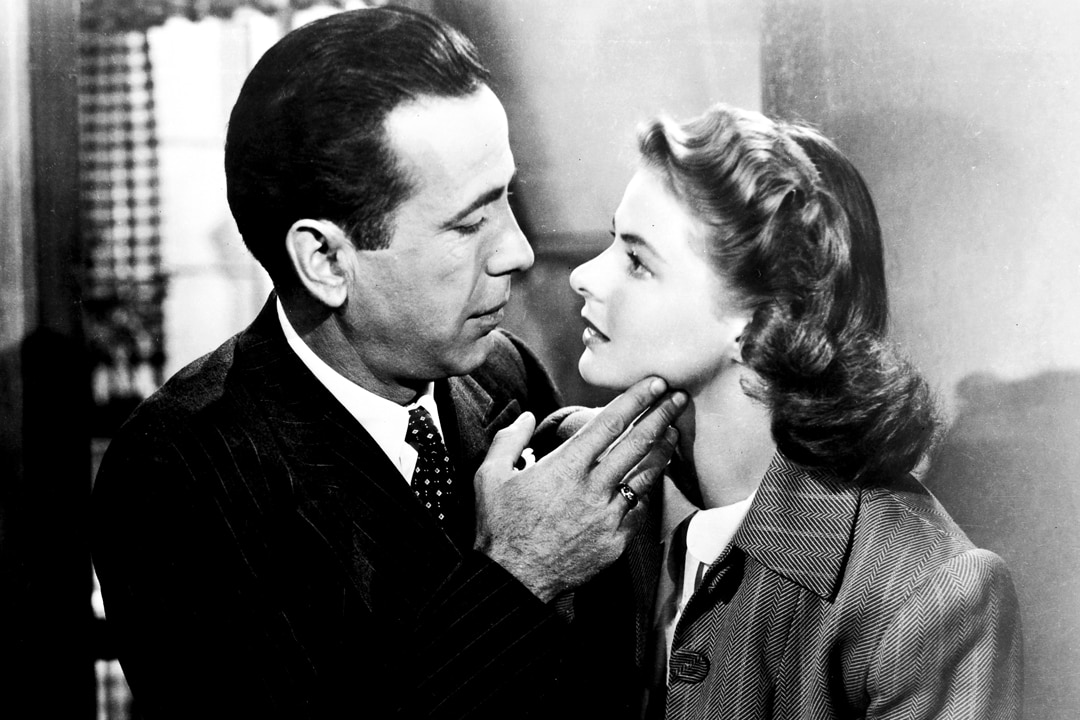
Citizen Kane (1941) represents the pinnacle of artistic derring-do and Gone With the Wind (1939) epitomizes the colorful bombast of the American epic, then Casablanca is surely the film that defines the apex of Hollywood’s studio system. The plot revolves around Rick's Cafe Americain, a bar and casino in Northern Africa that serves as a way station for expatriates and political refugees at the dawn of World War II. Rick (Humphrey Bogart) refuses to take sides with any nationality, but when a former lover (Ingrid Bergman) and her new husband (Paul Henried) arrive in Casablanca, desperate for visas, Rick is drawn into the volatile web of political and romantic espionage.
The ingredients that have made Casablanca such a timeless classic are not easy to pinpoint. Produced by Warner Bros., Casablanca embraced what is now known as "invisible style." Rather than dazzling audiences with eye-catching visuals and histrionic acting, it seduces the viewer by creating a seamless, lush universe that gradually envelops the audience. Hardly an effortless accomplishment, "invisible style" required absolute mastery of the various cinematic elements by its collaborators, including Hungarian director Michael Curtiz (Mildred Pierce, 1945), director of photography Arthur Edeson (The Maltese Falcon, 1941), Art Director Carl Jules Weyl (The Big Sleep, 1946), composer Max Steiner (Gone With the Wind) and soon-to-be-director Don Siegel (Dirty Harry, 1972), whose dynamic opening montage invests the film with a sense of political urgency.
It took no less than six writers to transform Murray Burnett and Joan Alison's unproduced play “Everybody Comes to Rick's” into Casablanca, taking a conventional exotic romance (patterned after Algiers, 1938, and Only Angels Have Wings, 1939) and investing it with a subtle, richly-textured brand of drama all its own. Not long after producer Hal Wallis decided to personally deliver Casablanca from script to screen, he sat with Philip G. and Julius J. Epstein, known in Hollywood as "The Boys." They were lanky identical twins who had earned a stellar reputation in the movie business for adapting plays, doctoring weak scripts and adding memorable wisecracks and colorful dialogue to cliched stories. They did not think Casablanca was anything special. It was simply an assignment that put food on the table. The Epsteins were not the only wordsmiths hired to write Casablanca. Howard Koch's participation was secured in response to the demanding production schedule and evolving screenplay. Koch was a one-time radio writer who wrote the infamous "War of the Worlds" script for Orson Welles' broadcast on Halloween 1938. All three writers won the Oscar for Best Screenplay at the 1943 ceremony.
According to various sources, Ronald Reagan was the first choice to play Rick. Reagan was under contract at Warner Bros., and once producer Hal Wallis decided on the final title for his next film, the studio sent out press releases announcing that Reagan would indeed headline the release, along with Ann Sheridan and Dennis Morgan. The only problem was that according to internal memos regarding casting issues, Wallis had Humphrey Bogart in mind from the start. Only Bogart could have endowed the character with such emotional depth in so few words. Tight-lipped and tough on the outside, while wounded and sentimental within, Bogart's nuanced performance as Rick is the capstone to this extraordinary cinematic achievement that shows no sign of succumbing to the frailties of age.
However, it was common knowledge around the Warner Bros. lot that Bogart found love scenes more embarrassing than pleasurable. He once told an interviewer, "I don't like them, maybe because I don't do them very well. It isn't possible to shoot a love scene without having a hairy-chested group of grips standing four feet away from you, chewing tobacco." Also, Bogart reportedly had to wear three-inch wooden blocks tied to the bottom of his shoes to measure up to Ingrid Bergman's height.
Rick’s love interest was originally written as an American, and the studio thought Ann Sheridan would be perfect in the role. But when the leading lady was changed into a European, Sheridan was out, and the part was offered to Hedy Lamarr. However, MGM kept her on a short leash and would not loan her out. French actress Michele Morgan was then offered the part, but her agents asked for too much money, $55,000 to be exact. Warner Bros. eventually got Ingrid Bergman for roughly half that – $25,000.
Neither Bergman nor Paul Henreid wanted to appear in Casablanca, which would eventually become their most popular films. Bergman thought the material little more than fluff, whereas the role in For Whom the Bell Tolls (1943), one she desperately wanted to do, would do wonders for her career. Once the wrap date for Casablanca approached, Bergman realized happily that she would be able to film the Hemingway story after all. For his part, Henreid had just starred with Bette Davis in Now, Voyager (1942), and the thought of playing second banana to Bogie and Bergman, not to mention Claude Rains, just didn't sound like a promising prospect. Fortunately, he reconsidered, becoming part of history as a featured player in the Best Picture winner for films of 1942 and the film often ranked among the greatest of all time.
Producer: Hal B.Wallis
Director: Michael Curtiz
Screenplay: Julius J. Epstein, Philip G. Epstein, Howard Koch, based on the play Everybody Comes to Rick's by Murray Burnett and Joan Alison
Art Direction: Carl Jules Weyl
Cinematography: Arthur Edeson
Costume Design: Orry-Kelly
Film Editing: Owen Marks
Original Music: Max Steiner
Principal Cast: Humphrey Bogart (Richard "Rick" Blaine), Ingrid Bergman (Ilsa Lund Laszlo), Paul Henreid (Victor Laszlo), Claude Rains (Captain Louis Renault), Conrad Veidt (Maj. Heinrich Strasser), Sydney Greenstreet (Senor Ferrari), Peter Lorre (Ugarte)
BW-103m. Closed captioning. Descriptive video.