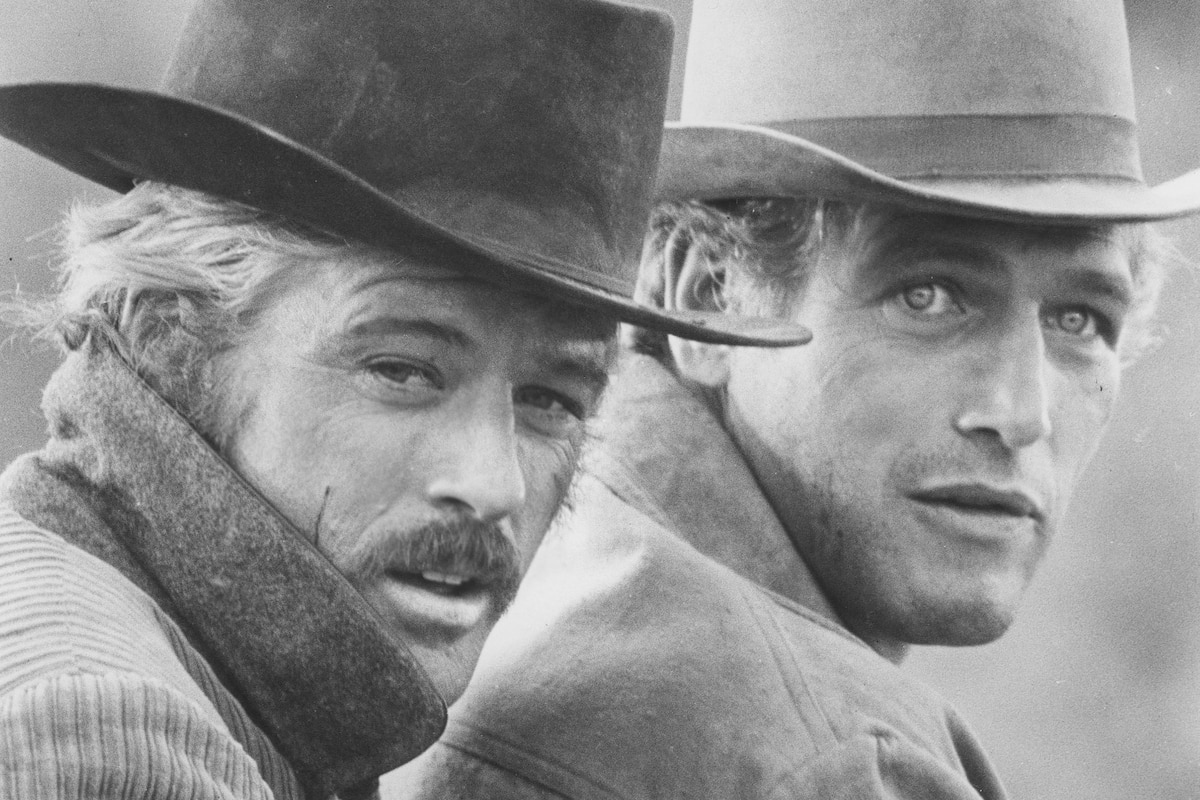

"Not that it matters, but most of it is true" was the tagline for the ad campaign for Butch Cassidy and the Sundance Kid (1969). What does matter is that the film is a wonderfully entertaining Western, which both debunks myths of the Old West and mourns its passing. What also matters is the film’s success, giving huge boosts to the careers of stars Paul Newman and Robert Redford, director George Roy Hill and screenwriter William Goldman.
Butch (Newman) and Sundance (Redford) are a pair of amiable, not-too-bright robbers, members of the legendary Hole-in-the-Wall Gang. But they're finding it harder to practice their profession since they're relentlessly pursued by a posse intent on wiping them out. With Sundance’s lover, a schoolteacher named Etta Place (Katharine Ross), they escape to Bolivia and again become legends as the "Yanqui banditos," all the while the law continues closing in.
Writer William Goldman was fascinated with the saga of Robert Leroy Parker a.k.a Butch Cassidy and Harry Longbaugh a.k.a. the Sundance Kid, which, surprisingly, had never been made into a film before. Goldman researched their story on and off for eight years before writing the screenplay. During that period, he wrote novels (Harry Longbaugh was one of the many pseudonyms he used) and eventually, screenplays. He had co-credit on the crime comedy Masquerade (1965) and sole credit for the screenplay of a private-eye movie starring Newman, Harper (1966).
During his holiday break between December 1965 and January 1966, he finally wrote the first draft of the Butch Cassidy and the Sundance Kid screenplay. Most of the story was, indeed, true. Indeed, Butch never killed anyone until he got to Bolivia, and he did use too much dynamite to blow up a safe, destroying the money as well. A super-posse was formed to hunt them down, and the boys really did run off to Bolivia because of it (although they left before the posse began pursuit). There was an Etta Place as well. The circumstances of the final shootout, if not the details, are also true.
Head of production at 20th Century-Fox, Richard D. Zanuck, bought the screenplay for $400,000. It was the most that had been paid for a screenplay up to that time and twice as much as Zanuck was contracted by his board to spend on a single script. Goldman wrote the screenplay with Jack Lemmon and Newman in mind for the leads. Twentieth Century-Fox had other ideas. They thought Newman was fine, but wanted Steve McQueen as his co-star. McQueen was interested until he found out Newman would get top billing. Zanuck tried and failed to get Marlon Brando, then offered the part to Warren Beatty. Newman was not happy about that and was having other doubts, too. His past efforts at comedy had flopped, and he decided he couldn't play comedy. Director George Roy Hill had to convince him otherwise, eventually persuading the actor to support his choice for Sundance – a rising young actor named Robert Redford.
Newman and Redford became fast friends, and all the participants remember a production filled with raucous but friendly arguments and many practical jokes. Redford fondly remembered that the two "found a common ground of humor and values off-set that could be worked into the work on the set." Newman said he and Redford "drank a lot of beer in Mexico and had a great deal of fun...probably the most fun I ever had on a film." Goldman later said Newman was "the least star-like superstar I've ever worked with. He's an educated man and a trained actor, and he never wants more close-ups. What he wants is the best possible script and character he can have. And he loves to be surrounded by the finest actors available because he believes the better they are the better the picture's apt to be, and the better he'll come out. Many stars, maybe even most, don't want that competition."
Throughout filming, Redford wanted to do all his own stunts. Newman was especially upset about Redford's desire to jump onto the train roof and run along the tops of the cars as it moved. Redford said Newman told him, "I don't want any heroics around here...I don't want to lose a co-star." Redford and Newman did jump off the cliff in Colorado, but they actually landed on a mattress-cushioned ledge six feet below. Stuntmen performed the full jump at another location. Newman did his own stunts during the bicycle scene, except for the final backward crash through the fence, which cinematographer Conrad Hall reportedly performed.
The two actors and screenwriter Goldman have all spoken about how rewarding and enjoyable the experience was. Redford has said he "felt guilty getting paid." Even a problem in filming one sequence was turned into an asset. The New York montage had been written as a dialogue scene, and Hill hoped to shoot these sequences on a huge New York set built for Hello Dolly! (1969), then in production. But Hello Dolly! would not open until after Butch Cassidy and the Sundance Kid, and Fox executives didn't want to dilute the set's impact, so they refused Hill permission to use it. Possibly inspired by photographs of the real Butch, Sundance and Etta in New York, Hill settled for shooting stills on the Dolly sets and making the sequence a montage of the photos. It proved to be an excellent pacing device and an effective marker between the two halves of the film.
Goldman and the actors had high praise for Roy Hill's direction. Goldman wrote that he couldn't say what the producers' contributions were to the picture because "on a George Roy Hill film, George is the giant ape. Because of his vast talent, his skill at infighting, his personality, he runs the show." Newman said Hill never displayed "any hesitation or indecision; he knew precisely what he wanted in a scene, what he wanted from an actor." Hall said it was Hill's decision not to show the posse clearly and that radios were used to coordinate shooting them from a great distance. As the cinematographer, Hall said he overexposed much of the film because he thought the lightness of the story did not require dramatic lighting and color. However, Fox and DeLuxe (the color film processing company) brought back a lot of the richness of tones, as was their trademark style.
The use of music in Butch Cassidy and the Sundance Kid was controversial. Burt Bacharach worked at writing something that would fit the mood, but it was a modern pop sound and not of the period. The most discussed aspect was the insertion of the musical bicycle scene interlude, something that wouldn't work in a conventional Western. Still, Bacharach thought Hill had "guts" to attempt that in the genre. The song "Raindrops Keep Fallin' on My Head" was written after the rough cut was completed, and when Redford first saw it in the movie, he thought it was terrible. Singer B.J. Thomas’ agents regretted letting him do it and thought it would ruin his career. The song went on to top the Billboard charts and in 2013, the National Academy of Recording Arts and Sciences inducted the song into the 2014 Grammy Hall of Fame.
Butch Cassidy and the Sundance Kid received mixed reviews from the critics, but the public cast the final vote. The film took in well over $30 million and became the highest-grossing Western in history. Newman became king of the box office that year, and Redford became a bankable star. Roy Hill and Goldman also became major Hollywood players. The film won four Academy Awards: Best Original Song for "Raindrops Keep Falling On My Head" and Score, both by Burt Bacharach; Best Cinematography for Conrad L. Hall; and Best Screenplay for Goldman. It was nominated for three more: Best Picture (Midnight Cowboy won), Best Direction and Best Sound. Hill, Newman and Redford reunited for The Sting (1973), which performed even better at the box office and won the Best Picture Oscar the following year.
The affection both Newman and Redford felt for Butch Cassidy and the Sundance Kid and their characters is evidenced in the names they've given to their favorite personal projects: Redford's Sundance Institute, a center for training and supporting new filmmakers, and Newman's Hole-in-the-Wall camp for children with debilitating illnesses.
Director: George Roy Hill
Producer: Paul Monash, John Foreman
Screenplay: William Goldman
Editor: John C. Howard, Richard C. Meyer
Cinematography: Conrad Hall
Costume Design: Edith Head
Art Direction: Jack Martin Smith, Philip Jefferies
Music: Burt Bacharach
Cast: Paul Newman (Butch Cassidy), Robert Redford (Sundance Kid), Katharine Ross (Etta Place), Strother Martin (Percy Garris), Henry Jones (bike salesman), Jeff Corey (Sheriff Bledsoe), Cloris Leachman (Agnes), Ted Cassidy (Harvey Logan), Kenneth Mars (Marshal).
C-112m. Letterboxed.