Thursdays in January at 8pm ET | 23 Movies
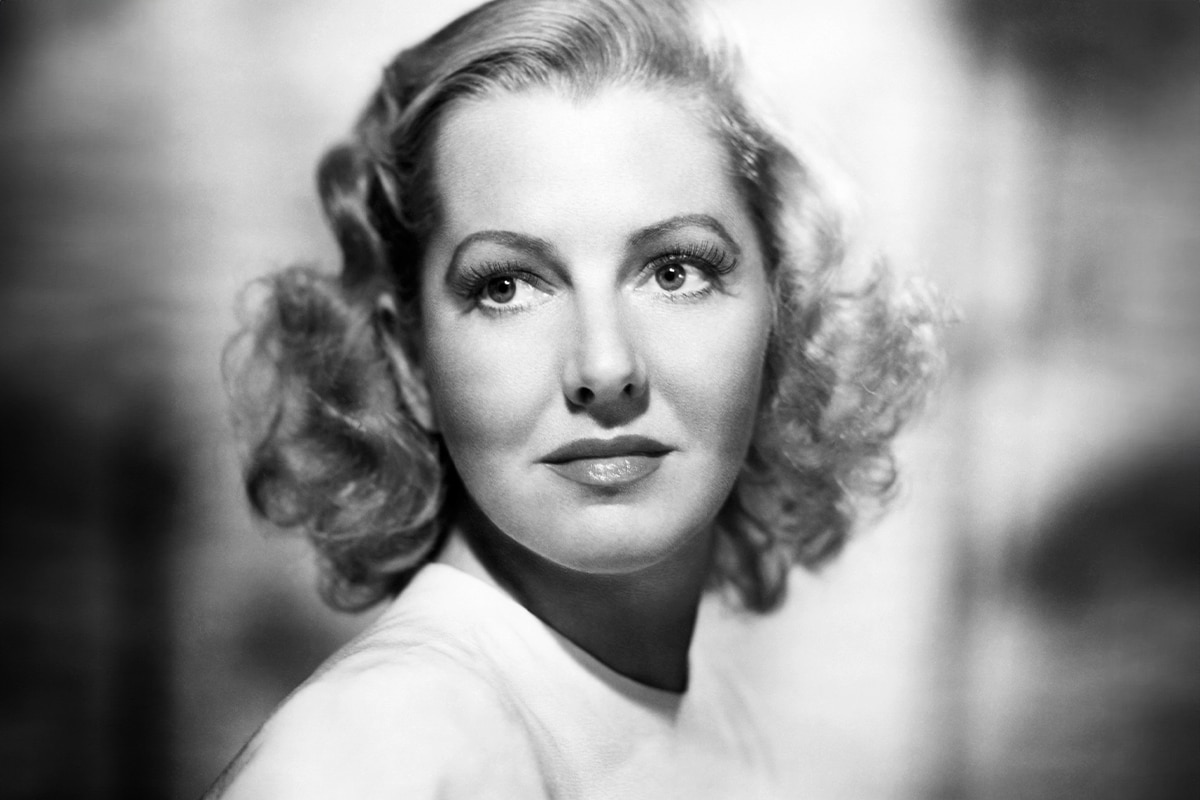
No one had a voice like Jean Arthur. It has been described as “wistful,” “quavering” and, as director Frank Capra said, “like a thousand tinkling bells.” She possessed a flair for comedy but could also portray characters that were strong and capable, while at the same time conveying a unique vulnerability. Strong and vulnerable could also apply to the actress herself, as seen in the variety of films part of her first Star of the Month tribute since 2007, airing every Thursday at 8pm ET.
She was born Gladys Georgianna Greene on October 17, 1900, in Plattsburgh, New York (although she would claim to be born in New York City in 1905 or 1908). Her father was an alcoholic photographer who was often absent from the family, which was said to have contributed to her lifelong insecurity, something that manifested itself in crippling anxiety and self-doubt. Her co-star, Joel McCrea, later recalled her difficulties with nervousness on set. "She just needed her ego boosted. It was surprising, because everybody just loved her voice, they loved her, she looked great and she was good.” Among her modern fans is actor Brian Cox of HBO’s “Succession.” “I think she’s a brilliant comedian and she’s soulful. [..] I just think she’s phenomenal.”
Although a shy girl, young Gladys Greene idolized silent movie star Mary Pickford and dreamed of being a tightrope walker but later worked as a fashion model. In 1923, she was spotted by a Fox talent scout, passed a screen test, was put under contract and gave herself a new name: Jean Arthur. The name reportedly was a combination of two of her heroes, Jeanne d’Arc (Joan of Arc) and King Arthur. While her career in silent films was not impressive, her first film, Cameo Kirby (1923), was directed by the legendary John Ford, and she shared a scene with Buster Keaton in Seven Chances (1925). Her most important role in the 1920s was as Clara Bow’s wild sister in The Saturday Night Kid (1929). But after films like The Silver Horde (1930) and Danger Lights (1930), she was deeply dissatisfied with the roles being offered. In the Spring of 1931, Arthur left Hollywood for the Broadway stage, where she appeared alongside stars like Dorothy Gish and Claude Rains, before returning to a new contract with Columbia Pictures, a move she later said was made because they would allow her to do Broadway plays in between films.

The first movie that solidified Arthur as a bona fide star was The Whole Town’s Talking (1935), a comedy about a milquetoast who is the spitting image of a gangster, again directed by Ford, and co-starring Edward G. Robinson. Robinson later wrote of Arthur in his autobiography, “She was whimsical without being silly, unique without being nutty, a theatrical personality who was an untheatrical person. She was a delight to work with and to know.” Following The Whole Town’s Talking, Arthur continued to score hits for Columbia, like Frank Capra’s Mr. Deeds Goes to Town (1936) opposite Gary Cooper, but the studio often loaned her out to other companies, like Paramount, for Cecil B. DeMille’s The Plainsman (1936) and Preston Sturges’ Easy Living (1937), and RKO for The Ex-Mrs. Bradford (1936), opposite William Powell.

As Arthur’s star rose, so did her problems. Her shyness and anxiety made being “a star” difficult. Arthur wasn’t into the Hollywood party scene, preferring to live a quiet life with her husband, writer/producer Frank Ross (who would later produce her films The Devil and Miss Jones [1941] and A Lady Takes a Chance [1943]), her dogs and cats and a few close friends. Biographer John Oller explained, “She did not like Hollywood publicity. She hated all that stuff. […] She didn’t make close friends easily. She had a coterie of maybe half a dozen very close friends, and most of them not from the Hollywood world.” While the industry admired her talent, a star was expected to cozy up to the press, something Arthur refused to do, resulting in the Women’s Press Club giving her their “Sour Apple Award” for being “uncooperative,” and powerful gossip columnist Hedda Hopper naming her “the most unpopular woman in Hollywood." In her own defense, Arthur said, in a rare 1940 interview with Life Magazine, “My private life is my own business.” Life touted their own interview as having been done “to the amazement of all Hollywood,” and called Arthur, “Hollywood’s reigning mystery woman.”
Her career peak as an actress lasted from the mid-1930s to the mid-1940s. During this time, she worked with some of the biggest leading men in Hollywood, like James Stewart in You Can’t Take It With You (1938) and Mr. Smith Goes to Washington (1939), the latter being perhaps her most famous role. Both films were directed by Capra, who called Arthur his “favorite actress.” She also worked twice with Cary Grant, in Howard Hawks’ Only Angels Have Wings (1939) and George Stevens’ The Talk of the Town (1942). They were not positive experiences for either star. Grant had never met Arthur before they started production, but he had admired her work and was puzzled at her insecurity once filming began. Arthur felt Hawks let Grant steal scenes from her and was angered by the director’s suggestion that she play her role of a stranded showgirl more sexily, saying, “I can’t do that kind of stuff.” The discord continued during filming of The Talk of the Town, when the accusation of favoritism was reversed, with Grant feeling that director Stevens was attracted to Arthur and was focusing more on her character. The Arthur and Grant tension led to a blow-up during their final scene, which required many retakes.
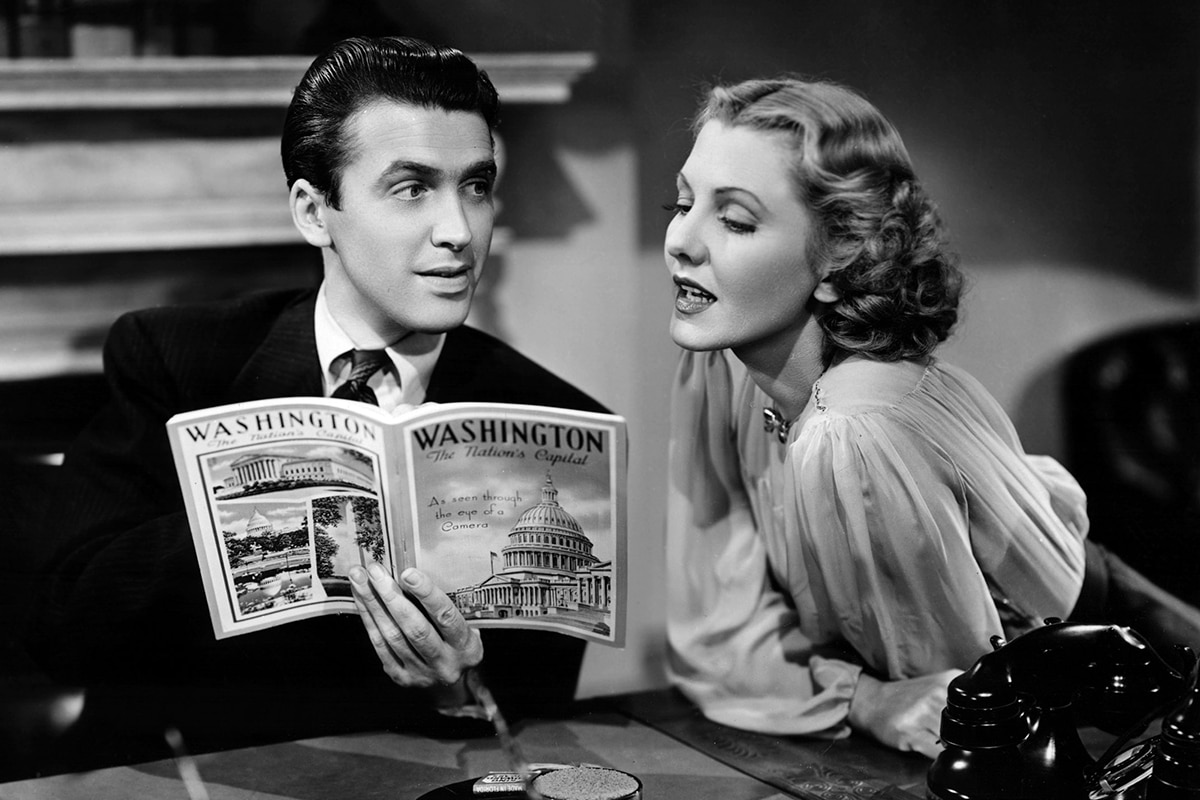
Later that year, Grant was asked to work with Arthur in The More the Merrier (1943), but he turned it down, as Arthur would when Capra wanted Grant for A Woman of Distinction (1950). Arthur was interested in the film, but not if she had to work with Grant. Joel McCrea would costar with Arthur in The More the Merrier, a wartime comedy co-written by her husband about the housing shortage in Washington, D.C., in which total strangers, McCrea, Arthur and Charles Coburn, share an apartment. The casting of McCrea would work to Arthur’s advantage, with their resulting chemistry sparking a performance that earned the “unpopular” Arthur a Best Actress Academy Award nomination for this film.
Arthur’s last appearance under her Columbia contract was in The Impatient Years (1944). On her final day at the studio, Arthur was said to have run through the lot, yelling, “I’m free! I’m free!” With her life now her own, she decided to go to college, first in Missouri, then UCLA and later in Vermont, where she studied philosophy, anthropology and psychology. While in New York, she learned that writer/director Garson Kanin had written a play with her specifically in mind, “Born Yesterday.” Arthur loved the part of a gangster’s girlfriend who gets an education that changes her life, but once again, her self-doubt proved too much. She abandoned the role before the play was previewed and was replaced by Judy Holliday, who would win a Best Actress Academy Award for her performance in the 1950 film adaptation.
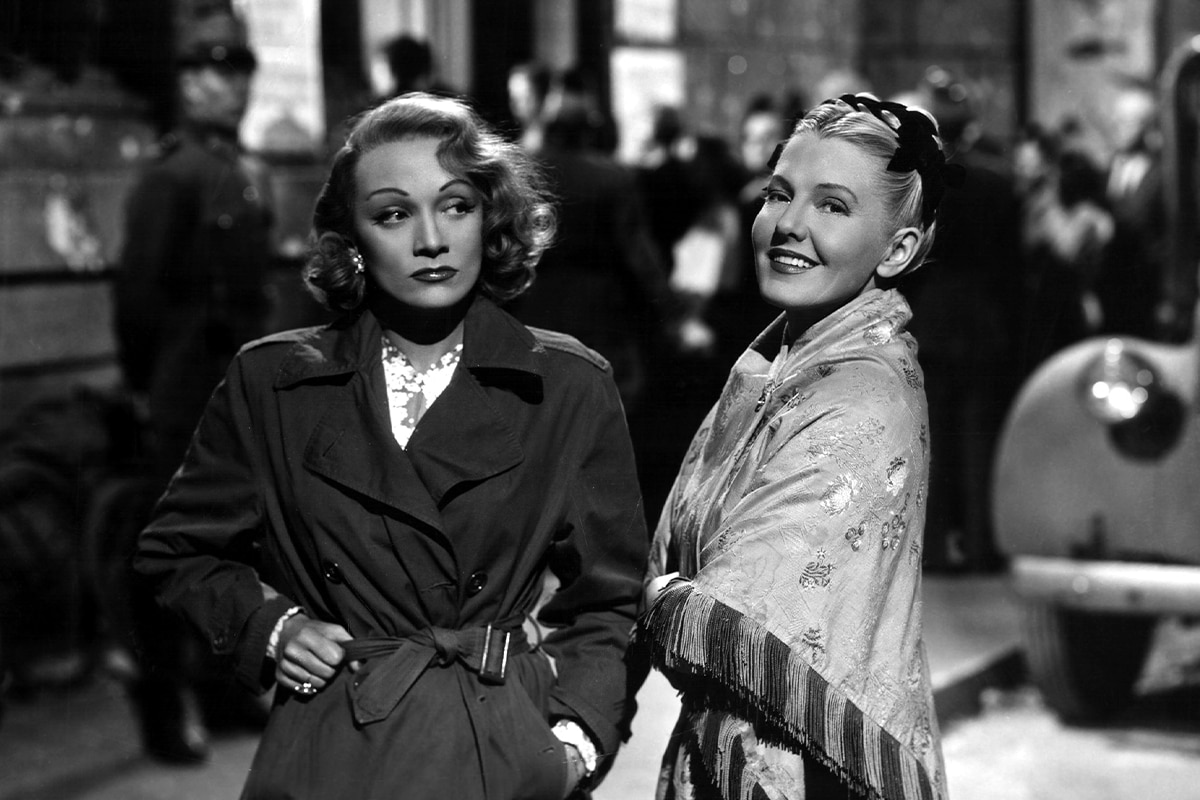
After turning down Capra’s It’s a Wonderful Life (1946), Arthur would make one more film in the 1940s, Billy Wilder’s comedy, A Foreign Affair (1948), playing a congresswoman investigating the morale of troops in post-war Berlin, opposite Marlene Dietrich. Paramount signed her to a three-picture contract, but she didn’t like any of the scripts they offered. Her final film (and only one in color) was Stevens’ Western classic, Shane (shot from late July to mid-October 1951, and released in 1953), with Arthur again dissatisfied, saying, “I didn’t like it. I just had to act old and worn out.”
Jean Arthur spent the rest of her life on stage, with only a small foray into television, with a one-off guest appearance on “Gunsmoke” and starring as a lawyer in her own 12-episode series, “The Jean Arthur Show” in 1966. Her last appearance on Broadway was in an abandoned play, “The Freaking Out of Stephanie Blake” in 1967, after which she taught drama at Vassar College for four years and at the North Carolina School of the Arts. The final years of her life were spent living quietly in Carmel, California, where she died in 1991.