December 5 at 8pm ET | 3 Movies
Bill Condon knows a bit about movie musicals. That’s an understatement, of course. He is the acclaimed director of Dreamgirls (2006), which he also co-wrote, and the live-action Beauty and the Beast (2017). His screenplay adaptation of Chicago (2002) was nominated for both an Academy Award and a Golden Globe, and he also adapted the stage musical The Greatest Showman (2017). And, most recently, he has taken on triple duties as executive producer, writer and director of Kiss of the Spider Woman (2025), adapted from the 1992 stage musical, itself an adaptation of the 1985 film based on the 1976 novel by Argentinian writer Manuel Puig.
Condon shares his wealth of experience and insight for three musicals airing on TCM on December 5. Talking with host Dave Karger, Condon speaks about the influence classic Hollywood musicals have had on his work, particularly his most recent project, directing Jennifer Lopez in the role made famous by Broadway legend Chita Rivera. The lavish design and high style of those old musicals had much to do with his approach to Kiss of the Spider Woman, but it was another essential element of how those movies were made that he wanted to tap into for his production.
“It was mostly the way they shot the musical numbers that we really, really wanted to honor,” Condon says. “It was the Fred Astaire idea that you watch people full figure, as few cuts as possible, and you’re really giving the audience the sense that these dancers are doing it in real time.”
Case in point: watch the number “Make Way for Tomorrow” in the evening’s first spotlighted movie, Cover Girl (1944), a musical starring Rita Hayworth, Gene Kelly and Phil Silvers. The trio begins the song in a restaurant, then takes it outside for an extended dance along a Brooklyn street for more than three minutes. The routine is shot almost entirely in full figure with only ten cuts, mostly in the service of emphasizing comic vignettes on the stoops of buildings passed by the three stars. This was once the standard method of filming musical numbers, almost as though you were watching the performers live, but it has largely been abandoned in recent years in favor of multiple quick cuts and shortened attention spans ushered in by the music videos of the 1980s.
That street set appears again later in the film in one of the innovative dance numbers Kelly became famous for, a duet with his own reflection. A fast-rising Broadway dancer-choreographer-actor, he had only been in films for two years and not yet a full-fledged star when his home studio, MGM, lent him out to Columbia Pictures for a project primarily meant to showcase Hayworth, their newest star. Recognizing Kelly’s talent and ambition, the studio allowed him, for the first time in his career, to choreograph (with frequent collaborator Stanley Donen) his own routines. He was even able to persuade Columbia to let him create the extended street set and basically take charge of all the dance numbers, much to the chagrin of director Charles Vidor, who was not known for musicals. Condon notes that many of the elements that would appear again in later Gene Kelly movies were first glimpsed in the two sequences staged on the street set.
Kelly’s “alter-ego” dance with himself introduced a note of darkness into what is little more than a featherweight story of show business success and glamour. (Hayworth wants to be a magazine model and Broadway star; boyfriend Kelly wants her to keep working at his Brooklyn nightclub — guess who wins?) Throughout his career, Kelly would strive to bring more complexity and shading to his characters and choreography, even at the risk of making his roles appear less sympathetic. He achieved it to its greatest degree in one of his last major musicals, It’s Always Fair Weather (1955), which has him dancing once again on vast urban street sets, as in On the Town (1949), An American in Paris (1951) and, most famously, Singin’ in the Rain (1952).
The darkness, tension and complexity Condon sees in Kelly’s work is cranked to the max, not always successfully but no less compellingly, in the second film in his guest programmer segment, another important influence on Kiss of the Spider Woman.
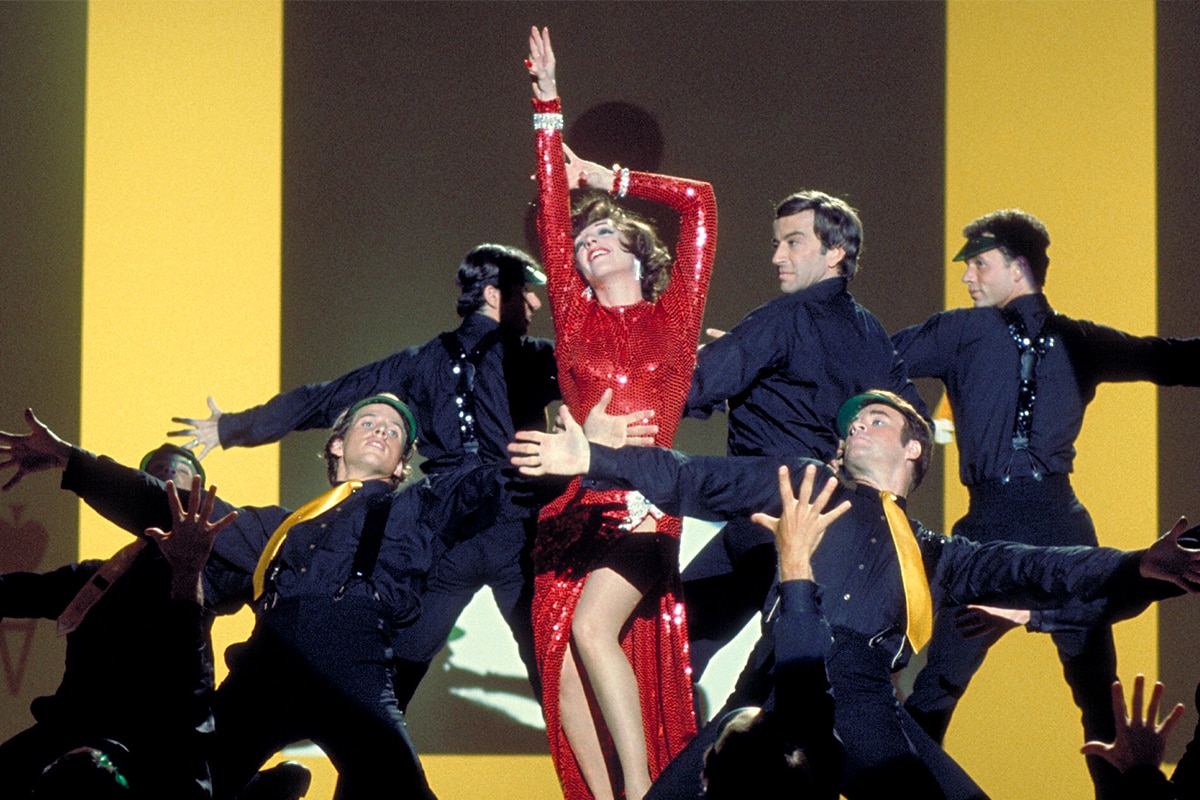
New York, New York (1977), Martin Scorsese’s unlikely follow-up to the violent, gritty Taxi Driver (1976), is a musical about the relationship between an ambitious young singer (Liza Minnelli) and a self-centered, callous jazz musician (Robert De Niro) in the years following World War II. Scorsese’s attempt to wed the glitzy, artificial look of classic musicals to an improvisatory psychodrama was a box office and critical failure upon its release. Even he hasn’t expressed much praise for it, but it has been seen in a more positive light in recent years, especially since a re-issue that restored sequences originally cut for time.
“All the darker stuff left out of musicals of this period, [Scorsese]’s putting in there,” Condon notes with admiration. The juxtaposition in New York, New York of downbeat naturalistic drama with glitzy theatricality tracks closely with Kiss of the Spider Woman, which combines a tense drama of “subversives” imprisoned by an oppressive political regime with a fantasy woven by a movie-obsessed gay man. But Condon says it was the production design of Scorsese's film, by Boris Leven (Anatomy of a Murder, 1959; West Side Story, 1961; The King of Comedy, 1982), that was foremost in his mind, particularly the verticality of the sets, creating an elevated space above the action.
Scorsese has said he hired Leven to design his musical after seeing The Silver Chalice (1954), a sword-and-sandal epic generally conceded to be a wretched movie, partially because of its inauthenticity. “It’s purely theatrical, and this is mainly due to the sets,” Scorsese said. “They’re clean and clear; it’s almost like another life, another world.”
Leven’s design is spectacularly showcased in the lengthy musical sequence, “Happy Endings,” which was cut from the initial release but restored in 1981. Designed as a lavish, kitschy Hollywood musical picture within the film, it makes rather obvious references to the similar “Born in a Trunk” musical sequence in A Star Is Born (1954), starring Minnelli’s mother, Judy Garland. According to Scorsese, however, the film that was his primary inspiration for New York, New York was My Dream Is Yours (1949), a Warner Bros. musical with some surprisingly dark undertones starring Doris Day as a struggling singer who falls for an egotistical, self-destructive radio crooner. That earlier movie has subtle traces of the ruthless ambition, infidelity and betrayal, addiction and fraught romance foregrounded in Scorsese’s film.
“Musicals often had more on their minds than they’re given credit for,” Condon tells Karger. He could be talking about New York, New York or even My Dream Is Yours, but what he’s specifically referring to is the third film in the evening’s showcase. Like Kiss of the Spider Woman, Silk Stockings (1957) is a musical version of an earlier film (Ernst Lubitsch’s offbeat romantic comedy Ninotchka, 1939) that was made into a stage musical and then brought to the screen again. The story of a Soviet bureaucrat who at first resists, then falls for both an American film producer and the pampered lifestyle of Western culture, the plot takes digs at both Soviet austerity and the more frivolous aspects of capitalism before, of course, coming down firmly on the side of the mainstream attitudes of the Eisenhower Era.
Rouben Mamoulian, who started his film career with one of the earliest American musical pictures, Applause (1929), aimed to tell the story through dance — a no-brainer considering his stars were Fred Astaire and Cyd Charisse. "I had two of the best dancers in the world, and what interested me was to give greater importance to the dancing than to the action proper, which was merely a repeat of Ninotchka,” he told biographer Tom Milne in 1970. “The psychological and dramatic development existed only in the dances."
Working with choreographers Hermes Pan and Eugene Loring, Mamoulian developed the personal and ideological changes experienced by Ninotchka, the stern communist functionary, through her movements — at first hard and rigid, then slowly exhibiting little physical flair as she reacts to new situations and feelings. The character finally breaks free in Charisse’s justifiably famous dance around her hotel room as she revels in her newly achieved soft, romantic nature and appreciation for the finer luxuries she once rejected. That sequence has been compared to the scene in Queen Christina (1933) in which Greta Garbo wanders around the room she shared with her lover, committing every object to memory. It’s no surprise that Mamoulian directed that film as well, telling Garbo, “This has to be sheer poetry and feeling. The moment must be like a dance. Treat it as you would do it to music.”
Silk Stockings was one of Mamoulian’s last films. It was also the final full-fledged musical Charisse would make. Fred Astaire made only one other musical in his career, Finian’s Rainbow (1968).