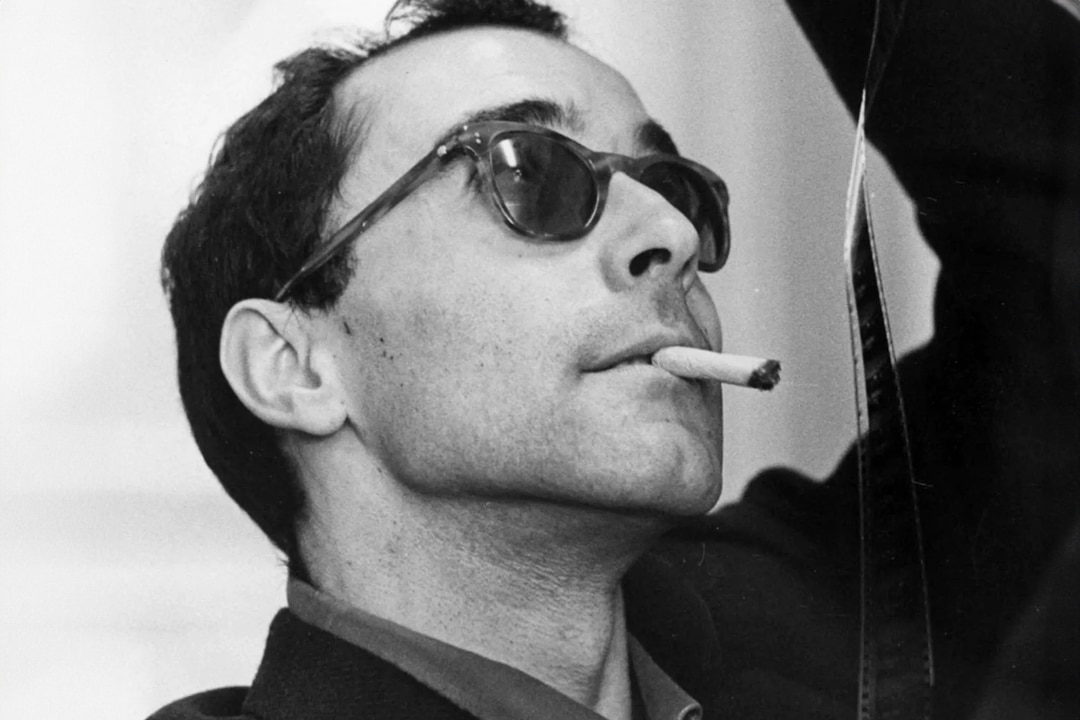
Few filmmakers had so profound an effect on the development of cinema as Jean-Luc Godard, certainly one of the most important and influential directors worldwide to have emerged since the end of World War II. From his early days as a critic in the pages of Cahiers du cinema, through the great age of the French New Wave of the 1960s, Godard redefined the way we look at film. Godard emerged on the international filmmaking scene with his most famous film, Breathless (1960), a celebration of the American film noir that also served as the stylistic template for the rest of the 1960s, widely considered to be his most fertile creative period. During that turbulent decade, Godard made no less than two films a year and sometimes more, creating such experimental and increasingly politically minded films as Vivre sa vie (My Life to Live, 1962), Contempt (1963), Bande à Part (Band of Outsiders, 1964) and Alphaville (1965), many of which starred his first wife, Anna Karina. After making the critically panned Week-end (1967), a disgruntled Godard chose to make political films.
Once that particular fancy waned in 1972, he entered into a transitional period of video and television projects that eventually segued into a second period of narrative filmmaking that was more experimental and inaccessible than his previous work, though some critics declared this time as being more creatively fruitful. Chief among the works was the highly controversial Hail Mary (1985), a contemporary retelling of the biblical Joseph and Mary story that was tagged by the Vatican as being blasphemous. Whether he was continuing his long love affair with film noir, as he did with Detective (1985), or overreaching with the baffling King Lear (1987), Godard was not only a tireless experimenter with form and context, but also synonymous with the world of cinema itself.
Born on December 3, 1930, in Paris, France, Godard was raised in a privileged home by his father, Paul-Jean, a physician, and his mother, Odile, the daughter of wealthy bankers. Having spent his upbringing in Switzerland, Godard also traveled to and from his family's various estates while attending school at the Lycée Buffon in Paris. But World War II forced him to go back to Switzerland until the war was over. Upon his return to Paris following the War, Godard discovered the Cinėmathèque Française, a film club formed by silent movie buff Henri Langlois, who had preserved numerous films and screened them in small rooms. Because of his diverse and eclectic tastes, Langlois's ciné-club was one of the more popular ones to have sprung up in post-war France. It was there that Godard began to meet some of the filmmakers that would make up the French New Wave, including Jacques Demy, Claude Chabrol, Éric Rohmer and Francois Truffaut. While his interest in film turned into obsession, eventually trumping his desire to become a novelist, Godard placated his parents, who wanted him to have a steady career, by enrolling at the Sorbonne to study ethnology. But he instead spent his time watching movies, sometimes three a day, which led to his family cutting off his allowance for neglecting his studies.
In 1950, Godard put his literary aspirations to use writing articles for a short-lived film publication edited by Rohmer and co-founded by Andre Bazin. Two years later, he began writing for the literary magazine, Cahiers du cinema. It was here that Godard began formulating the central ideas behind his future films: a love for classic American cinema, a penchant toward the political, a vehement distaste for contemporary Hollywood and the grandiose idea of using cinema to band together the whole of Western civilization. He began making fictional shorts, including Une Femme Coquette (1955), while writing film reviews for Arts magazine. In 1957, Godard briefly worked in the publicity department for the Paris office of 20th Century-Fox, after which he was hired as a press attaché for Artistes Associes. Meanwhile, his documentary short about the Swiss dam, Operation Concrete, had its first public screening in 1958.
He made his landmark feature debut with Breathless, and Godard broke with established narrative conventions, spontaneously mixing elements from the detective, comedy and suspense genres, while using a variety of techniques, including hand-held cameras, location shooting, improvised dialogue and a loose narrative, that came to define the essence of the French New Wave. On the surface, Breathless is the story of a petty thief (Jean-Paul Belmondo) wanted for the murder of a police officer and who returns to Paris to meet with an American student and aspiring journalist (Jean Seberg), who is unwittingly called upon to help hide him from the law. Underneath, however, the film is a loving ode to American film noir, with numerous references littered throughout—the most obvious being the thief modeling his image on Humphrey Bogart—while breaking seemingly every rule in the book, from jump-cut editing in the middle of a shot to characters looking directly into camera and breaking the proverbial fourth wall. Breathless turned Godard into an international celebrity who won numerous awards, including a Silver Bear for Best Director at the 1960 Berlin Film Festival, while the film itself joined the ranks of Truffaut's The 400 Blows (1959) and Alain Resnais's Hiroshima mon amour (1960) as the preeminent examples of French New Wave cinema.
Because of the enormous notoriety he gained from Breathless, Godard publicly wished that his next film would be a failure. And in a way it was. Deciding that there was something fundamentally wrong with the way people were leading their modern lives, Godard was ready to turn to political action as a solution. With his second film, Le petit soldat (The Little Soldier, 1960), a deeply personal love story set during France's notorious war against Algeria, Goddard earned a degree of notoriety and even a few death threats prior to French authorities banning the film, largely due to scenes depicting torture. By this time, Godard was entering a fertile period that lasted well into the decade, only to end abruptly when he defiantly left the movie industry to make political documentaries. In 1961, he married actress Anna Karina, with whom he spent the next three years in a turbulent affair that sometimes saw Godard disappear for weeks at a time with no warning or explanation. But Karina starred in some of the director's finest work, including A Woman Is a Woman (1961), his whimsical send up of the musical comedy in which she plays a nightclub striptease artist who decides it is time to have a child.
With a prodigious sense of exploration, Godard's films at the time tended to focus on couples who are alienated both from each other and from their environment; driven by uncertainty and mistrust and surrounded by the crass commercialism of late 20th century capitalism. This was best exemplified in Vivre sa vie, an almost documentary-like look at a young Parisian woman (Karina), who abandons her husband and child to pursue an acting career, only to fall into prostitution with tragic results. The film is structured into 12 sequences, with one of his typical scenes in which he drifts into philosophical discourse, which culminates in a stark commentary on the consumerist culture of modern-day Paris. In another effort from the era, Les Carabiniers (1963), Godard discusses the politics of war in absurdist terms, with a screenplay co-scripted by one of Godard's key influences, Roberto Rossellini.
Godard turned to big-budget filmmaking for the first time when he directed French superstar Brigitte Bardot in Contempt, one of his more compelling works about a crumbling relationship between a beautiful French woman (Bardot) and her screenwriter husband (Michel Piccoli), who is hired by an arrogant American producer (Jack Palance) to adapt Homer's “Odyssey.” The film is also a cynical satire on mainstream filmmaking and the never-ending conflict between art and consumerism. In one of his more accessible films, Bande à part, three alienated youngsters (Anna Karina, Claude Brasseur and Sami Frey) plan to rob a suburban house, leading to disastrous results. Another tour de force in terms of style, the film also served as inspiration for numerous filmmakers, including Quentin Tarantino, who named his production company, A Band Apart, after the movie.
Over the next three years, Godard continued to make challenging films, even as he secretly grew more frustrated with the moviemaking business. After a lesser work, The Married Woman (1964), he blended film noir with dystopian science fiction for Alphaville, in which he created a uniquely menacing, futuristic look out of largely contemporary settings. The ambitious film tells the tale of secret agent Lenny Caution (Eddie Constantine), who arrives at the titular capital of a fictional totalitarian state to destroy its leader, Alpha 60, an almost human-like supercomputer that has outlawed free thought. Godard directed his sixth film with his ex-wife Karina, Pierrot le fou (Pierrot the Fool, 1965), a sad tale about an errant husband (Jean-Paul Belmondo) who abandons his wife and infant daughter in order to run away with the babysitter (Karina). With Masculin-Feminin (1966), Godard tackled the youth culture of the 1960s for the first time with this tale about a young man (Jean-Pierre Léaud) who engages in a love affair with a burgeoning singer (Chantal Goya).
As a favor to financially struggling producer Georges de Beauregard, Godard made the Made in USA (1966), a dense and deliberately fragmented attempt to satirize the American crime thriller, starring Karina. Meanwhile, Two or Three Things I Know About Her (1967) has been considered by some as the greatest of his masterpieces, being memorable for such stunning set-pieces as the coffee-cup cosmos and the model city built of consumer goods. Godard himself served as both filmmaker and narrator, commenting on the dysfunctional bourgeois universe he depicts via a housewife (Marina Vlady) who works part-time as a prostitute. Though little-seen as compared to his other work, La Chinoise (The Chinese, 1967) turned out to be one of his more exquisite and fondly remembered films, if only because it was prescient of the New Left activism in France that came to the world's attention during the crippling worker’s strike in 1968. By the time he made Weekend, Godard had reached a point where cinematic conventions no longer mattered. A Maoist diatribe against the evils of consumer society as seen through the eyes of a bourgeois couple (Mireille Darc and Jean Yanne), Weekend completely eschewed any semblance of normalcy, as characters directly address the camera, music rises and falls with no rhyme or reason and the camera moves according to the director's own whim. Experimental to the extreme, the film proved to be one of Godard's least accessible films, while marking not only the end of his fertile 1960s period, but also his desire to make narrative fiction for the next decade.
From 1968-1972, Godard made 11 political films; over half were in collaboration with Jean-Pierre Gorin, whose involvement often varied from project to project, with most released as signed by the "Dziga-Vertov Group." By invoking the name of one of early Soviet cinema's most inventive filmmakers, Godard and Gorin were, according to them, "making political films politically." Although they claimed to have no answers, "only questions," their films appeared to address and support militant issues. Yet, in the end, it was clear that Godard and Gorin had more concern with the process of filmmaking than with the process of revolution. Throughout their collaboration, they became obsessed with the job of turning theory into practice. British Sounds (1969) was perhaps the most successful of Godard's so-called revolutionary experiments, a collection of images and sounds meant to incite discussion about workers, women, students and revolution in general. The Dziga-Vertov period culminated with two films: Tout va bien (1972) and A Letter to Jane (1972). Tout va bien, with Yves Montand and Jane Fonda, was one of his more accessible films from this period, complete with international stars. As if in reaction, A Letter to Jane is a 45-minute monologue by Godard/Gorin about an image of Jane Fonda in Vietnam, which had appeared in the magazine L'Express. The film explains their theories of images and sounds and how they related to politics.
The Dziga-Vertov Group disbanded in 1973, with Gorin moving to California to teach and Godard moving on to video, which proved to be a better medium for the essays and experimentation he had in mind. In 1975, he left Paris for Grenobl to collaborate with his third wife, Anne-Marie Mieville, on intimate, challenging television and video work. The main productions of the video period were the two series, the ten-hour Six Fois Deux/Sur et sous la communication (1976) and the six-hour France-Tour-Detour-Deux-Enfants (1978). Godard started with the premise that "video is for those who do not see." These series comprised essays on commonplace everyday subjects, including family, love and work; all as they were presented by the media for mass consumption. With some success, Godard challenged the passivity of television viewers and their unquestioning acceptance of media messages. Individual segments of the Six Fois Deux series examine mass media's approach to such subjects as unemployment, farming, the language of images, photo news, math, madness and society, and, of course, filmmaking. In separate segments, real people with direct knowledge of each area of inquiry, including a farmer, a filmmaker and a mathematician personally discuss these topics and their representation in the media.
France-Tour-Detour-Deux-Enfants juxtaposes philosophical interviews with two children (ages 9 and 12) from the same family about the meaning of daily activities against images of everyday life with their parents, including watching television. For the first time, in these projects for the small screen, Godard took on the role of teacher to share with a much larger audience his understanding of the complex language of film and TV. In 1975, Godard released two films: Numero deux, notable not only for its bold sexuality, but also for his spare usage of only parts of the frame; and Comment ca va, which indicated the direction for the future. Starting in 1980, Godard continued the reinvestigation of concerns and themes he had first developed in the 1960s. Sauve qui peut (la vie) (1980) and Passion (1982) gave portraits of emotional confusion mixed with commentary on the problems of filmmaking. With his next three films, Godard hit his stride again, starting with First Name: Carmen (1983), which imaginatively retold the old story of Bizet's opera “Carmen” alongside a crime drama about a group of young people plotting to rob bank. His next film, Detective (1985), a challenging comic homage to the crime genre that was dedicated to John Cassavetes, Edgar G. Ulmer and Clint Eastwood, brought Godard back, marking one of his most accessible films in years.
But it was Hail Mary (1985) which truly marked Godard's return to cinematic prominence. This modern nativity tale placed the story of Joseph (Thierry Rode) and Mary (Myriem Roussel) in contemporary society and filled it with rampant jealousy and loneliness and a bitter divorce. Adding to the controversy was a healthy amount of nudity and coarse language, leading to some in the Catholic world—particularly the Vatican—to denounce the film as blasphemous. More serious critics, however, observed that the film was in fact quite devout in its faithful depiction of the famous biblical story. Regardless, there was no doubt that Godard had finally bridged the gap between his fertile 1960s period and the more difficult to understand 1970s.
In 1987, the ever prolific and experimental Godard turned out three more films. His segment of the omnibus feature Aria was one of the funnier exercises, setting Jean-Baptiste Lully's opera "Armide" in a gymnasium with brooding, nude female workers contemplating the murder of muscle-bound males. Soigne ta droite is a docu-essay on French pop group Les Rita Mitsouko, drawing comparisons to his earlier One Plus One (1968), which had intercut the Rolling Stones recording "Sympathy for the Devil" with fragments of contemporary English life. Meanwhile, King Lear (1987) marked Godard's English-language debut, which featured American theater director Peter Sellars as the Bard's descendent, William Shakespeare the Fifth, who has been tasked with restoring his famed ancestor's lost works. Rounding out the cast with Molly Ringwald as Cordelia, Burgess Meredith as Lear and Woody Allen as Mr. Alien, King Lear unfortunately proved to be one of his weaker efforts of this period.
In 1990, he released Nouvelle Vague (New Wave, 1990), an experimental fantasy about big business machinations on a Swiss estate. Godard's affectionate video History of the Cinema (1991) and his feature Germany Year 90 Nine Zero (1991)—which revisited both Rossellini's classic Germany Year Zero (1947) and Godard's own Alphaville—further confirmed his singular position taken to explore the relationship between cinema and life itself. In 1993, he reworked the Greek myth of Amphitryon to explore the issue of God's role in human lives in Helas Pour Moi (Woe Is Me,1993). Turning the camera directly on himself following decades of making personal allusions, Godard made the documentary JLG/JLG: autoportrait de décembre (JLG/JLG: Self-Portrait in December, 1994), a meditative self-portrait that referenced his works in the larger context of cinema and the world itself. In 1998, he completed Histoire(s) du cinema, a video project started in the late 1980s that examines the history of cinema in its relation to the 20th century. With Eloge de l'Amour (In Praise of Love, 2001), Godard unsurprisingly turned to digital filmmaking after shooting the first part in 35mm black and white, bridging the gap between the past and future of cinema in this more straightforward narrative about show business.
Meanwhile, Notre musique (Our Music, 2004) earned critical praise for his reflections on art, violence and morality while deftly connecting past colonialism with the current Israeli-Palestinian conflict. After releasing Socialisme (2010), Godard received an Honorary Oscar at the 2011 Academy Awards alongside Francis Ford Coppola, Eli Wallach and film preservationist Kevin Brownlow. He made his final feature length film in 2018, Le Livre d'Image (The Image Book). At the age of 91, Godard died on September 13, 2022, through legalized assisted suicide. “He was not sick, he was simply exhausted,” a family represented told the public. Two short films of his were released posthumously: Film annonce du film qui n'existera jamais : ‘Drôles de guerres’ (Trailer of the Film That Will Never Exist: "Phony Wars," 2024) and Scénarios (2024).
(Edited: August 2026 by Quatoyiah Murray)