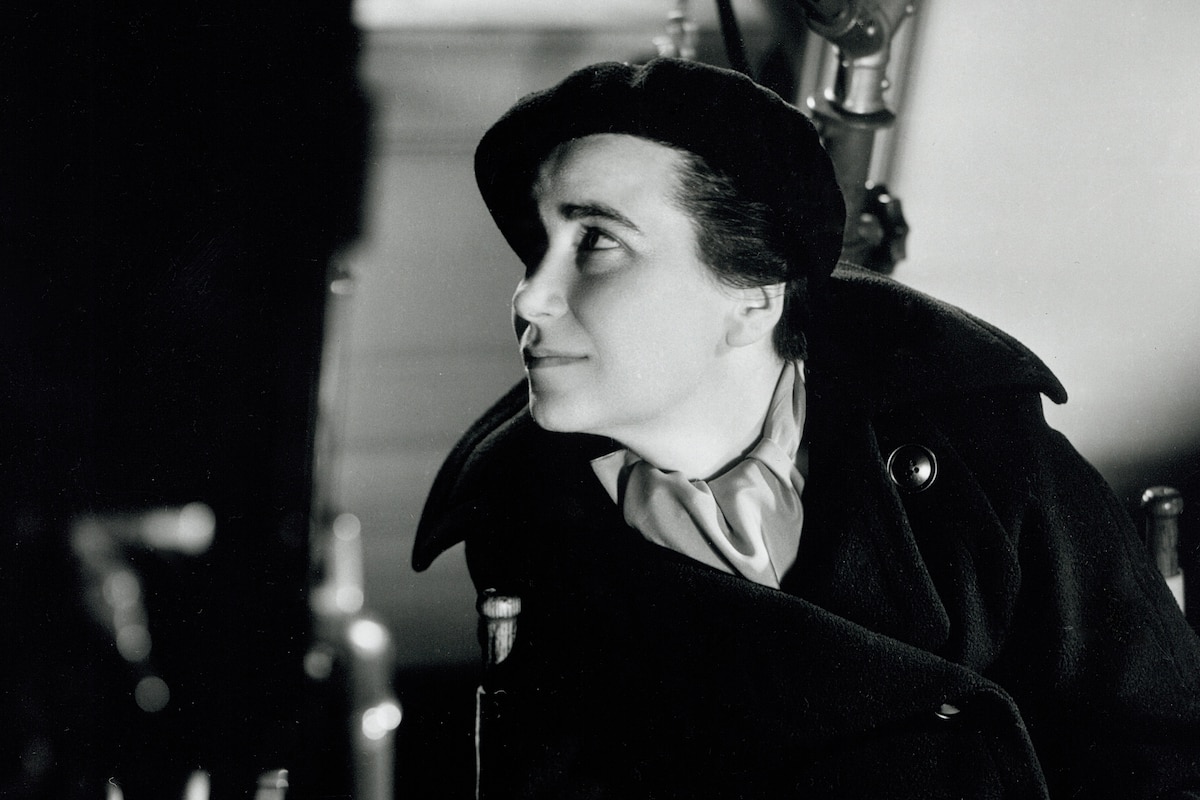
In the early days of Hollywood when women had few paths to choose from, Dorothy Arzner bucked the system and became a feature film director. Though her body of work remained uneven at best, Arzner nonetheless managed to rise from being an editor to directing her first picture, Fashions for Women (1927), a silent comedy that went on to box-office success. After helming Ten Modern Commandments (1927) and Get Your Man (1927), she entered the talkie era with The Wild Party (1929) and quickly established herself as a director who made movies featuring fiercely independent women. Arzner typically cast appropriate actresses like Katharine Hepburn and Joan Crawford to ably play such roles, as they did in Christopher Strong (1933) and The Bride Wore Red (1937), respectively. Not shy about her sexuality, Arzner wore skirt suits on set while gaining a reputation for pursuing her actresses, as she did with Crawford. After directing Dance, Girl, Dance (1940) and First Comes Courage (1943), she fell ill with pneumonia and found it difficult to return to pictures. Instead, she taught at the University of California, Los Angeles, and the Pasadena Playhouse, while Crawford helped pave the way for her to direct over 50 commercials for Pepsi. Though she slipped into obscurity before her death in 1979, Arzner re-emerged as a pioneering woman who managed to compile a body of work at a time when most other women were not given the opportunity to do so.
Born on January 3, 1897, in San Francisco, CA, Arzner grew up in Los Angeles and spent a great deal of time at the Hoffmann Cafe, a restaurant owned by her father, Louis, that was frequented by top celebrities and filmmakers like Mack Sennett, Charlie Chaplin and D. W. Griffith. Although drawn to the world of show business, she enrolled at the University of Southern California as a medical student and even signed on to be an ambulance driver during World War I. In 1919, having decided to pursue a career as a film director, Arzner was hired by William de Mille to work as a typist in the script department of Famous Players-Lasky, soon to become Paramount Pictures. While still in its infancy, the film industry allowed women more opportunities for work behind the camera, although Arzner did get pigeonholed for a time as an assistant editor in part because of her exemplary work cutting the bullfighting sequence of Blood and Sand (1922). James Cruze hired her to edit The Covered Wagon (1923), and Arzner went on to work on several films for the director including Ruggles of Red Gap (1923), Merton of the Movies (1924) and Old Ironsides (1926).
Using an offer from Harry Cohn at Columbia as leverage, Arzner finally convinced Paramount head B.P. Shulberg to give her a shot at directing, mainly by threatening to leave for rival Columbia Pictures. Her first assignment was Fashions for Women (1927), a lightweight comedy that earned respectable reviews and became a box-office success. She went on to handle similar chores on Ten Modern Commandments (1927) and Get Your Man (1927) before breaking into talking pictures with The Wild Party (1929), one of the quintessential flapper pictures starring Clara Bow. By this time, Arzner had begun to develop a reputation for films built around fiercely independent women and her ability to elicit strong performances from the actresses in those roles. Beginning an ongoing film collaboration with screenwriter Zoe Akins, she continued in this vein with such efforts as Sarah and Son (1930), which earned star Ruth Chatterton an Academy Award nomination as Best Actress, and Anybody's Woman (1930). After Arzner left Paramount, she and Akins reteamed once more for one of Arzner’s more interesting efforts, Christopher Strong (1933), starring Katharine Hepburn as an aviatrix modeled on Amelia Earhart.
Hired by Samuel Goldwyn to direct the screen adaptation of Nana (1934), Arzner was tasked with directing the American debut of Russian actress, Anna Sten, whom the producer was trying to build into the next Greta Garbo. But Arzner's homogenized take on Émile Zola's novel was a box-office failure and helped pave the way to Sten being released by Goldwyn. The director found a more satisfactory leading lady in Rosalind Russell for Craig's Wife (1936), in which the actress plays a shrew who drives away her husband and friends with her incessant need to control everything. Arzner next directed Crawford in The Bride Wore Red (1937), a rags-to-riches tale in the vein of Cinderella that suffered an underdeveloped script and overproduced production values. With Dance, Girl, Dance (1940), Arzner featured Lucille Ball in one of her best straight performances, playing a vain burlesque dancer who accepts the grimy environment in which she works with no illusions. Although visually unremarkable, the film's critique of the inherent sexism of the world of burlesque was far ahead of its time. By this time, Arzner had conducted affairs with a number of actresses, but for the most part, she maintained a long-standing relationship with dancer and choreographer Marion Morgan.
After a stint making training films for the U.S. Army during World War II, Arzner made one last studio film for Columbia, the little known First Comes Courage (1943), starring Merle Oberon as a Norwegian double agent who pretends to be in love with a Nazi commandant (Carl Esmond) in order to extract secrets. But once the film was complete, Arzner fell ill with pneumonia and was bedridden for more than a year. With societal changes and the after-effects of women working during WWII, changes in Hollywood were taking place. Women were no longer finding the opportunities they had in the halcyon early days as the studios began adopting a more bottom-line approach to the business. Certainly, a woman in her mid-40s was regarded as problematic. Undoubtedly, Arzner could have returned to the editing room or might have been allowed a chance to write scripts, but the idea of a female film director was now becoming rare. Faced with these harsh realities, Arzner opted to leave the business and instead turned to teaching, first at the Pasadena Playhouse and later at the University of California, Los Angeles, where she counted Francis Ford Coppola as one of her students.
Meanwhile, old friend Joan Crawford, then married to the chairman of PepsiCo, helped Arzner get hired to direct over 50 television commercials for the soft drink in the 1950s. Arzner lived the remainder of her days in quiet anonymity, though in 1975, she was given a tribute by the Directors Guild of America, having been the first woman to ever join the guild. She lived to 82 years old and died on October 1, 1979, in La Quinta, CA. After her death, a new generation of film historians rediscovered Arzner, and her body of work became fodder for discussion due to its targeting of feminist issues that prefigured the concerns of contemporary directors like Lizzie Borden, Joyce Chopra and Agnes Varda. While there certainly were female directors before her, Arzner held the unique distinction of being the only woman to compile a significant body of work within the studio system of the 1930s and 1940s, a time when women had few opportunities behind the camera.
(Edited: August 2026 by Quatoyiah Murray)