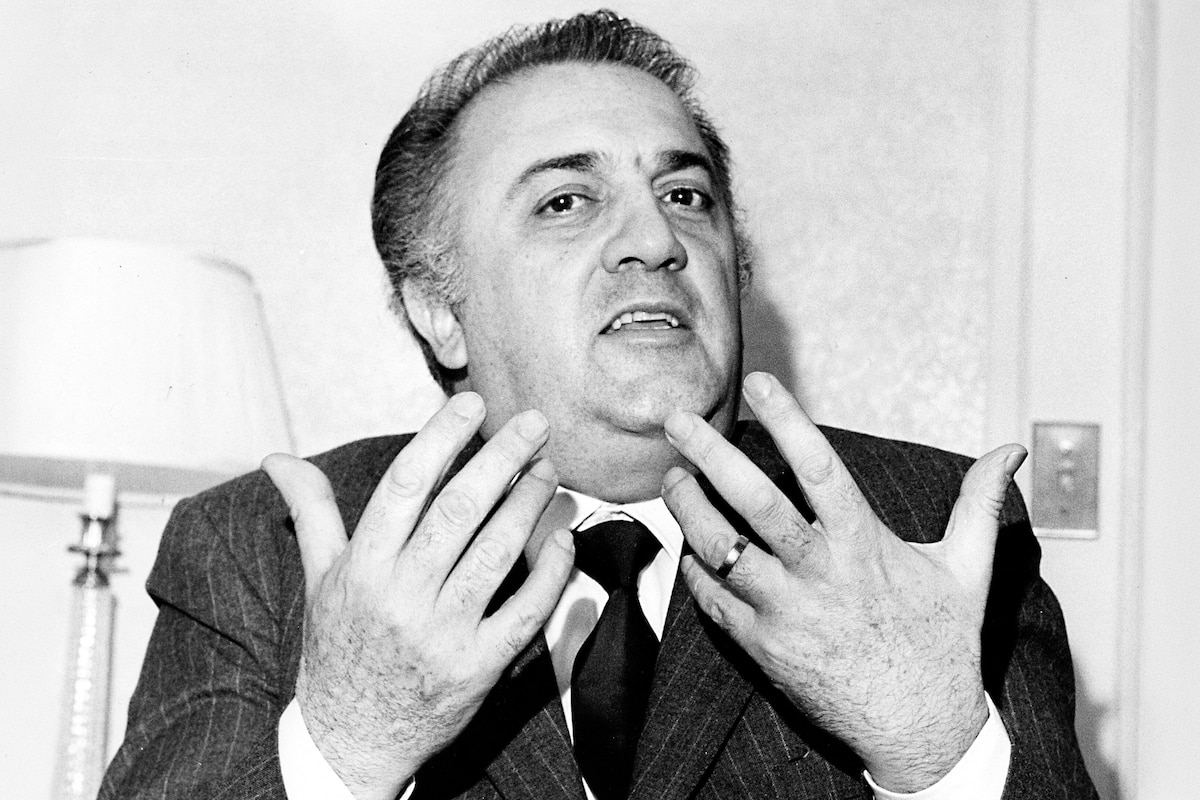
Often called the most influential director of the 20th century, Italian filmmaker Federico Fellini was a master of the surreal, using striking images, autobiographical detail and disjointed narratives to create poetic films that impressed audiences across the world. As an emerging figure of the Italian Neorealism movement, Fellini started as a screenwriter before making his feature debut with the bittersweet Variety Lights (1950). In a few short years, he directed his first masterpiece, La Strada (1954), a tragically poignant tale that earned him international acclaim and award recognition. Following a pair of lesser works, Fellini reached the height of his talents and popularity with La Dolce Vita (1960), a wild, satirical look at decadent Italian life that raised the ire of those it parodied while earning the adulation of critics, filmmakers and art house filmgoers.
Fellini hit a third master stroke with the highly personal 8 1/2 (1963), a seamless blend of artifice and autobiography that put on full display the extent of his profound artistry. But as time passed and his films became more surreal, Fellini was tagged as being self-indulgent and saw his stature diminish. He had one final brush with greatness in directing Amarcord (1974), his most accessible film, before struggling for the rest of his career to find financial backing for his movies. Despite slipping into mediocrity later in life, Fellini nonetheless remained a filmmaking giant whose influence crossed generations all over the world.
Born on January 20, 1920, in Rimini, Italy, a resort city on the Adriatic Sea, Fellini was raised by his father, Urbano, a baker who became a coffee and specialty groceries salesman, and his mother, Ida, who came from a prominent family that disapproved of her marriage. While being educated at religious boarding schools as a child, Fellini developed a love for drawing and staging puppet shows, while also becoming fascinated with the circuses and vaudeville performers his town attracted. Meanwhile, his Catholic education profoundly affected his later work, which—while critical of the church—was infused with strong spiritual dimensions. When he was older, Fellini was forced into mandatory conscription with the Avanguardista Giovanile Fascista, a Fascist youth organization headed by Benito Mussolini. After writing for the satirical magazine Il 420 in Florence and also working as a proofreader, Fellini went to Rome, where he worked on the newspaper Il Popolo di Roma. In 1938, with war looming on the horizon, Fellini enrolled at the University of Rome Law School but did not attend classes. Instead, he used his student status to avoid conscription while selling stories and cartoons to the weekly magazine Marc Aurelio.
It was at Marc Aurelio that Fellini finally found success after years of struggling and almost plunging into poverty thanks to his regular column “Will You Listen to What I Have to Say?” The column allowed him to interact with several film writers, which eventually opened the doors for him to the cinema. During this time, Fellini also began trying his hand at writing screenplays, which led to working on his first film Lo vedi com sei!... Lo vedi come sei? (1939), as well as gag writing for a traveling vaudeville troupe. After making his radio debut as a gag writer for on-air comedian Macario in 1940, Fellini worked as an uncredited screenwriter on Documento Z 3 (1941). The following year, he met future wife, Giulietta Masina, in the studio office of a public radio station, where he landed a job to avoid being drafted into the War. The couple married in 1943; Fellini later called Giulietta the single greatest influence on his work. Hiding out in an aunt's home until Mussolini's fall in July 1943, Fellini opened the Funny Face Shop, where he survived drawing caricatures of American G.I.s after the fall of Rome in June 1944.
After the war was over in Italy, Fellini landed was invited to collaborate on the script of Rome, Open City (1945), director Roberto Rossellini's seminal work of the Italian Neorealism movement. Written and shot when the Nazis still occupied Rome, the film was an act of bravery among the filmmakers, as well as one of the first postwar European films to find an American audience. This landmark film was hailed by critics as a masterpiece of Italian cinema and earned Fellini an Academy Award nomination for Best Screenplay. As a member of the Neorealist movement, Fellini penned a number of films during the mid-to-late-1940s, working with Rossellini again on Paisà (1946), another widely hailed war film that earned him another Oscar nomination for Best Screenplay. In 1948, Rossellini directed L'Amore, one part of which was based on Fellini's original story “Il Miracolo (The Miracle)” about a peasant woman (Anna Magnani) who thinks that the tramp (Fellini) who has impregnated her is St. Joseph and that she is about to give birth to Christ. Meanwhile, he embarked on a fruitful collaboration with director Alberto Lattuada, writing both Il mulino del Po (The Mill on the Po, 1949) and Senza pieta (Without Pity, 1950).
Having worked as an assistant director on a number of the films he wrote, Fellini made the natural transition to directing on Variety Lights, a bittersweet drama that details the intrigues of a misfit group of travelling entertainers. He went on to direct The White Sheik (1952), a comedy about a woman's affair with a comic strip hero, and I Vitelloni (1953), a comedy-drama about the aimless lives of a group of young men. Though Fellini's earliest films were clearly in the neorealist tradition, from the start his interest in and sympathy for characters' eccentricities and his penchant for absurdist, sometimes clownish humor, made them distinctive from the work of his contemporaries. His international breakthrough came with La Strada, one of the most memorable and moving films of world cinema. Tragically poignant, it’s the story of an innocent, simple young woman (Giulietta Masina) who is sold by her family to a brutish strongman in a traveling circus. Because he infused his film with his touch of the surreal, Fellini was accused by purists of violating the precepts of Neorealism. Ultimately, La Strada was a poetic and expressive parable that became Fellini's first unquestioned masterpiece, earning him an Academy Award nomination for Best Original Screenplay and winning the Oscar for Best Foreign Language Film during the category's first year in competition.
After two very strong but less important works—Il Bidone (The Swindlers, 1955) and Nights of Cabiria (1956), with the latter winning Best Foreign Language Film at the Academy Awards—Fellini directed his two most influential masterworks: La Dolce Vita and 8 1/2. La Dolce Vita was a three-hour, panoramic view of contemporary Italian society as seen from the perspective of a journalist, played by Fellini's alter ego, Marcello Mastroianni. A savage, if subtle, satire which exposes his perception of the worthless hedonism of Italian society, La Dolce Vita provides a wealth of unforgettable images: from its opening to its signature scene of bosomy Anita Ekberg bathing in the Trevi Fountain. The film was an international hit that was condemned by both the Catholic Church for its casual depiction of suicide and sexual themes and by the Italian government for its scathing criticism of Italy. Ultimately, La Dolce Vita was the greatest and most important film to emerge from Europe in the 1960s and earned Fellini an Academy Award nomination for Best Director and his third Oscar for Best Foreign Language Film.
Celebrated as a brilliant social critic, Fellini found himself under careful scrutiny by the international community, which anxiously awaited his next film. But like any long-suffering artist, he suffered from a bout of writer's block, which he transformed into his most personal work, 8 1/2. The film was a brilliant gamble, as Fellini took his uncertainty about what film to make next and ended up creating one about an internationally acclaimed director who does not know what film to make next, thus confronting his personal confusion head-on. Once again, Mastroianni played the director's alter ego, and again Fellini was Oscar-nominated as Best Director. Even the name of the film itself came directly from his own experiences. Having directed six features, co-directed another (counting as one-half) and heading episodes of two anthology films, each also counting as a half, Fellini realized he had made 7 1/2 films and hence chose the title 8 1/2 for his most reflexive film. For the first time, surreal dream imagery clearly dominated, with no clear demarcation between fantasy and reality in this groundbreaking and exceptionally influential film.
Fellini's next film, Juliet of the Spirits (1965), was his first in color. Starring Masina, whose career was at a low ebb and with whom Fellini had been having personal problems, Juliet applied the methods of his previous two films to examine the psyche of a troubled upper-class housewife. For the first time, the voices of those critics who attacked Fellini for self-indulgence were louder than those who praised him for his perceptive vision. Fellini's next film, Fellini Satyricon (1969), which was loosely based on extant parts of Gaius Petronius' “Satyricon,” was the most phantasmagorical of all Fellini's works and followed the bawdy adventures of bisexual characters in the pre-Christian world. Fragmentary and at times incomprehensible, the dream-like Satyricon was best described by the director himself as a science fiction of the past. The film polarized critics, with some declaring that Fellini's self-indulgence had run amuck, while others praised it as a new kind of non-linear cinema. Still, it earned Fellini his second Oscar nomination for Best Director.
Fellini's work since Satyricon was seen by many as less focused and more inconsistent. Retreating from the excess of Satyricon, he directed a set of more modest films that possessed striking imagery while diminishing the distinctions between fiction and documentary. With The Clowns (1970), Fellini dealt with his life-long love of circuses, while Roma (1972) centered on his love-hate relationship with the Eternal City. Meanwhile, the critically potent but little-seen Orchestra Rehearsal (1978), his most overtly political work, portrayed the orchestra as a metaphor for discordant Italian politics. Perhaps his most acclaimed post-Satyricon film was Amarcord (1974), an accessible work which can be seen as a summation to that point of his autobiographical impulse. Lovingly remembering Fellini's Rimini boyhood and peppered with offbeat humor, Amarcord earned Fellini his third and final Best Director nomination at the Academy Awards.
Though Amarcord was his fourth film to win an Oscar for Best Foreign Language Film, Fellini found it increasingly difficult to find financial backing and distributors for his films in the 1980s. The downturn in his critical reputation and the inaccessibility of several key films led many to dismiss them as either unimportant or as further signs of his alleged self-indulgence. City of Women (1980) contained a number of striking images but unfortunately failed to overcome its muddled take on men's conflicting feelings toward women. He fared better with his next effort, And the Ship Sails On (1983), which showed that his flair for flamboyant characterization had not lost its comic or satiric prowess. Set on a luxury liner in 1914, the film focuses on a group of aristocrats, politicians, singers and even a rhinoceros bound for a remote island to scatter the ashes of a famed opera singer. He next directed Ginger and Fred (1985), which was heavily criticized upon its release and was the last to get a full arthouse run in the United States, though it did contain its share of touching and amusing moments featuring longtime collaborators Masina and Mastroianni.
With Intervista (1987), Fellini carried the reflective outlook of his later years around full circle. A fitting companion piece to 8 1/2 and a revisitation with Mastroianni and Anita Ekberg of La Dolce Vita, Fellini again directly confronted his own position and status as a filmmaker, this time with a sadder, more wistful nostalgia. His last completed film, Voice of the Moon (1990), was considered by some critics to be his most surreal. Like Intervista, it was a small film chock-full of references and last-minute thoughts, altogether alternately strange and sad. Voice of the Moon turned out to be an appropriate postscript to a film career filled with laughter and wonder at the bizarre circus of life. Critics at the time were harsh, however, with many panning it at the 1990 Cannes Film Festival. After sitting down with Canadian filmmaker Damian Pettigrew for a series of long interviews, that were later shown in the documentary Fellini: I'm a Born Liar (2002), Fellini received an Honorary Oscar in 1992, presented to him by Sophia Loren and Marcello Mastroianni. The following year, Fellini suffered a series of health problems, including two strokes that ultimately ended his life on October 31, 1993. He was 73 years old.
(Edited: August 2026 by Quatoyiah Murray)