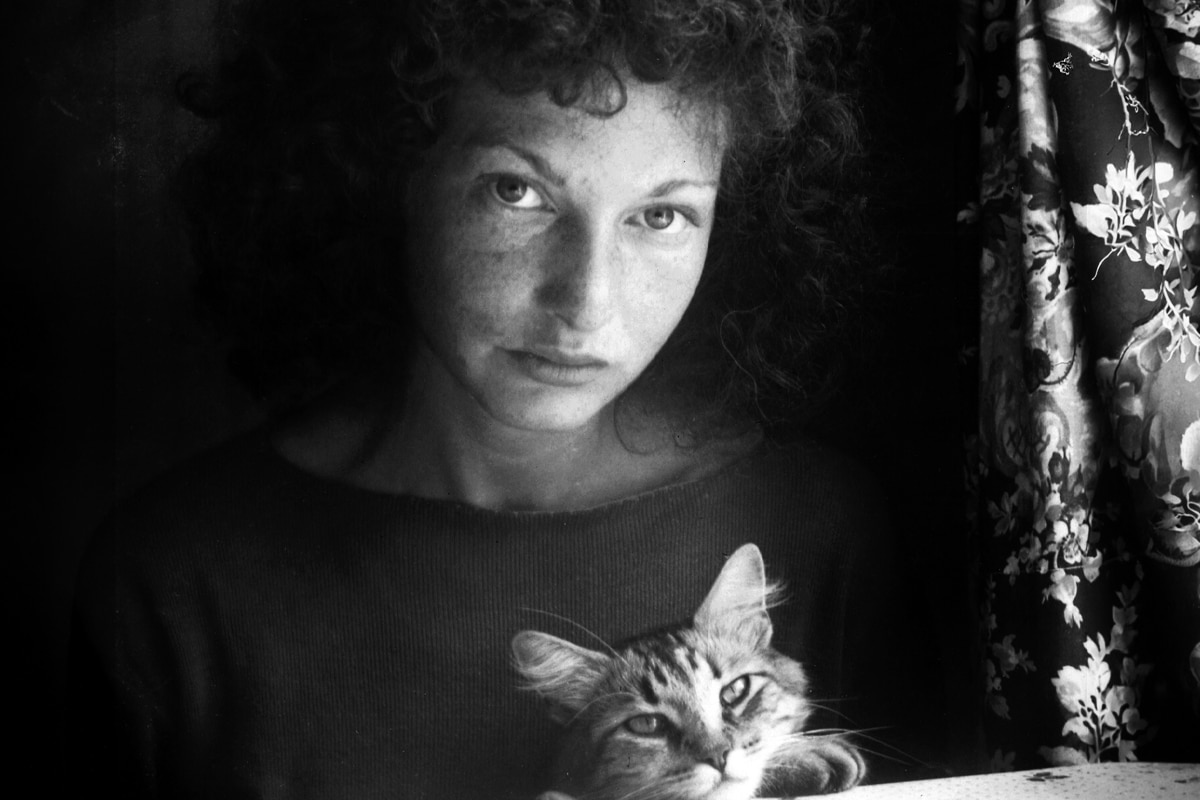
Although she only completed six films in her short lifetime, Maya Deren was dubbed “the mother of American avant-garde filmmaking” and “the mother of underground film.” She proudly worked outside the mainstream, believing that amateur filmmakers could create art with a freedom unavailable to those constrained by studio systems. In her 1947 essay “Planning by Eye: Notes on 'Individual' and 'Industrial' Film,’" she wrote, “I am firmly convinced that a prerequisite of really original and creative work is that a production be scaled modestly enough to ‘afford’ failure.”
Maya Deren was born Eleanora Derenkowsky on April 29, 1917, in Kyiv, Ukraine (then Russia), to artist Marie Fiedler and psychiatrist Solomon David Derenkowsky, and was named after the famous Italian actress Eleanora Duse, but it was a name she always disliked. Years later, Deren asked her second husband, Alexander Hammid, to help find her another name. He discovered the name Maya in a book about mythology, and in 1943, she adopted the name professionally and socially. The Derenkowsky family fled the country in 1922 due to the ongoing persecution of Jews, initially settling in Ohio before relocating to New York, where Solomon enrolled in Syracuse University to get his American degree. In 1928, the family became naturalized American citizens and shortened their name to Deren.
A bright child who wanted to become a writer, Deren was accepted into the League of Nations’ International School in Geneva, Switzerland, which she attended from 1930 to 1933, before studying journalism and political science at Syracuse University. During her brief marriage to a fellow student when she was 18, Deren moved to New York City, became involved in socialist politics and earned a bachelor’s degree from New York University in 1936. After her divorce, Deren received her master’s degree in English literature in 1939 from Smith College in Massachusetts. Following graduation, she worked as an editorial assistant but was interested in modern dance, which led to her taking a job as a secretary for the famed choreographer Katherine Dunham and publishing an essay, “Religious Possession in Dancing,” for the journal Educational Dance. While on tour in 1942 with Dunham’s dance company in Los Angeles, Deren met and fell in love with Hammid, who had been an experimental filmmaker in Czechoslovakia in the 1930s and was then working as a newsreel cameraman for “The March of Time.” Deren left Dunham’s company to stay in Los Angeles, where her mother was living, and married Hammid in 1943.
The couple moved to a house on North Kings Road in Hollywood, where they would film Deren’s most famous work, Meshes of the Afternoon (1943). She wrote, produced, edited and starred in the film, which was shot by Hammid. The film has been called the most important piece of American avant-garde cinema and was more a poetic examination of psychology than a linear story. As Deren wrote in her 1946 book “An Anagram of Ideas on Art, Form and Film,” Meshes of the Afternoon “is concerned with the interior experiences of an individual. It does not record an event which could be witnessed by other persons, but rather it reproduces the way in which the subconscious of an individual will develop, interpret and elaborate an apparently simple and casual incident into a critical emotional experience.”
Deren once told an interviewer that she was “a poet before I was a filmmaker, and I was a very poor poet because I thought in terms of images. […] Poetry was an effort to put [a visual experience] into verbal terms. When I got a camera in my hand, it was like doing what I always wanted to do without the need to translate it into a verbal form.” Meshes of the Afternoon reflected her theory that film was different from the other arts because it could manipulate time and reality to create a new reality and, therefore, shouldn’t rely on literature or theater for its subject. Nor should filmmakers rely on tripods, which limited shots to only positions it could reach. Instead, the camera should be handheld to move more fluidly. In 1990, the film was deemed “culturally, historically or aesthetically significant” by the National Film Registry and selected for preservation by the Library of Congress. BBC Culture named Meshes of the Afternoon the 40th Greatest American Movie in 2015, and Sight and Sound voted it the 16th Greatest Film of All Time in a 2022 poll.
Moving back to New York in 1943, Deren left the world of dance for the world of film, directing and starring in At Land (1944); A Study in Choreography for Camera (1945), with dancer Talley Beatty; and Ritual in Transfigured Time (1946), with Rita Christiani, Frank Westbrook (who also choreographed) and writer Anaïs Nin. Mediation on Violence (1948) was Deren’s first film to have sound, and it was an examination of the movements in Chinese martial arts, performed by renowned Tai Chi instructor Chao Li Chi. Her final completed film, The Very Eye of Night (1955), featured the Metropolitan Opera Ballet School with choreography by Antony Tudor. In addition to these were several projects she never finished, including the 1944 film Witch’s Cradle, starring the artist Marcel Duchamp.
Receiving a Guggenheim Fellowship in 1946, Deren used the money to travel to Haiti, where she spent 18 months filming Haitian dancers. While there, she was fascinated by the Vodou culture, becoming a believer in and practitioner of its rituals. She would author “Divine Horsemen: The Living Gods of Haiti” in 1953, an ethnographic study that was highly regarded, but never completed the film she planned to make from the 18,000 ft shot from 1947-1954. Composer Teiji Itô, Deren’s third husband until her death, and his wife, Cherel, compiled the footage into the 1993 documentary Divine Horsemen: The Living Gods of Haiti.
When not working on films, Deren was a lecturer and essayist on the subject of independent filmmaking. Along with famed mythological scholar Joseph Campbell, she founded the Creative Film Foundation, supporting independent filmmakers. Deren knew firsthand the difficulties in being an independent filmmaker who had to distribute her films herself, which involved traveling around the United States, Cuba and Canada, where she showed the films and lectured to audiences. She once observed that it “would be so much easier to be a painter or a writer, you don’t have this equipment, you don’t have to do all the things, you’re not at the mercy of the laboratories, you’re not here and you’re not there. It’s a terrible pain to be a filmmaker because you not only have the creative problems, but you have financial problems that they don’t have. You have technical problems that they don’t have, you have machines that are breaking down in a way that paint brushes don’t break down. It’s just a terrible thing to be a filmmaker, and if you’re a filmmaker, it’s because there’s something in the sheer medium that seems to be able to make some sort of statement that you particularly want to make in which no other medium to you seems capable of making in the same way.”
On October 28, 1953, Deren appeared at a symposium at Cinema 16 in New York, called “Poetry and the Film,” with Dylan Thomas, Arthur Miller, Parker Tyler and moderated by filmmaker Willard Maas, who called Deren the person, “more than anyone else [… ] responsible for the renaissance of the experimental film movement in the United States. [T]he person who makes us realize that we don’t have to look to Hollywood, we don’t have to look to anywhere to make films if we’re interested in them.” That night, Deren said, “Poetry is an approach to experience, in the sense that a poet is looking at the same experience that a dramatist may be looking. It comes out differently because they’re looking at it from a different point of view, and they are concerned with different elements in it. Poetry is concerned, in a sense, not with what is occurring, but with what it feels like or what it means. A poem, to my mind, creates visible or auditory forms for something that is invisible, which is the feeling or the emotion or the metaphysical content of a moment.”
Maya Deren died unexpectedly of a brain hemorrhage in New York on October 13, 1961, at the age of 44.
(Edited: August 2026 by Quatoyiah Murray)