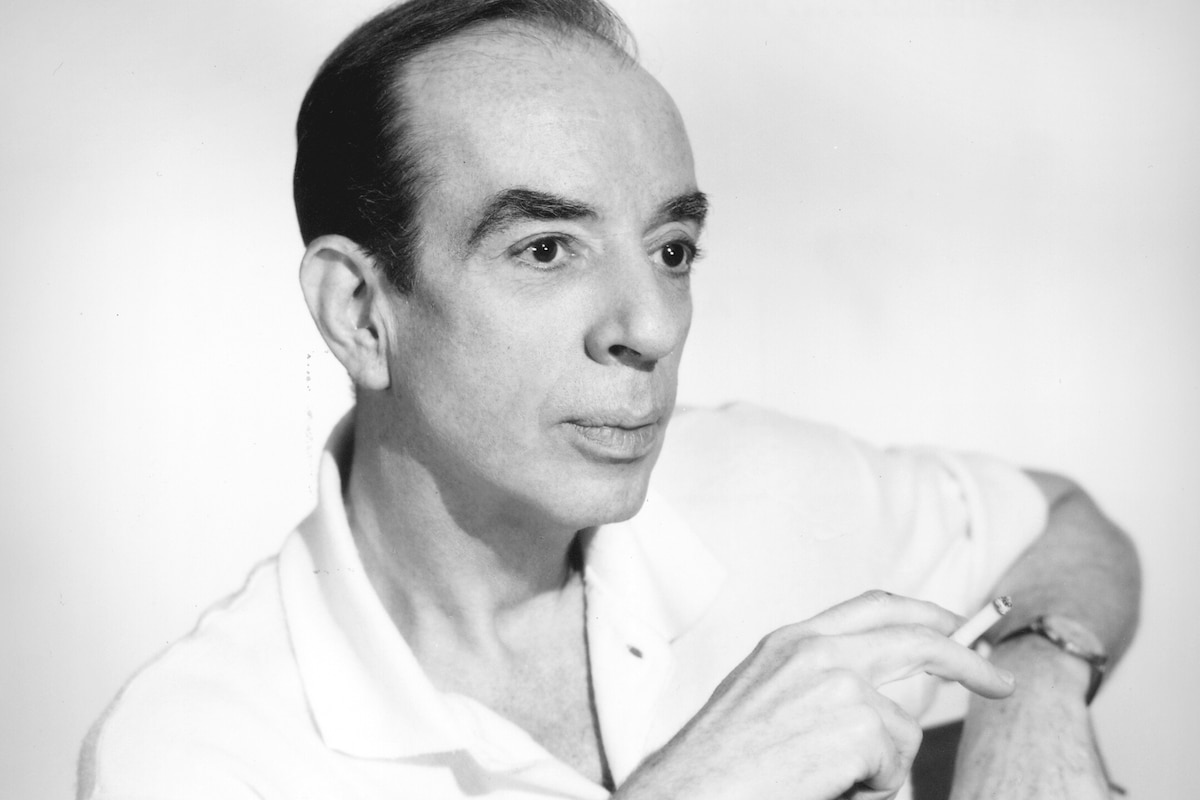
Vincente Minnelli looked through the camera lens with a painter's eye. Although the director is usually associated with the musical as John Ford is with Westerns and Hitchcock with suspense, Minnelli actually worked in many genres, constantly seeking to expose truth behind facades. He directed some of the most celebrated works in cinema history, including Meet Me in St. Louis (1944), Father of the Bride (1950), An American in Paris (1951), The Bad and the Beautiful (1952), The Band Wagon (1953), Lust for Life (1956) and Gigi (1958). Nevertheless, serious commentary on his work has, until recently, been sparse, partly because of the glossy nature of his films. Minnelli was born into a theatrical family on February 28, 1903, in Chicago, Illinois. His parents and his uncle operated a tent show that toured the Midwest. As a young man he became a costume and set designer for the Balaban and Katz theater chain in Chicago, and in 1931, he moved to New York, where he worked for Radio City Music Hall, eventually graduating in 1935 and directing Broadway musicals.
After a brief, abortive stay as a producer at Paramount in the late 1930s, Minnelli was brought permanently to Hollywood by producer Arthur Freed in 1940, who was assembling his own unit at MGM. Under Freed's sponsorship, Minnelli directed his first film, the all-Black musical Cabin in the Sky (1943). It had been a hit on Broadway, but MGM recruited only one member of the original cast to star in the screen version: Ethel Waters. Eddie Anderson and Lena Horne joined Waters on the sound stage for the story of "Little Joe," an Everyman who's tempted by God and the Devil in the afterlife to stay true to his loving wife Petunia (Waters) back on Earth or fall for the seductive enticements of Sweet Georgia Brown (Lena Horne). There was trouble on the set from the very beginning. Waters felt threatened by Horne—and the fact that Minnelli had recently begun dating Horne only made the Broadway star more temperamental.
As Minnelli's first film, Cabin in the Sky is far rougher than the rich style that became his screen signature, but the picture transformed the backstage musical formula of the 1930s for a new kind of musical, leaving behind economic and political realities to plunge fully into a world of fantasy. He followed up with I Dood It (1943), starring Red Skelton and Eleanor Powell and featuring Horne, Hazel Scott, and Jimmy Dorsey and his Orchestra. Minnelli soon after fell in love with the star of his next picture, Meet Me in St. Louis (1944), Judy Garland. They married in 1945 and had a child the very next year, Liza Minnelli. Meet Me in St. Louis, with its lush Technicolor cinematography and unforgettable musical numbers, was the beginning of Minnelli's peak years at MGM, with Garland’s renditions of "The Trolley Song" and "Have Yourself a Merry Little Christmas" becoming instant classics. Minnelli followed this with The Clock (1945), a charming romance about a soldier (Robert Walker) on a two-day leave in New York City where he meets and falls in love with an office worker (Garland). That same year, Minnelli directed the pseudo-Broadway revue all-star film Ziegfeld’s Follies (1945)—starring William Powell, Fred Astaire and Lucielle Ball— and Yolanda and the Thief (1945), with Astaire playing a con artist who convinces Lucille Bremer that he is her guardian angel, a great cover for his scheme to loot her wealthy South American mansion.
Garland plays another South American sweetheart whose dream world is shattered by a harsher reality in The Pirate (1948). Garland plays Manuela, whose arranged marriage to Don Pedro Vargas (Walter Slezak) is imminent. She dreams of true love, of being whisked away by an enchanting buccaneer, Macoco “Mack the Black.” A traveling troubadour (Gene Kelly) hears her longing and masquerades as the pirate. Minnelli followed the film with the romantic drama Madame Bovary (1949), in which Jennifer Jones plays the ill-fated heroine of Gustave Flaubert's moralistic fable. The film is often celebrated for its period-rich detail and an unforgettable ball sequence. Minnelli then kicked off the 1950s with the box-office smash hit and critically acclaimed Father of the Bride (1950), starring Spencer Tracy and Joan Bennett as the parents of a soon-to-be-wed Elizabeth Taylor. The film was so successful that MGM rushed its 1951 sequel, Father’s Little Dividend.
By the 1950s, Minnelli's reputation as a great visual stylist and innovator was confirmed with An American in Paris (1951). With Kelly in the lead and Leslie Caron as the object of his affection, An American in Paris won over audiences and became the first musical to win a Best Picture Academy Award since the dawn of sound with The Broadway Melody (1929), and the film earned Minnelli his first Best Director nod. The Band Wagon (1953) was another career highpoint, with Minnelli directing Fred Astaire, Cyd Charisse and Oscar Levant in a backstage musical that features a classic score by Howard Dietz and Arthur Schwartz and the famous 'Girl Hunt' ballet, a parody of Mickey Spillane's pulp fictions. Exotic settings gave a dream-like feel to Minnelli's fantasy-based musicals. Brigadoon (1954) brought Kelly to a mythical Scottish village. Kismet (1955) transported viewers to ancient Baghdad. Gigi (1958) brought Minnelli and his crew back to the city of Paris. Once again Caron starred as a young ingenue, this time being groomed as a great courtesan. Shortly after Gigi took home 10 Academy Awards, including Best Director for Minnelli, the U.S. government broke up the major studios' monopoly of production exhibition and distribution, putting an end to the studio system that Minnelli been a part of.
Throughout the 1950s, Minnelli directed several other dramas which were just as artfully composed and designed as his MGM musicals. In The Bad and the Beautiful (1952), Kirk Douglas plays a manipulative, ruthless movie producer, based on a composite of several real-life Hollywood characters. Harkening back to his days as a costume and set designer, it was no accident that he directed The Cobweb (1955), which involves neurotic tensions that begin to break out in a psychiatric clinic when new drapes are selected for the common room. Minnelli ventured out into the cinematic countryside of France with Lust for Life (1956), which focuses on the tormented life of Vincent Van Gogh. Kirk Douglas impersonated the artist with uncanny realism, and Minnelli's Technicolor landscapes perfectly captured the fields of sunflowers and starry nights that Van Gogh memorialized. Minnelli went on to direct the adaptation of Robert Anderson’s stage production of the same name Tea and Sympathy (1956), starring John Kerr as a young, sensitive boy bullied relentlessly for his perceived homosexual nature by his peers in an all-boys prep school. Deborah Kerr also stars as the wife of the boy’s headmaster (Leif Erickson). He followed that film with the charming comedy Designing Woman (1957) starring Lauren Bacall and Gregory Peck.
As MGM struggled financially, Minnelli’s career slowed down in the 1960s with the director helming only five films for the studio that decade: Home from the Hill (1960), Bells Are Ringing (1960), The Four Horsemen of the Apocalypse (1962), Two Weeks in Another Town (1962), The Courtship of Eddie’s Father (1963) and The Sandpiper (1965), his final film for MGM. Minnelli had already made Goodbye Charlie for 20th Century-Fox, and by 1970, he made his final two films: On a Clear Day You Can See Forever (1970) for Paramount Pictures and A Matter of Time (1976) for American International Pictures. In the latter film, Douglas plays a Hollywood star at the end of his career who is offered a part by a once-famous director (Edward G. Robinson). In contrast to his opulent musicals where he created magical moments amid artificial environments, Minnelli was also a master at exposing the deceit and deception behind the scenes in his moody melodramas.
Minnelli's career represents the zenith of the Dream Factory. His films illustrated what the studio system was able to achieve: a synthesis of great stories, big stars, beautiful sets and stunning cinematography. After the movie realism of the 1960s and '70s, looking back on the films of Vincente Minnelli is a reminder that great art could be achieved within MGM's studio system. Minnelli had kept files on different styles of painting that he liked to run through for inspiration. He particularly admired the surrealists and was among the first Hollywood directors to appropriate their motifs. He loved flamboyant color, costume, and decor, but he never allowed those elements to freeze into static compositions. A master of changing patterns and complex movements, he filled his pictures with swooping crane shots, swirling patterns of fabric and light, with a skillful orchestration of background detail. Minnelli died on July 25, 1986, from emphysema and pneumonia.
(Edited: August 2026 by Quatoyiah Murray)