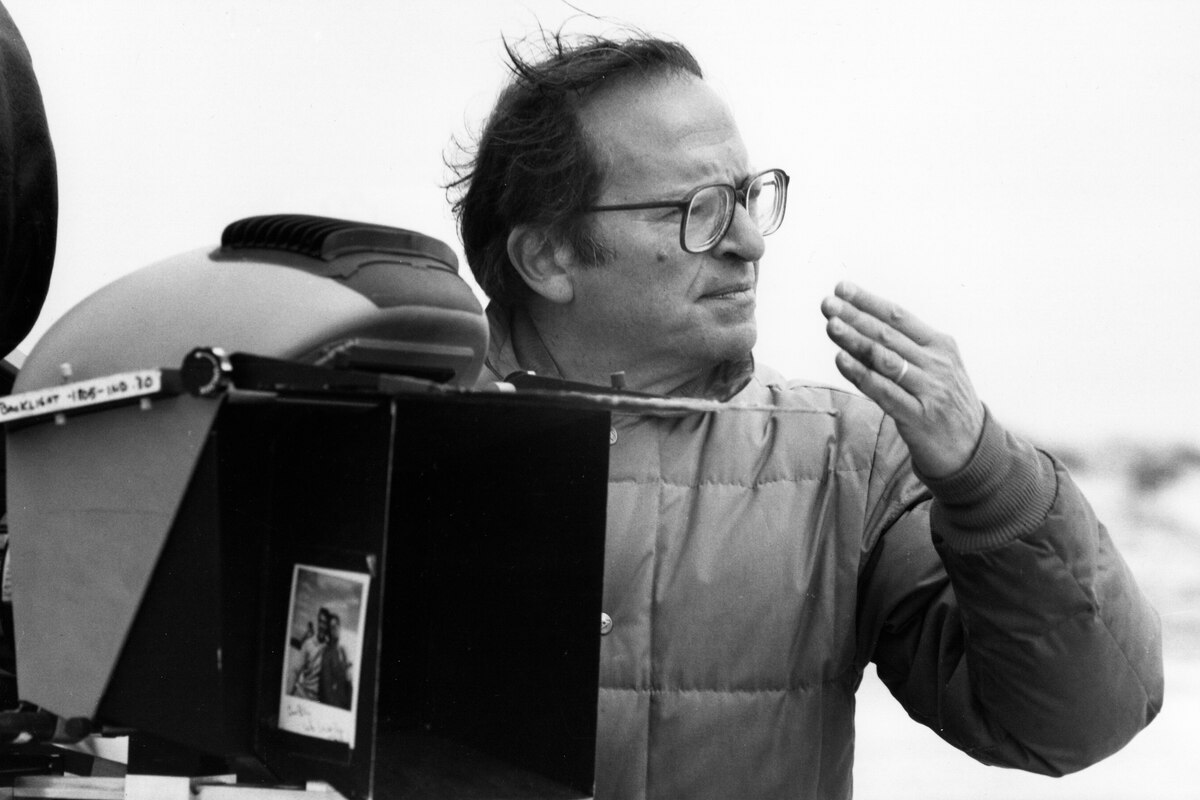
A consummate workaholic who directed vibrant films well into his 80s, Sidney Lumet laid claim to being one of the most revered and most imitated directors of all time. Films like Twelve Angry Men (1957), Dog Day Afternoon (1975), Network (1976) and The Verdict (1982) were more than just classics, they became cultural fixtures that transcended generational demands. Because of his strong direction of actors, vigorous storytelling and use of the camera to accent themes, Lumet produced a body of work that could only be defined as extraordinary. By refusing to “go Hollywood,” he instead became known for the city of his youth, New York, the place where he filmed a majority of his movies. In fact, Lumet's use of the city became more than just location—he turned New York into a character just as vital and alive as Frank Serpico, Howard Beale or Sonny Wortzik. But it was the social realism which permeated his greatest works that truly defined Lumet. The themes of youthful idealism beaten down by corruption and the hopelessness of inept social institutions allowed Lumet to produce several trenchant and potent films that no other director could have made.
Born on June 25, 1924, in Philadelphia, PA, Lumet was raised in an entertainment family in New York, NY. His mother and father were both veterans of the Yiddish stage. Starting off as an actor, Lumet made his debut on radio at age four, then a year later began appearing onstage at the Yiddish Art Theater on the Lower East Side in Manhattan. For two years during the Great Depression, he performed in “The Rabbi from Brownville,” a serial on Yiddish radio written and directed by his father and starring both parents in multiple roles. As he grew older, Lumet continued to act, making his Broadway debut in 1935 as part of the original Dead End Boys production, “Dead End,” playing a part written especially for him by family friend Sidney Kingsley. He next appeared in Max Reinhardt's 1937 production of “The Eternal Road,” a massive spectacle depicting the Jewish story of the Old Testament. His performance led to other Broadway productions, including roles in “One Third of a Nation (1939),” which was later adapted into a film, and Maxwell Anderson's “Journey to Jerusalem” (1940).
As World War II raged across the globe in 1942, Lumet volunteered to join the Army at 17, becoming a radar repairman for the Signal Corps and serving in China, Burma and India. After his service, Lumet—whose skills with radar and fascination with physics led to a brief stint teaching at the Philco Corp. radar labs in Philadelphia—returned to his true passion: the stage. He became involved in The Actors Studio, then formed his own theater workshop, eventually stepping off the stage to direct. Lumet landed a job at CBS as the assistant to friend and then-director, Yul Brynner, later getting a promotion to staff director, which led to him directing hundreds of episodes of “Danger” (CBS, 1950-55), “I Remember Mama” (CBS, 1948-1957) and “You Are There” (CBS, 1953-57). In 1953, Lumet began directing original plays for Playhouse 90, Kraft Television Theatre and Studio One, filming around 200 and establishing himself as one of the most prolific and respected directors in the business. Because of the high turnover inherent in television, Lumet quickly developed a lightning-quick method for shooting that later carried over to his film career.
Despite a bustling television career, Lumet managed to direct theater in-between television gigs, staging productions of George Bernard Shaw's “The Doctor's Dilemma” in 1955 and Arch Oboler's “Night of the Auk” in 1956. Thanks to the triumph of the motion picture Marty (1955), originally an hour-long television special, Lumet was to find his own extraordinary success adapting small screen material for his first feature, 12 Angry Men (1957). After producer and star Henry Fonda saw Lumet teaching an acting workshop in New York, he knew he had his director. Made in just 19 days for $343,000, 12 Angry Men captivated viewers with its gripping tale about a lone dissenting juror (Fonda) slowly turning a seemingly open-and-shut murder case into a long, hot debate on the meaning of “beyond a reasonable doubt.” Lumet used the tight quarters of the juror room to his advantage, shooting with longer lenses and from different eye levels as the movie progressed, adding tension and a growing sense of claustrophobia among the jurors. The film earned three Academy Award nominations, including a Best Director nod for Lumet.
Though Lumet broke into film with critical acclaim, he spent the next few years toiling on mediocre fare that nonetheless starred the biggest stars of the day. He again directed Henry Fonda, this time in Stage Struck (1958), a remake of the Katharine Hepburn triumph, Morning Glory (1933). After directing Sophia Loren in That Kind of Woman (1959), Lumet drew a finely nuanced performance out of Marlon Brando in The Fugitive Kind (1960), based on the Tennessee Williams play “Orpheus Descending.” Lumet continued his early penchant for adapting classic plays for both film and television, directing a live television version of “The Iceman Cometh,” Eugene O'Neill's grim tale of a happy-go-lucky drunk (Jason Robarbs) dealing with his newfound sobriety, and A View From the Bridge (1962), a big-screen telling of Arthur Miller's psychological drama about a working-class Italian-American family coping with two illegal immigrants who have come to live in their Brooklyn home
Lumet returned to film with O'Neill's Long Day's Journey into Night (1962), starring Hepburn in a bravura performance that resulted in one of her many Oscar nominations. Though limited by location—the play took place entirely in one room—Lumet nonetheless helmed a taut and emotionally gripping film that was voted one of the year's “Ten Best Films” by The New York Times. Lumet's reputation for bringing extraordinary performances from his actors reached a high-water mark with The Pawnbroker (1965), a stark and surprisingly stylized drama about Holocaust survivor Sol Nazerman (Rod Steiger), who is paralyzed by guilt for being the only member of his family to escape the Nazis. The Pawnbroker marked one of the rare instances that Lumet utilized a more noticeable and vibrant cinematic style, incorporating French New Wave techniques and a subliminal editing style that allowed the audience to journey into Nazerman's subconscious and witness the horrors he experienced in the concentration camps. For his efforts, Lumet earned a nomination at the British Academy Film Award for the now-defunct United Nations Award, which celebrated the best film embodying one or more of the principles of the United Nations Charter.
After directing The Hill (1965), a powerful drama of wretched life in a British military prison that stars Sean Connery, Lumet entered a middling phase of his prominent career, directing such films as The Group (1966) and The Deadly Affair (1967). He returned to theatrical material with his take on Anton Chekhov's The Sea Gull (1968), then took a further step back directing The Appointment (1969), a romantic melodrama about a young lawyer (Omar Sharif) who marries a young woman (Anouk Aimee) accused of being a high-class call girl. Lumet showed signs of breaking out of his creative doldrums with The Anderson Tapes (1971), a high-tech thriller that reunited him with Connery, who plays a career criminal just released from prison being used by law enforcement to ensnare several mafiosos. Lumet promptly followed with stage plays adaptations, Child's Play (1972) and The Offense (1973), and a sojourn into documentary with King: A Filmed Record Montgomery to Memphis (1970), a compilation of Martin Luther King Jr. and the Civil Rights movement that earned Lumet critical praise.
Just when his career had seemingly hit its nadir, Lumet managed to resurrect himself with Serpico (1973), the first of four seminal films he made in the 1970s that staked his claim for being one of the greatest filmmakers of his generation. The story of power and betrayal in the New York City police force, Lumet hit upon a theme that later coursed throughout many of his films to follow—how the flaws of the criminal justice system have a negative impact on the democracy it supposedly serves. Coupled with the idea that innocence is lost in the face of corruption, Serpico laid out a blueprint Lumet returned to again and again, one that took place in a world of amoral cops, lawyers and hoods, with only an idealistic lone wolf battling seemingly impossible odds. Based on Peter Maas's best-selling biography, Serpico stars Al Pacino as a rookie policeman who refuses to take extortion money from fellow cops, causing his youthful idealism to erode in the face of a stifling, hypocritical bureaucracy. Lumet drew almost universal praise for adeptly combining gritty action and thought-provoking social commentary in what many consider his finest work.
After momentarily faltering with Lovin' Molly (1974), Lumet scored big again with the star-studded Murder on the Orient Express (1974), a box-office hit romp based on the Agatha Christie novel. One of the most ambitious British production in years, Orient Express boasted a who's-who of accomplished thespians of the day, while giving Lumet a rare lush palette from which to paint this extravagant period piece. Returning to gritty post-noir crime territory, Lumet helmed the second of his truly great films, Dog Day Afternoon (1975), again starring Pacino. Written by Frank Pierson and based on true events involving the disastrous attempt by three criminals to rob a Brooklyn bank in August 1972, Dog Day Afternoon deftly straddled the line between farce and tragedy. In order to maintain realism, Lumet used no artificial light, relying instead on natural fluorescents inside the bank and augmenting light for certain dark scenes just enough to get exposure. Meanwhile, Dog Day Afternoon boasted outstanding performances from John Cazale, Charles Durning, Chris Sarandon and James Broderick. But it was Pacino as the desperate ringleader looking to pay for his lover's sex-change operation who stole the show, earning his second Oscar nomination under Lumet's direction.
Lumet followed Dog Day Afternoon with the brilliant satire on television Network (1976), his greatest commercial success. Scripted by legend Paddy Chayefsky, Network chronicles the story of fading anchorman Howard Beale (Peter Finch) and his sudden messianic rise in the ratings after he gets mad as hell and becomes a modern-day prophet angrily denouncing the hypocrisies of our time. At the same time hysterical, preachy and just plain bizarre, Network also makes a compelling statement about the often-ludicrous nature of our entertainment. Outrageous as it was on the surface, however, the story possessed more than just a kernel of truth, and on a certain level was eerily plausible, predicting many of the coming changes in television. Fueled by strong performances from a stellar cast that also featured William Holden, Ned Beatty, Faye Dunaway and Beatrice Straight, Network earned 10 Oscar nominations, including one for Lumet's direction, and went on to win four statutes for Finch, Dunaway, Straight and Chayefsky.
Though Lumet went on to a long, busy career, he never again achieved the artistic and commercial heights he achieved with Network. His next film, the screen version of Peter Shaffer's play Equus (1977), is generally admired, particularly for Richard Burton's portrayal of a psychiatrist trying to understand why a young man (Peter Firth) has been mutilating horses. But Lumet's box-office success post-Network bottomed out with The Wiz (1978). A rehashing of The Wizard of Oz with an all African-American cast, which includes Diana Ross, Michael Jackson, Richard Pryor and Nipsey Russell, The Wiz was universally panned, with some critics accusing Lumet of stereotyping Black culture with his G-rated allusions to gangs, drug addicts and shady politicians. Though the film has earned a strong cult status, the amalgam of R&B musical and social commentary proved to be his most ill-advised and financially disastrous movie to date. Lesser directors would have lost their careers over such a stinker, but Lumet was able to weather the storm.
After Just Tell Me What You Want (1980) failed to generate much enthusiasm, despite a fine performance by Alan King, Lumet was back in familiar territory with Prince of the City (1981). Another story of power and betrayal among NYC cops–a natural successor to Serpic –the film was inspired by the true story of a Manhattan detective (Treat Williams) whose undercover work with the Knapp Commission led to 52 indictments of fellow officers and two suicides. To emphasize the cop's increasing sense of alienation, Lumet divided his movie into thirds, keeping the background behind in the first third extremely busy. As the movie progresses, there are fewer and fewer people in the background until the last third when there is no one, highlighting the cop's increasing isolation; in the end, he is all alone sleeping in the bed he made for himself. A rewarding experience for Lumet and considered by some to be a culmination of his previous work, the film was ultimately doomed by its ambition, with a nearly three-hour running time and too many characters to keep track of, Prince of the City was considered tedious by some.
Lumet scaled down for his next film, The Verdict (1982), a taut courtroom drama written by David Mamet and buoyed by one of Paul Newman's best screen performances. The story of an alcoholic lawyer (Newman) seeking redemption by taking on a difficult malpractice case, The Verdict earned Lumet a fourth nomination without a win at the Academy Awards. His next project, Daniel (1983), loosely based on the lives of Julius and Ethel Rosenberg (fictionalized as the Isaacsons), follows the attempts of their children to come to terms with their appalling family legacy. Though some critics bristled at Lumet's bleeding-heart presentation of the condemned couple, most agreed that Daniel was a provocative and extremely well-made film despite its flaws. After three subpar films–Garbo Talks (1984), Power (1986) and The Morning After (1986)–Lumet returned to form with Running on Empty (1988), a quiet and believable tale of 1960s radicals on the run, featuring superb performances from Judd Hirsch, Christine Lahti and River Phoenix.
Lumet returned to the police milieu for Q&A (1990), picking up his first solo writing credit in his adaptation of Edward Torres's novel. He inhabited similar terrain, though less successfully, with A Stranger Among Us (1992), in which he cast Melanie Griffith as a New York cop living among Brooklyn's Hasidic community to uncover a murderer. Harkening back to his days as an acting teacher, Lumet published “Making Movies,” a virtual how-to of making films masked in a personal memoir. Back on the big screen, he provided better fare with Night Falls on Manhattan (1997), again scripted by Lumet, which seemed to pick up where Prince of the City left off, depicting the ethical compromises of middle-aged cops who inherently are decent people. He continued addressing ethical concerns, this time in the medical profession, with Critical Care (1997), a rather inconsequential addition to the Lumet canon.
If The Wiz was Lumet's biggest box-office flop, his remake of John Cassavetes's Gloria (1999) may well have been his most universally derided movie. With Sharon Stone assuming Gena Rowland's Oscar-winning turn as an aging gun moll who becomes the reluctant guardian of a young boy hiding from the mob, critics pounded on Lumet for his clumsy handling of a previously well-regarded film. He did, however, make a jump back to series television as the director and executive producer of “100 Centre Street “(A&E, 2000-02), a short-lived drama that told the stories of prosecutors, judges, defense attorneys and accused criminals in a New York City night court.
After directing Strip Search (HBO, 2004), a compelling look at how crime and punishment changed since September 11th, Lumet won an honorary Academy Award in 2004 for a lifetime of achievement in motion pictures. He returned to the big screen with Find Me Guilty (2006), an amusing, but flawed courtroom drama based on real events about a mafioso (Vin Diesel) serving a 30-year sentence who refuses to testify against the Lucchese and instead decides to represent himself in what became the longest and most controversial criminal trial in U.S. history. Meanwhile, Lumet once again defied the critics and returned to top-notch form with Before the Devil Knows You're Dead (2007), a kinetic, time-bending crime noir about two brothers (Philip Seymour Hoffman and Ethan Hawke) who plan to rob their parent's jewelry store, only to have the seemingly perfect crime go awry and forever damage their family. Hailed as one of his best films since Prince of the City, Lumet was again the recipient of high praise from critics who had previously written off his career. It was his final film before he passed away from lymphoma at the age of 86 on April 9, 2011.
(Edited: August 2026 by Quatoyiah Murray)