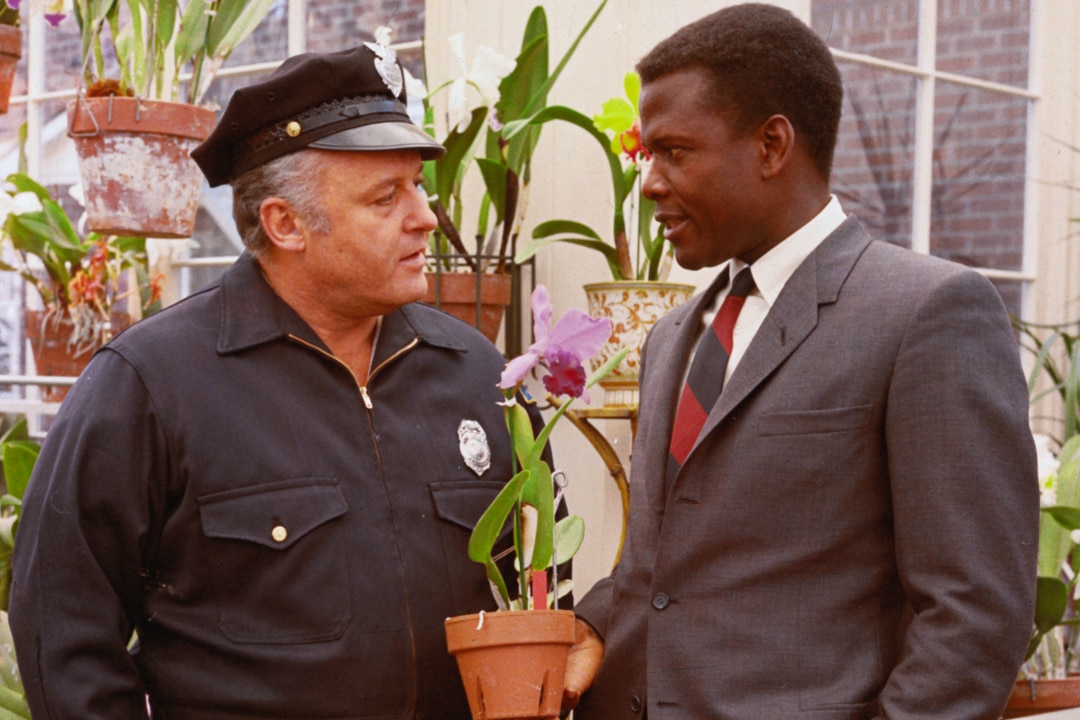
The greenhouse was added to the Dyersberg, TN, house used for Endicott's home for the production. It cost $15,000 to fill it with orchids.
It only took two takes to get the slapping scene. Director Norman Jewison insisted that Larry Gates slap him first to make sure he would slap hard enough. Jewison didn't want Poitier to hold anything back when slapping Gates, only warning him not to hit him on the ear. For his part, Gates encouraged Poitier to hit him as hard as he wanted.
When Poitier told Jewison of almost being killed by Klansmen in Mississippi, he mentioned the night he was driving on a country road when a car pulled up behind him and started running into his bumper. Jewison had Silliphant add a similar scene to the film.
Illinois locals hired as extras were paid $1.50 a day.
Poitier and Silliphant disagree over whether Tibbs's slapping Endicott was in the shooting script. Silliphant insists it was, but Poitier states that he had it added during shooting and made Jewison guarantee it would stay in the final print. According to Mark Harris, who wrote about the film in his “Pictures at a Revolution,” the slaps were always in the screenplay.
Lee Grant's ex-husband, writer Albert Manoff, had died a year before her work on the film, so shooting scenes as the murder victim's grieving widow was a very emotional experience for her. She always credited Poitier with helping her get through those moments.
To get an appropriately gritty effect as dogs chase Scott Wilson's character through the woods, cinematographer Haskell Wexler knelt on a specially constructed wooden platform as crew members ran alongside Wilson. Occasionally, tree branches and other foliage slapped into Wexler as he shot.
At the end of one chase scene, Wexler used a rapid zoom in, which created a grainy, documentary-style effect. The rapid zoom would become a mainstay of '70s filmmaking.
Jewison and Wexler chose amber sunglasses for Steiger because they felt the color was the most threatening. They also made his eyes more visible than darker lenses might have.
For the song Ralph Henshaw dances to, Jewison wanted to use Sam the Sham and The Pharaohs' "Lil' Red Riding Hood," which was played for actor Anthony James when the scene was shot. When United Artists couldn't get the rights to that song, Quincy Jones wrote "Foul Owl on the Prowl," recorded by Boomer & Travis.
FUN QUOTES FROM IN THE HEAT OF THE NIGHT (1967)
"What's a northern boy like you doing all the way down here?" - Rod Steiger, as Chief Gillespie, questioning Sidney Poitier, as Virgil Tibbs. "I got the motive, which is money, and the body, which is dead." - Steiger, as Chief Gillespie. "They call me MISTER Tibbs!" - Poitier, as Virgil Tibbs, delivering the film's most famous lines. "I do want to thank you for offering such a powerful piece of manpower as Virgil Tibbs." - Steiger, as Gillespie, on the phone with Poitier's boss. "I came by to make it as clear as I possibly can: that I do not want the Negro officer taken off this case...If it wasn't for him, your impartial chief of police would still have the wrong man behind bars. I want that officer given a free hand, otherwise I will pack up my husband's engineers and leave you to yourselves." - Lee Grant, as Mrs. Colbert
"Just once in my life, I'm gonna own my temper. I'm telling you that you're gonna stay here. You're gonna stay here if I have to go inside and call your chief of police and have him remind you of what he told you to do. But I don't think I have to do that, you see? No, because you're so damn smart. You're smarter than any white man. You're just gonna stay here and show us all. You've got such a big head that you could never live with yourself unless you could put us all to shame. You wanna know something, Virgil? I don't think that you could let an opportunity like that pass by." - Steiger
"What you doin' here, man?"
"Policeman."
"You're a policeman here in Sparta."
"They've got a murder they don't know what to do with. They need a whipping boy."
"You got a roof." "No, I'll find a motel." "(Taking his suitcase Viola...We got company." - Khalil Bezaleel, as Jess, welcoming Poitier to town
"Got no more smile than a turnip." - Scott Wilson, as Harvey Oberst, describing Steiger
"Now listen, hear me, good mama. Please. Don't make me have to send you to jail...There's white time in jail and there's colored time in jail. The worst kind of time you can do is colored time." - Poitier, as Tibbs, to Beah Richards, as Mama Caleba
"Last Chief we had...he'd have shot Tibbs one second after he slapped Endicott, claim self-defense." - William Schallert, as Mayor Schubert
"Thirty-seven years old, no wife, no kids...scratching for a living in a town that doesn't want me. Fan, I have to oil for myself...desk with a busted leg...this place. Know something, Virgil? You're the first person who's been around to call. Nobody else has been here...nobody comes." - Steiger, welcoming Poitier to his home
"You take care, y'hear?"
policeman here in Sparta."