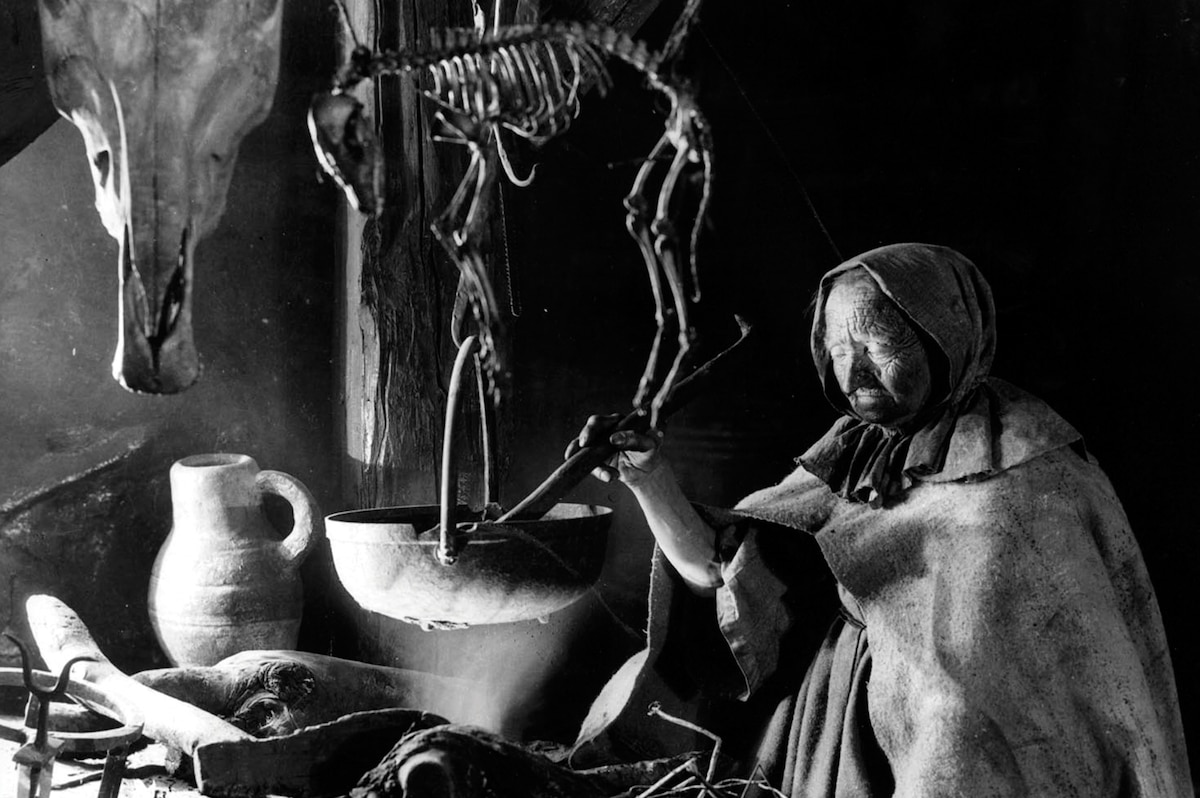
One of the most unconventional films of the silent era, Benjamin Christensen's Häxan (1922) is a semi-documentary examination of witchcraft throughout history and the unearthly, human horrors that permeate it. Christensen spent about two years researching and shooting Häxan, at great expense. The quality of production is evident throughout the film, which resembles no other motion picture of its era.
Christensen derived much of Häxan’s historical data from the book “Malleus Maleficarum,” written in 1486 by two Inquisitors of the Dominican Order of the Catholic Church, Heinrich Kramer and Jacob Sprenger. The Latin title translates into English as “The Hammer of Witches.” Even though the book was banned by the Catholic Church in 1490, it was frequently republished and is believed to have been the handbook for the prosecution (and persecution) of suspected witches throughout late-Medieval Europe.
Though financed by a Swedish company (Svensk Filmindustri), Christensen persuaded the producers to allow him to film Häxan in Denmark at a small studio north of Copenhagen, where his previous films were made. Not only did SF allow Christensen to work "off-campus," they paid a hefty sum to bring the studio's facilities up to date, which greatly increased Häxan’s production costs. According to film historian Casper Tybjerg, Haxan was "probably the most expensive film made in any of the Scandinavian countries during the whole silent period."
Even though most scenes were filmed in interior studios, Christensen insisted that Haxan be shot almost entirely at night. He explained, "The film, which examines hysteria, deals with the dark side of human nature. And when the sun was shining during the day, it was not possible to bring out this side in the actors."
One of the most dazzling sequences of the film is one in which a horde of witches fly over a village and through the countryside on their brooms and pitchforks. Christensen claims to have shot approximately 75 individual witches on separate pieces of film, then combined them through an optical printer. An airplane propeller was used to whip up enough of a wind to furl the clothing of the witches (who were actually stationary, against a black background). The village beneath them is a miniature town, built upon a huge turntable. This turntable was rotated, so the "tracking shot" would appear endless. The circular model was so large that it reportedly took 20 men to operate it.
In an early test of this complicated process shot, Christensen was photographed by cinematographer Johan Ankerstjerne, perched on a chair against a black background, gesticulating with his arms. This was superimposed against footage (taken from the side of a moving train) of a landscape speeding past. The test successfully conveyed the sense of a flying person, but it required some modification since the view from the train was so cluttered by electrical poles and telegraph wires that they realized the need to construct the artificial landscape.
For the shots in which the witches are seen against glowing nocturnal clouds, a camera crew was dispatched to Norway, where dramatic skyscapes were more easily found.
Häxan includes several scenes in which a demon sits at a butter churn, maniacally working the handle in an explicitly masturbatory fashion. Christensen was inspired to adopt this image after reading Troels-Lund's “Daily Life in the Nordic Countries in the Sixteenth Century.” According to this 14-volume study, witches were often referred to as "the devil's dairy maids." "That era seemed to find something ambiguous about the mere image of a butter churn. It was therefore a common subject in the wall paintings of both Danish and Swedish churches: the devil getting off with a woman churning butter."
Maria, the weaver (one of the persecuted witches) was played by Maren Pedersen, whom Christensen allegedly discovered while she was selling flowers on a street corner. Pedersen claimed she was the first Red Cross nurse in Denmark. During the shoot, Pedersen reportedly turned to Christensen and said, "The Devil is real. I have seen him sitting at my bedside." Christensen was so struck by this confession of modern demonic activity (or at least the belief in modern demonic activity) that he incorporated this anecdote into the film itself, and even shows the woman's prayer book, its pages instructing the reader on how to recognize the various incarnations in which Satan might appear.
The Swedish film censors required numerous cuts in the film before authorizing its release. Among the censored scenes were the closeup of the finger being removed from the hanged man's hand, the trampling of the cross in the witch's sabbath scene, the shot of the oozing infant held over a cooking pot, a closeup of a woman's face while she is on a torture rack, closeups of several instruments of torture being employed and a shot of a demon embracing a nude woman (all these shots have since been restored to the film).
Christensen intended for Häxan to be the first chapter of a trilogy of films, followed by The Saint and The Spirits, but these projects were never realized. This was partly because of the astronomical cost of Häxan, and also because of Christensen's departure from Europe for the seemingly green pastures of Hollywood. At American studios such as MGM or First National (later Warner Bros.), such didactic, eclectic films were unthinkable.
In 1968, Häxan was modified for contemporary audiences. Experimental filmmaker Antony Balch supervised the creation of a version in which most of the title cards were removed and replaced with narration, drawn mostly from Christensen's original text. William S. Burroughs narrated in his inimitable vocal fashion. Balch and Burroughs had previously collaborated on the short film Towers Open Fire (1963) and The Cut Ups (1966). These modifications, as well as running the film at the standardized projection speed of 24 frames per second, instead of the historically accurate 20 fps, reduced the film's running time from 104 minutes to 75 minutes. Released as Witchcraft Through the Ages, it was through the Balch version that most contemporary viewers—during the cult film movement of the 1970s—came to know Christensen's startlingly unique film.
When Balch oversaw the revamping of Häxan for its 1968 re-release, he commissioned a score by Daniel Humair. This controversial musical accompaniment (that employs avant-garde stylings rather than the traditional themes integrated in the original cue sheet) was performed by Humair, Jean-Luc Ponty, Bernard Lubat, Guy Pederson and Michel Portal.