Sturges started as a writer in Hollywood, primarily at Paramount, where he scripted a number of acclaimed films, including Remember the Night (1940) with Barbara Stanwyck and Fred MacMurray and Easy Living (1937) with Jean Arthur and Ray Milland. Both were directed by Mitchell Leisen. It has been suggested that Sturges' script for The Power and the Glory (1933) inspired some of the structure and themes of Orson Welles' and Herman Mankiewicz's Citizen Kane (1941).
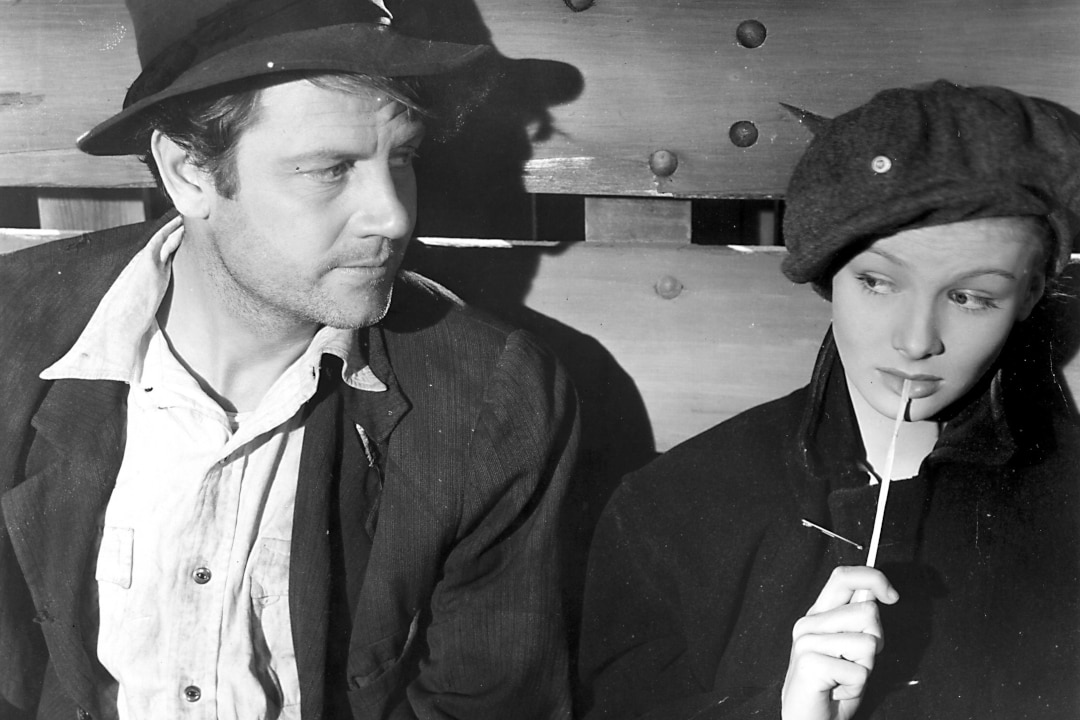
Near the end of Sullivan's Travels, Sturges himself can be glimpsed on camera behind Veronica Lake on the movie set.
Sturges used certain character actors so many times, they came to be known collectively as the "Sturges stock company." The following performers, who are featured in Sullivan's Travels, are listed with the total number of movies that were made with Sturges: Porter Hall (4), Robert Warwick (6), Franklin Pangborn (6), Robert Greig (6), Esther Howard (7), and William Demarest (8). McCrea starred in two other films for Sturges: The Palm Beach Story (1942) and The Great Moment (1944).
Familiar Sturges supporting actor William Demarest is perhaps better known to later-day audiences as Uncle Charlie on the TV sitcom My Three Sons (1960-72). He was nominated for a supporting actor Oscar for his work in The Jolson Story (1946).
Cinematographer John Seitz got his start lensing Shirley Temple movies and some of the films in the MGM "Dr. Kildare" series. He was the director of photography for such notable film noirs as This Gun for Hire (1942), Double Indemnity (1944), and The Big Clock (1948). Perhaps his most famous work can be seen in Sunset Boulevard (1950). He worked with Sturges twice more, Hail the Conquering Hero (1944) and The Miracle of Morgan's Creek (1944).
The assistant director on the film was Anthony Mann, who later went on to direct movies himself, including some memorable crime dramas (Raw Deal (1948), Border Incident, (1949)) and a series of critically respected Westerns with James Stewart in the 1950s (The Naked Spur (1953), The Man From Laramie, 1955).
Sturges' mother, Mary Desti, started her own cosmetics business after splitting from Sturges' father. It was under the auspices of his mother's company that young Preston invented a "kiss-proof" lipstick. Mother and son lived in Paris for a while, where Mary became friends with Isadora Duncan.
Memorable Quotes from SULLIVAN'S TRAVELS
OPENING TITLE: "To the memory of those who made us laugh: the motley mountebanks, the clowns, the buffoons, in all times and in all nations, whose efforts have lightened our burden a little, this picture is affectionately dedicated."
SULLIVAN (Joel McCrea): "I want this picture to be a document. I want to hold a mirror up to life. I want this to be a picture of dignity, a true canvas of the suffering of humanity."
LE BRAND (Robert Warwick): "But with a little sex."
LE BRAND: "Who goes to the Music Hall? Communists!"
SULLIVAN: "What do they know in Pittsburgh?"
HADRIAN (Porter Hall): "They know what they like."
SULLIVAN: "If they knew what they liked, they wouldn't live in Pittsburgh."
BUTLER (Robert Greig): "Rich people and theorists -who are usually rich people -think of poverty in the negative, as the lack of riches -as disease might be called the lack of health. But it isn't, sir. Poverty isn't the lack of anything, but a positive plague, virulent in itself, contagious as cholera, with filth, criminality, vice and despair as only a few of its symptoms. It is to be stayed away from, even for purposes of study. It is to be shunned."
SULLIVAN: "You seem to have made quite a study of it."
BUTLER: "Quite unwillingly, sir."
GIRL: "Oh, that was a wonderful scene. Of course it was stupid, but it was wonderful."
SULLIVAN: "There's always a girl in the picture. Haven't you ever been to the movies?"
GIRL: "You know the nice thing about buying food for a man is that you don't have to laugh at his jokes."
SULLIVAN: "There's a lot to be said for making people laugh. Did you know that's all some people have? It isn't much but it's better than nothing in this cockeyed caravan."