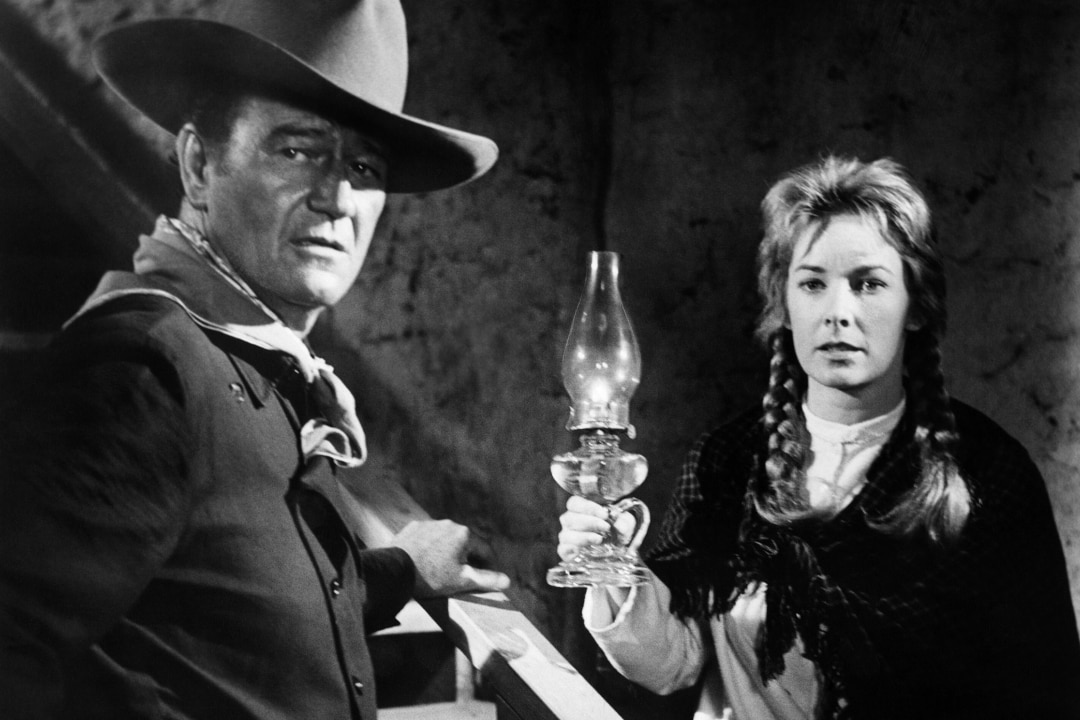
Tom Doniphon refers to Valance as "the toughest man south of the Picketwire...next to me!" The Picketwire is not a fence or dividing wire, as it sounds, but slang for the Purgatoire River, which flows into the Arkansas River in Colorado. This is the only indication in The Man Who Shot Liberty Valance of the specific location of the town of Shinbone. The location, however, could be New Mexico or possibly Oklahoma (south of the river), since the territory in the film has yet to achieve statehood and the flag in the classroom scene has 38 stars, placing it after Colorado's entry into the union.
John Wayne made a total of 21 films with John Ford. It was Wayne's appearance in Stagecoach (1939) that brought him from the ranks of B pictures to true stardom, and he first received credit for his acting in such Ford films as She Wore a Yellow Ribbon (1949) and The Searchers (1956). It's fair to say the actor owed much of his career to his most frequent director, which is one of the reasons Wayne remained respectful of him, even though Ford was often abusive to the actor. After The Man Who Shot Liberty Valance, they worked on two more films together, the Civil War sequence of How the West Was Won(1962) and the comedy-action picture Donovan's Reef (1963).
The Man Who Shot Liberty Valance was James Stewart's second film with John Ford, after Two Rode Together (1961).
Ford also directed Stewart and Wayne in an hour-long Alcoa Premiere teleplay the same year this picture came out, a baseball drama called "Flashing Spikes." Stewart and Wayne appeared together again in Wayne's final film, The Shootist (1976), directed by Don Siegel. They were also both in the cast of How the West Was Won (1962), but in different segments.
Woody Strode (1914-1994) was a star athlete at UCLA before he was discovered by Ford and put in his first role, a bit part in Stagecoach. Strode played a few small parts in the following years, and after the war he became one of the first black athletes to integrate pro football as a member of the Los Angeles Rams. Besides Liberty Valance, he made two other films for Ford, Two Rode Together and the title role in Sergeant Rutledge (1960). He always gave Ford credit for making him an actor and called him "the greatest director I ever worked for."
The Man Who Shot Liberty Valance was the second Ford movie for both Vera Miles (The Searchers) and Jeanette Nolan (Two Rode Together). Miles was the sister of the murdered Janet Leigh in Alfred Hitchcock's Psycho (1960), for which Nolan supplied the voice (uncredited) of Mrs. Bates.
This was Andy Devine's third picture with Ford after Stagecoach and Two Rode Together.
Ford stock company sightings: In addition to stars like John Wayne and Henry Fonda, the director often used many of the same character actors and supporting players in his films. The Man Who Shot Liberty Valance included the following frequent Ford players: John Carradine, John Qualen, Willis Bouchey, Carleton Young, Anna Lee, Woody Strode, O.Z. Whitehead, Denver Pyle, Shug Fisher. Qualen played Vera Miles's father in The Searchers.
Ford also liked to give work to former silent stars, such as Mae Marsh, who had worked with him in his earliest days but were barely remembered by the public. Gertrude Astor was the first actress signed to a contract with Universal. That was 1915. She made dozens of movies before the end of the 1920s, gaining a reputation as one of the most elegant and best-dressed women in the business, but by the mid-’30s, she was mostly doing uncredited bits. She made two silent films with Ford, a 1917 Western and the lead in a 1925 drama. He cast her in a bit part in Three Godfathers (1948) and again in The Man Who Shot Liberty Valance.
In the cast as an uncredited townsman was Danny Borzage, brother of director Frank Borzage and something of a Ford mascot. Borzage had been playing bits in Ford's films since The Iron Horse (1924) and was always on set to play mood music on his accordion for the cast and crew between scenes and sometimes during them.
Scenarist James Warner Bellah was a novelist and short story writer before going into screenwriting at the age of 55 with the John Wayne film, The Sea Chase (1955). Ford's cavalry trilogy–Fort Apache(1948), She Wore a Yellow Ribbon, Rio Grande (1950)–all came from Bellah stories, and Ford's Sergeant Rutledge was taken from a Bellah novel, adapted by Bellah and his Liberty Valance co-writer, Willis Goldbeck.
Cinematographer William Clothier worked in Spain and Mexico before the war and got his first break doing photography (uncredited) on William Wyler's war documentary The Memphis Belle (1944). He followed his work on a minor crime drama, For You I Die (1947), with uncredited work on Ford's Fort Apache. He also shot Ford's Donovan's Reef and a few other John Wayne pictures. He received Academy Award nominations for Wayne's The Alamo (1960) and Ford's Cheyenne Autumn (1964).
The same year she was nominated for her work on The Man Who Shot Liberty Valance, Edith Head also designed costumes for eight other pictures, including Hatari! (1962) starring John Wayne. Her 35 Oscar nominations and eight awards make Head the most honored costume designer and woman in Academy history.
Lee Marvin's widow Pamela said The Man Who Shot Liberty Valance was her "all-time favorite" of all the movies her husband made.
"Jim Stewart and Duke Wayne gave, for me, top-notch performances in a picture ideally suited to them." - cast member Edmond O'Brien
The Man Who Shot Liberty Valance went into general release in April 1962 and received mostly unfavorable reviews. In many cases, it was relegated to the bottom half of a double bill. It took a few decades before critical reassessment turned in its favor, and it is now regarded as one of John Ford's most significant achievements. There has been a bit of a backlash in recent years, however. Some critics and theorists have gone to great pains to make a case in favor of the film, seeing great significance in every shot and even in the names of the characters, leading some writers to say now that Liberty Valance is solid and worthy, but overrated.
Memorable Quotes from THE MAN WHO SHOT LIBERTY VALANCE
HALLIE (Vera Miles): The place has sure changed. Churches, high schools, shops.
LINK APPLEYARD (Andy Devine): Well, the railroad done that. Desert's still the same.
HALLIE: The cactus rose is in blossom.
LINK APPLEYARD: Maybe you'd like to take a ride out desert way and maybe look around.
HALLIE: Maybe.
RANSOM STODDARD (James Stewart): I don't want a gun. I don't want to kill him. I want to put him in jail.
TOM DONIPHON (John Wayne): Out here, a man solves his own problems.
RANSOM STODDARD: You know what you're saying to me? You're as bad as he is! What kind of community have I come to here?
LINK APPLEYARD: The jail's only got one cell, and the lock's broke and I sleep in it.
TOM DONIPHON: Hey, pilgrim! You forgot your pop-gun!
LIBERTY VALANCE (Lee Marvin): You lookin' for trouble, Doniphon?
TOM DONIPHON: You aim to help me find some?
HALLIE: Ranse, do you think I could...I mean, grown up and all...do you think I could learn to read?
RANSOM STODDARD: Why, sure you can, Hallie. Why, there's nothing to it. It'd be...it'd be easy. Can you learn how to read? Why, I can...I can teach you. A smart girl like you? Of course you can learn how to read. Now, do you want to try?
HALLIE: It's awful worrisome not knowing how. I know the Good Book from preacher talk; but it'd be a soul comfort if I could read the words myself.
DUTTON PEABODY (Edmond O'Brien): Liberty Valance... and his myrmidons!
DUTTON PEABODY: Good people of Shinbone; I, I'm your conscience, I'm the small voice that thunders in the night, I'm your watchdog who howls against the wolves, I, I'm your father confessor! I - I'm...what else am I?
TOM DONIPHON: Town drunk?
TOM DONIPHON: You talk too much, think too much. Besides, YOU didn't kill Liberty Valance.
TOM DONIPHON: Cold-blooded murder, but I can live with it. Hallie's happy. She wanted you alive. ... Hallie's your girl now. Go back in there and take that nomination. You taught her how to read and write; now give her something to read and write about!
DUTTON PEABODY: I'll have the usual, Jack.
JACK THE BARMAN (Jack Pennick): The bar is closed, Mister Editor, during voting.
DUTTON PEABODY: Bar's closed?
TOM DONIPHON: You can blame your lawyer friend. He says that's one of the "Fundamental laws of democracy." No exception.
DUTTON PEABODY: No exceptions for the working press? Why, that's carrying democracy much too far!
RANSOM STODDARD: You're not going to use the story, Mr. Scott?
MAXWELL SCOTT (Carleton Young): No, sir. This is the West, sir. When the legend becomes fact, print the legend.
HALLIE: Look at it. Once it was a wilderness. Now it's a garden. Aren't you proud?
RANSOM STODDARD: Hallie, who put the rose on Tom's coffin?
HALLIE: I did.