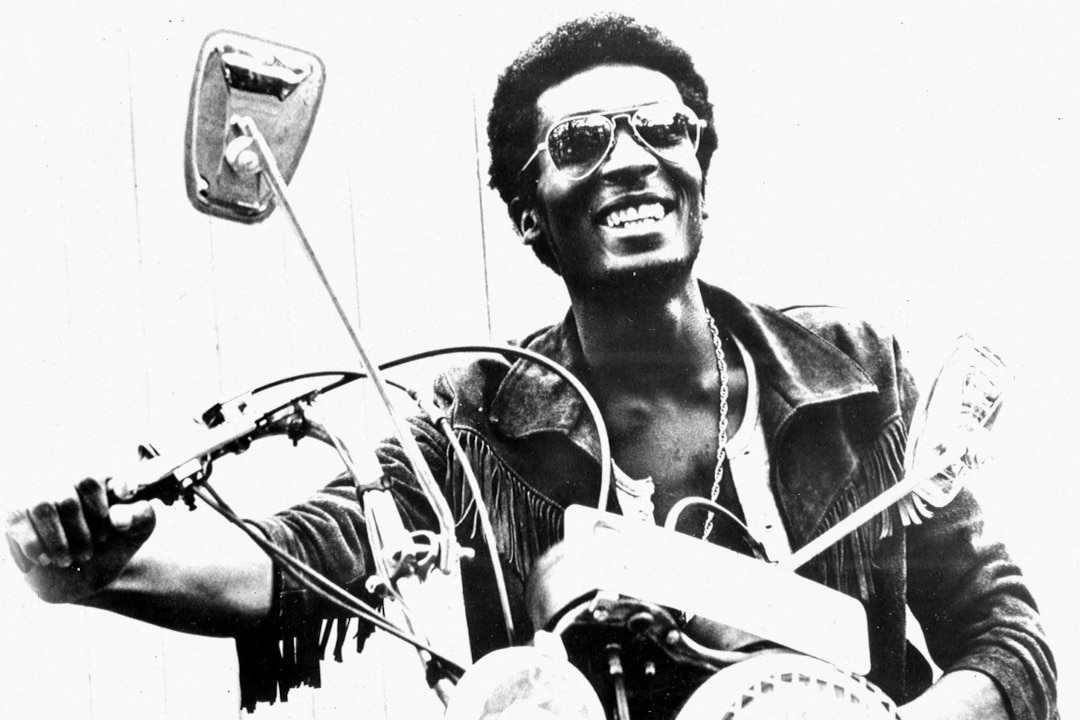
The ultimate irony of The Harder They Come (1973) would not have been lost on its doomed protagonist, Ivanhoe "Ivan" Martin. Based on the real-life 1940s Jamaican criminal, better known as “Rhyging,” the film is a rags-to-not-quite-riches story of a Jamaican country boy who travels to Kingston to become a hit recording artist but winds up a tragic Trenchtown martyr. The picture was a vehicle tailored for singer-songwriter Jimmy Cliff, but the production (Jamaica's first film) made a bigger star out of his countryman Bob Marley, who wasn't even in the movie. Released in 1973, The Harder They Come was a bona fide cult hit, but its soundtrack—which featured upbeat tunes by the Melodians, Toots and the Maytals and Desmond Dekker alongside four songs by Cliff—became an international smash that sold the world on reggae as a growing mainstream staple.
Although Bob Marley was a national hero to Jamaicans in 1973, he had yet to make the international crossover; sales from and interest in the soundtrack to The Harder They Come helped put Bob Marley and The Wailers over the top around the same time that they were signed by Island Records and recorded their breakout album “Catch a Fire.” Although Marley may have been elevated to the rank of No. 1 above him, Jimmy Cliff didn't fare badly at all in the wake of The Harder They Come's release. Cliff toured the world over the next several years, converted to Islam, then unconverted and went on to enjoy considerable success as a recording artist and to act in other movies.
While The Harder They Come marked a major milestone for Jamaican culture, the film (apart from its soundtrack) was a slower sell for the rest of the world. Director Perry Henzell had to stand outside of London tube stops handing out flyers during a bitter English winter to publicize the film's British release; even more reluctant was Italy, where reggae at the time had no substantial following. (Henzell ultimately sold The Harder They Come there in 1979.) In America, Henzell got the film into the Los Angeles Film Festival and personally peddled his canisters from studio to studio with no takers until Roger Corman stepped in with an offer from his New World Films. (A counteroffer came from, of all people, novelist Harold Robbins.) The Harder They Come received an American theatrical release in February 1973, but attracted little attention despite some strong reviews, particularly from “The New York Times.”
The feature caught fire on the college and repertory film circuit that spring and enjoyed record-breaking runs at the Orson Welles Theater in Cambridge, Massachusetts (over seven years) and revival cinemas in New York City and Washington, D.C. Film critic Danny Peary wrote extensively about The Harder They Come in his first volume of “Cult Films” in 1981 and the feature was also discussed at length in the 1983 book “Midnight Movies” by J. Hoberman and Jonathan Rosenbaum. The Harder They Come is referenced in two songs by The Clash. Talks of sequels and remakes went on for years to no avail, but the story was retold as a stage musical in England in 2005 and in a musical adaptation by Suzan-Lori Parks at New York's Public Theater in 2023.
Acquired for American distribution by New World Pictures around the same time as The Harder They Come was the Shaw Brothers film Seven Blows of the Dragon (Shui hu zhuan, 1972). While the two titles may seem at first glance to be unlikely bedmates, "chop sockey" films and spaghetti Westerns were popular fare in the slums of West Kingston, where movie underdogs who rose up against the forces of corruption and oppression with their hands balled into fists or wrapped around the handles of revolvers became heroes on an almost mythic scale. Western critics (among them Roger Ebert) who decried The Harder They Come's second act segue into criminality (seen as a condescension to the violent tropes of "Blaxploitation") seemed ignorant of the realities of slum life and the ganja trade in Jamaica (then and now an exotic tourist drop for the affluent) and blind to the unabashedly honest fatalism of Perry Henzell and writing partner Trevor D. Rhone.
Has any movie rebel ever been more poorly repaid for his services than Ivanhoe Martin, whose "rise" amounts to little more than a joy ride in a stolen Cadillac before he falls under a hail of police bullets (while mouthing off a come-on to the cops that sounds like a pencil sketch for Al Pacino's classic "Say goodnight to the bad man" speech in Brian De Palma's Scarface [1983] remake). The education of Ivanhoe takes him from being unwanted and underutilized by Jamaican society to being a literal wanted man, a commodity as hotly desired as the music from which he hoped to profit and the ganja he resorted to selling. A local hero for as long as the locals could afford him, Ivan is ultimately betrayed, sold out for the price of a measure of normalcy to Trenchtown life by an impoverished populace who can only afford so much revolution.
Producers: Perry Henzell, Chris Blackwell
Director: Perry Henzell
Screenplay: Perry Henzell, Trevor D. Rhone
Cinematography: Peter Jessop, David McDonald, Franklyn St. Juste
Film Editing: Seicland Anderson, John Victor-Smith, Richard White Art Direction: Sally Henzell
Music: Jimmy Cliff, Desmond Dekker, The Slickers
Cast: Jimmy Cliff (Ivanhoe "Ivan" Martin), Janet Bartley (Elsa), Carl Bradshaw (Jose), Ras Daniel Hartman (Pedro), Basil Keane (Preacher), Bob Charlton (Hilton), Winston Stona (Det. Ray Jones), Lucia White (Mother), Volair Johnson (Pushcart Boy), Beverly Anderson (Housewife), Clover Lewis (Market Woman), Elijah Chambers (Longa), Ed "Bim" Lewis (Photographer), Aston "Bam" Winter (Drunk).
C-103m.