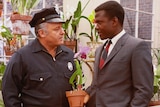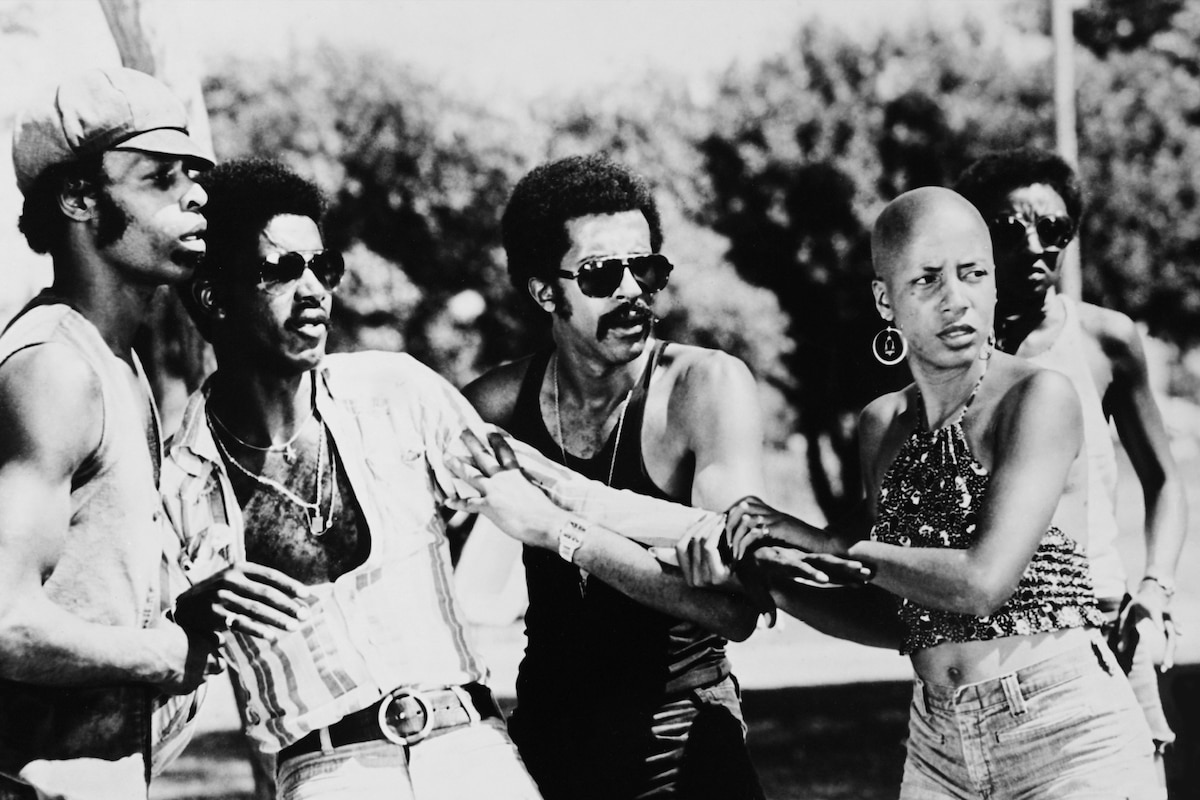
While writer-director Jamaa Fanaka intentionally frustrates any association with Blaxploitation, he courts the forms of that money-grubbing action subgenre for the purposes of his 1976 film Emma Mae, if only to subvert them. As such, the film occupies a lonely middle ground between such well-remembered grindhouse titles as Black Mama, White Mama (1972) and The Mack (1973) and the scattering of Black family dramas to which the big studios condescended in the early to mid-’70s, such as Oscar Williams' Five on the Black Hand Side (1973) and Michael Schultz's Cooley High (1975). The latter was a direct influence on Fanaka while he was a student at UCLA's film program, and Emma Mae, his second feature, reflects a similar interest in depicting the texture of African-American community and family life in all its contrasting and contradictory patterns. Overseas, Emma Mae was given the crass alternative title Black Sister's Revenge but the 1976 production bears only a superficial resemblance to such distaff vengeance films as Coffy (1973) and Foxy Brown (1974), in which Pam Grier's angry women of color strike back at the powers that be evil.
Jamaa Fanaka was born Walter Gordon on September 6, 1942, delivered by a midwife in the bedroom of his parents' Prosperity Street home in Jackson, Mississippi. Fanaka's father was a TV repairman for the Graybar Electric Company, and his family one of the first in the area to own a television set. A turning point in Fanaka's life was the gift of a Super 8 film camera when he was 11 years old. Too poor to afford film, Fanaka developed his cinema aesthetic by looking through the empty camera's viewfinder.
As a child, William Wyler's Ben-Hur (1959) was Fanaka's favorite film, and Wyler remains his favorite director. After serving four years in the United States Air Force, Fanaka returned to his adopted hometown of Compton, California, where he discovered a boyhood friend had become a successful pimp. While contemplating a cash-raising armed robbery, the Compton High grad stumbled into a UCLA outreach center and wound up with a scholarship. Fanaka studied film at UCLA. After a revelatory screening of Schultz's Cooley High (1975), the fledgling filmmaker changed his name to Jamaa Fanaka so that audiences would know he was Black, unlike Schultz who had often found himself in rooms with executives who hired him thinking he was white. In Swahili, "jamaa" means togetherness and "fanaka" means progress.
For his second project at UCLA, Fanaka opted to make a feature film, which became the notorious Welcome Home Brother Charles (1975). One of Fanaka's UCLA Film School classmates was Charles Burnett, who served as Fanaka's cameraman on the shoot of Welcome Home Brother Charles. Jamaa Fanaka has been called "the most famous unknown director in America."
Emma Mae was the second of three films Fanaka made while a student at UCLA and was his master's thesis. The production was financed in part by the American Film Institute. Emma Mae was shot entirely in Compton, California, where Fanaka's family relocated when he was 11. The character of Emma Mae was based on Fanaka's cousin, Daisy Lee, who was sent to Compton from Crystal Springs, Missouri, every year for summer vacations. Jerri Hayes was a theatre student at UCLA when she was cast as Emma Mae.
The park seen in the film's opening title sequence was Compton's West Park. The conga player seen in the opening frames is jazz percussionist Doug Sides. The jailhouse sequence was shot at the long-closed Lincoln Heights Jail.
Emma Mae cinematographer Stephen Posey was later a second unit director on the cult film classics The Howling (1981) and Repo Man (1984). He also shot Friday the 13th: A New Beginning (1985) and became a busy television director. The film's composer, Hidle Brown ("H. B.") Barnum, had a Top 40 hit with "Lost Love" in 1960, but is best known as an arranger for such artists as Count Basie, Frank Sinatra, Etta James, Aretha Franklin and Gladys Knight and the Pips.
Sources:
Jamaa Fanaka interview by Michael Guillen, The Evening Class
Jamaa Fanaka interview by Suzanne Donahue, AssociatedContent.com
Jamaa Fanaka interview by Millie De Chirico
Internet Movie Database