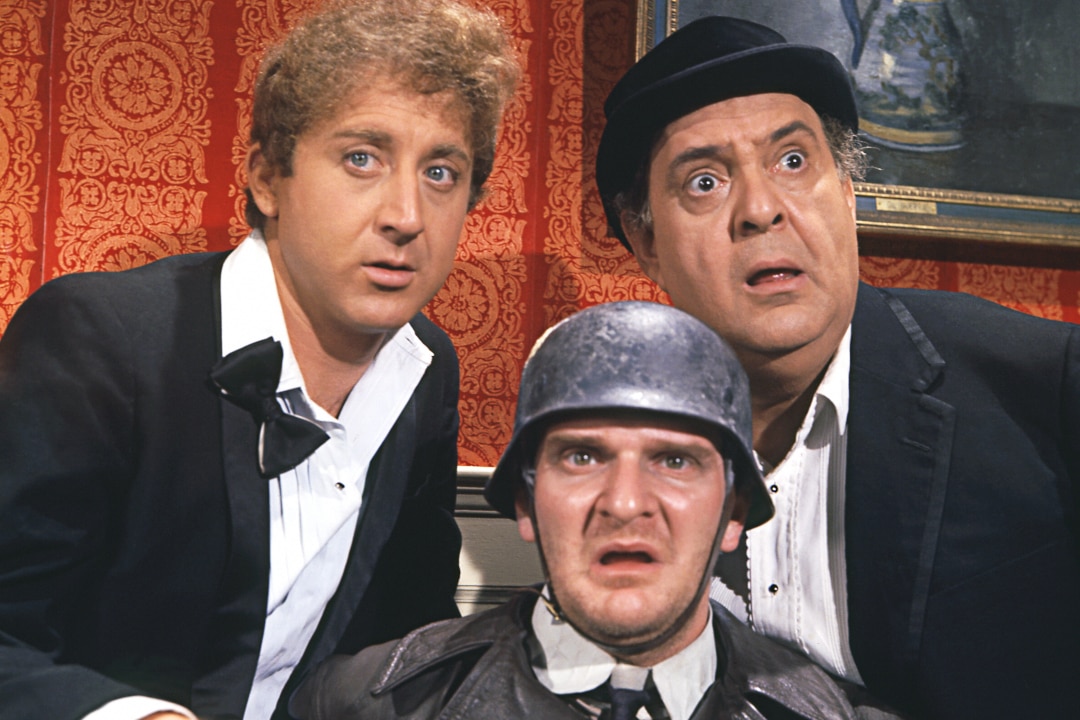
In the role of the outrageous choreographer Roger De Bris, TV fans may recognize actor Christopher Hewett before his long-running success as TV's Mr. Belvedere.
For the Springtime for Hitler number, Mel Brooks dubbed the actor who sings the lyric, "Don't be stupid, be a smarty, come and join the Nazi Party!" with his own voice when he didn't feel that the original line had enough punch. Brooks would later lend his voice for one of Madeline Kahn's outrageous musical numbers in Blazing Saddles (1974).
Mel Brooks learned his stock in live television when he was hired to write gags for Sid Caesar's “Your Show of Shows” in 1950. For over a decade, he served as script doctor for TV, radio, and stage musicals, including the libretto of a real Broadway musical flop, “All American,” which starred Ray Bolger and ran 80 performances in 1962.
Mel Brooks derived the title of the play within the film, “Springtime for Hitler: A Gay Romp with Adolf and Eva in Berchtesgarten,” from a favorite of the summer stock circuit called “Springtime for Henry.” He had used the provocative title as a running gag for many years; when anyone asked him what his next project was, he'd say he was planning a musical called “Springtime for Hitler.” This news, of course, was usually received with shocked expressions, exactly the reaction Brooks wanted.
Mel Brooks had an extremely rare deal for the production of The Producers: a contract that gave a novice director full creative control of the project. Producer Sidney Glazier gave him creative autonomy based on Brooks' brilliant comedic work with Sid Caesar and the legendary audio recording of “The 2,000-Year-Old-Man” that he made with Carl Reiner. Furthermore, Brooks helped his own case by agreeing to direct the picture at one-third his normal fee. Glazier raised $600,000 for the production.
When Mel Brooks accepted his Oscar for the Best Original Screenplay for The Producers at the April 14, 1969, awards ceremony, he quipped, "I'll just say what's in my heart – ba-bump, ba-bump, ba-bump."
The “Springtime for Hitler” sequence was filmed at Broadway's Playhouse Theater (torn down in 1969), whose marquee can be glimpsed momentarily. However, in the scene where the theater blows up, we see the marquee of the Cort Theater, which stood (and still stands) across 48th Street from the Playhouse.
Zero Mostel's early film work mainly consisted of playing the menacing heavy in such films as Panic in the Streets (1950) and The Enforcer (1951). Unfortunately, Mostel's promising film career took a nosedive when allegations put him in front of the House Un-American Activities Committee. Even though Mostel denied ever being a Communist Party member, he was blacklisted from working as a film actor for several years. He returned to the Broadway stage in 1958. In the early 1960s, he scored three successive stage triumphs, winning Tony Awards for his performances in “Rhinoceros,” “A Funny Thing Happened on the Way to the Forum” and “Fiddler on the Roof.” Now a heralded stage phenomenon, Mostel returned to film in 1966, after a 15-year absence, with Richard Lester's adaptation of A Funny Thing Happened on the Way to the Forum (1966). He followed this with the role of Max Bialystock in The Producers.
Brooks described to Gene Wilder the character of Leo Bloom as "a neurotic bud that blossoms into a neurotic flower, a shy guy who carries around a piece of blue baby blanket with him for security." He continued to reassure Wilder that he wouldn't have to act, because Brooks was careful to hire only the actors "who are just right for the parts." Concerned, Wilder asked Bancroft, "Does he really think I'm like that?" She replied, "Just go along with him."
The drunk in the theater bar is played by William Hickey, a familiar character actor who was nominated in 1985 for Best Supporting Actor for his work in John Huston's Prizzi's Honor. He also lent his unique, high-pitched voice for the mad scientist in Tim Burton's The Nightmare Before Christmas. (1993).
The Producers was banned in Germany during its initial release due to its negative portrayal of Germans.
Actor Kenneth Mars, who portrayed “Springtime for Hitler” author Franz Liebkind, took his costume home every night and slept in it, thinking it would help him channel the character.
Zero Mostel had it written into his contract that he didn't have to work past 5:30 PM due to a leg injury he had suffered in a bus accident.
For the pivotal scene in which Max finally convinces Leo to help him with his scheme, Mel Brooks was originally going to shoot it on the parachute jump ride at Coney Island. When he discovered that the ride was out of order, awaiting repair, Brooks decided instead to shoot the scene at the fountain in Lincoln Center.
The actor who played Carmen Ghia, Andreas Voutsinas, was a friend of Anne Bancroft (Mel Brooks' girlfriend at the time) at the Actors Studio. He received the following direction from Brooks on how to portray his character: "I want you to look like Rasputin and behave like Marilyn Monroe.''
For the scene in which Leo goes crazy when his blue blanket is taken away, Gene Wilder did a sense memory, imagining that it was his beloved dog Julie that was being taken from him.
Max Bialystock is named after the Polish city of Białystok.
Franz Liebkind's last name means literally "love child'' in German.
During his search for "the worst play ever written," Max reads from one of the submissions a description of a man waking up one morning to find himself transformed into a giant cockroach. Max rejects the story, on the grounds that it is "too good." In actuality, it is the opening sentence to Franz Kafka's classic short story, “The Metamorphosis.”
Carmen Ghia is named after the Volkswagen car, the Karmann Ghia.
TV star Bill Macy can be glimpsed in the courtroom scene as the jury foreman, who proclaims Bialystock and Bloom "incredibly guilty." Macy later became a television fixture as Bea Arthur's husband on the sitcom “Maude” (1972-1978). He also appeared in a number of films for Mel Brooks' good friend and colleague, Carl Reiner.
Famous Quotes from THE PRODUCERS
"Bialystock and Bloom, I presume! Heh heh, forgive the pun!"
"What pun?"
"Shut up, he thinks he's witty." – Roger De Bris (Christopher Hewett), Leo Bloom (Gene Wilder), and Max Bialystock (Zero Mostel)
"Not many people know it, but the Führer was a terrific dancer." – Franz Liebkind (Kenneth Mars)
"That's exactly why we want to produce this play. To show the world the true Hitler, the Hitler you loved, the Hitler you knew, the Hitler with a song in his heart." – Max to Franz Liebkind
"Actors are not animals! They're human beings!"
"They are? Have you ever eaten with one?" – Leo and Max
"Hitler...there was a painter! He could paint an entire apartment in one afternoon! Two coats!" – Franz Liebkind
"You have exactly ten seconds to change that look of disgusting pity into one of enormous respect." – Max to Leo.
"I'm condemned by a society that demands success when all I can offer is failure." – Max Bialystock
"I'm hysterical! I'm having hysterics. I'm hysterical. I can't stop when I get like this. I can't stop!" – Leo Bloom
"I'm in pain and I'm wet and I'm still hysterical! No, no, no don't hit, don't hit. It doesn't help. It only increases my sense of danger." – Leo Bloom to Max
"Will the dancing Hitlers please wait in the wings? We are only seeing singing Hitlers." – Roger De Bris
"I don't know about tonight. I'm supposed to be the Grand Duchess Anastasia, but I think I look more like Tugboat Annie." – Roger De Bris
"How could this happen? I was so careful. I picked the wrong play, the wrong director, the wrong cast. Where did I go right?" – Max Bialystock
"He who hesitates is poor!" – Max to Leo
"I want everything I've ever seen in the movies!" – Leo Bloom
MEL BROOKS QUOTES TO REMEMBER:
"There's not enough bad taste! I LOVE bad taste! I live for bad taste! I am the spokesman for bad taste!" - Films Illustrated, January 1982
"Vulgarity is in the hand of the beholder." - Films Illustrated, January 1982
"Comedy is serious–-deadly serious. Never, never try to be funny! The actors must be serious. Only the situation must be absurd." - Playboy, December 1974
"One day, God said 'Let there be prey.' And he created pigeons, rabbits, lambs and Gene Wilder." - Newsweek, February 17, 1975