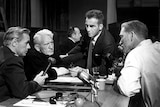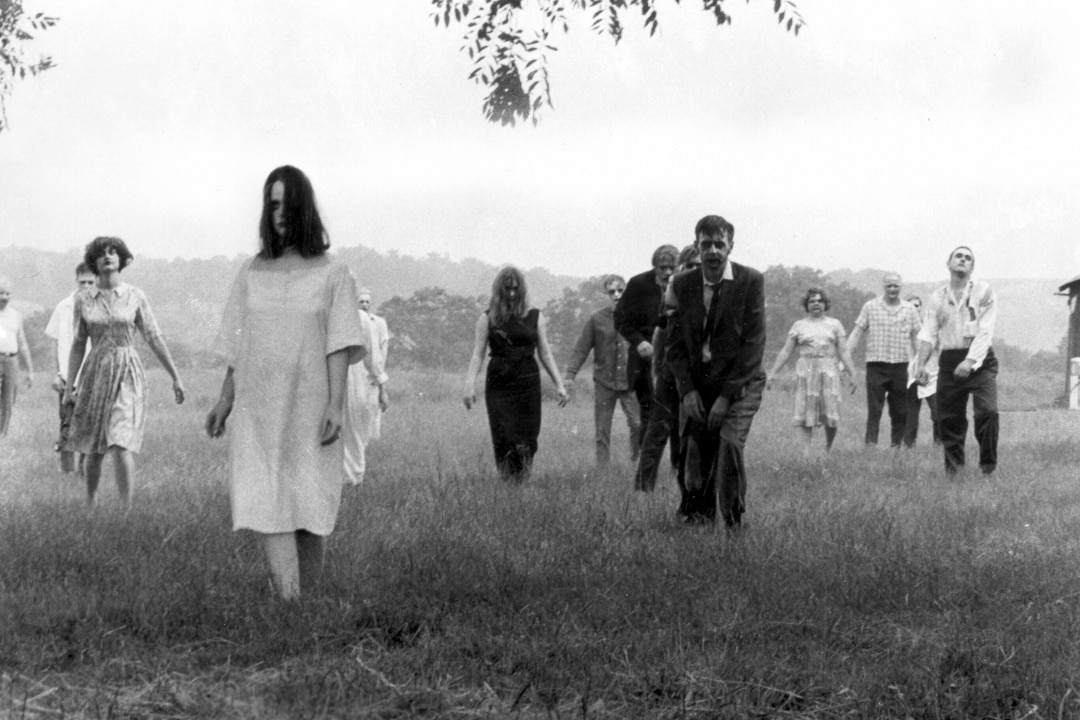
Forty years on, it is difficult to appreciate just how completely George Romero's taboo-shattering Night of the Living Dead (1968) sucker punched a nation weaned on bloodless Universal monster rallies and the Eastmancolor gloss of Great Britain's Hammer horrors. With only $60,000 in seed money, Romero turned the limitations of his cash-starved production into a cultural phenomenon that would quickly become a genre-defining chapter in film history. While cost-saving (and continuity-sparing) black-and-white cinematography gives the film the queasy urgency of newsreel footage, what puts Night of the Living Dead over the top as a genre milestone is the fearlessness of its nihilistic vision.
At its inception and throughout principal photography, Night of the Living Dead was referred to by cast and crew as Monster Flick. Romero originally offered direction on the film to Karl Hardman, an investor and supplier of the film's throbbing electronic sound effects track. Instead, Hardman served as a producer, still photographer and uncredited makeup artist, while playing the principal role of antagonist Harry Cooper.
Karl Hardman's real-life 9-year-old daughter, Kyra Schon, was cast as Harry and Marilyn Cooper's onscreen daughter Karen, a role written for a young boy. Although the casting of Black actor Duane Jones as the film's resourceful protagonist marked a horror movie milestone, Romero always maintained that Jones was chosen primarily on the strength of his acting. Lead actress Judith O'Dea was pursuing an acting career in Hollywood when she was asked to return to her hometown of Pittsburgh to audition for the female lead in Night of the Living Dead.
Shooting commenced in Evans City, an area of rural Pennsylvania, 40 miles north of Pittsburgh. For $300 a month, the filmmakers rented an old farmhouse that was later bulldozed to make room for a sod farm. The mud-floor basement of the farmhouse location was deemed unsuitable for filming, and a more accommodating cellar set was constructed at the Pittsburgh office building where Latent Image was headquartered.
Co-scenarist John A. Russo recalled, "We shot that picture in 30 days and they were real back-breaking days. Twenty-hour days. Some of us slept at the house where we were shooting. There wasn't running water. We had to carry water from a spring...Even to flush the toilets....We all built props. We made dummies that had to take gunshots." Russo plays the first of the living dead to enter the farmhouse, for which he receives a tire iron in the forehead from hero Duane Jones as Ben.
The film's first scene, the initial cemetery attack on Barbara and Johnny, was the last filmed in November 1967. The actors had to hold their breath to avoid visible condensation in the frosty autumn air.
The materials used in the film's infamous "zombie feast" included animal entrails obtained from a butcher's shop, ham glazed with Bosco chocolate syrup and mannequin limbs covered in Silly Putty.
For the climactic scene between Ben and Harry, Hardman said, "..as the character, I saw what was coming. The force of the bullet was to slam me into the corner. I was to bounce off the corner, hit the piano on the other side of the doorway leading to the basement, then clutching myself, fall down the steps into the basement of the house. Well, there was a coat tree next to the door, which had been in every shot, and there were coats on it. Eleven times I got shot, slammed myself into the corner, bounced off onto the piano and got wrapped up in that coat tree, and the coat tree would follow me into the basement. By the time we got a good take, I was so exhausted from laughing I hardly had enough energy left to do it."
According to producer and original investor Russell Streiner, "Probably the most difficult shooting was the day we photographed most of the posse, the helicopters and the police dogs. It was difficult just from a pure logistics point of view. We had an awful lot of people to handle. We also had to be careful. One person was assigned to make sure all of the live ammunition was out of the weapons being used in the scene and replaced with blanks. We didn't want any mishaps, or anything thinking they had an empty gun and, in fact, shooting someone."
Streiner, who also played Barbara's ill-fated brother Johnny, won $2,000 worth of soundtrack mixing for the film in a drunken game of chess with the President of the WRS Motion Picture Laboratory.
According to Romero, Night of the Living Dead was originally 10 minutes longer, but the distributor pressured him to cut it down. Some of his directorial choices were overruled as well. "The feast on the front lawn was inserted again where I had another cut," recalled Romero," towards the end of the film when they're watching the second telecast they look out the window and I had expansive shots of the fields with just the ghouls dotting the countryside, which I felt at that point would have been more effective, but the distributor insisted that we cut back to the ghouls eating flesh. I said, no, we've had that, but of course, I didn't get my way."
Sources:
Cult Movies by Danny Peary
Dark Visions: Conversations with the Masters of the Horror Film by Stanley Wiater
The Monster Show: A Cultural History of Horror by David J. Skal
Midnight Movies by J. Hoberman & Jonathan Rosenbaum
The Cinema of George Romero: Knight of the Living Dead by Tony Williams movies.about.com
www.thefilmjournal.com
DVD Times
iconsofright.com
"Anatomy of a Horror Film", Interview by Gary Anthony Surmacz, Cinefantastique
"Romero," Interview by Tony Scott, Cinefantastique