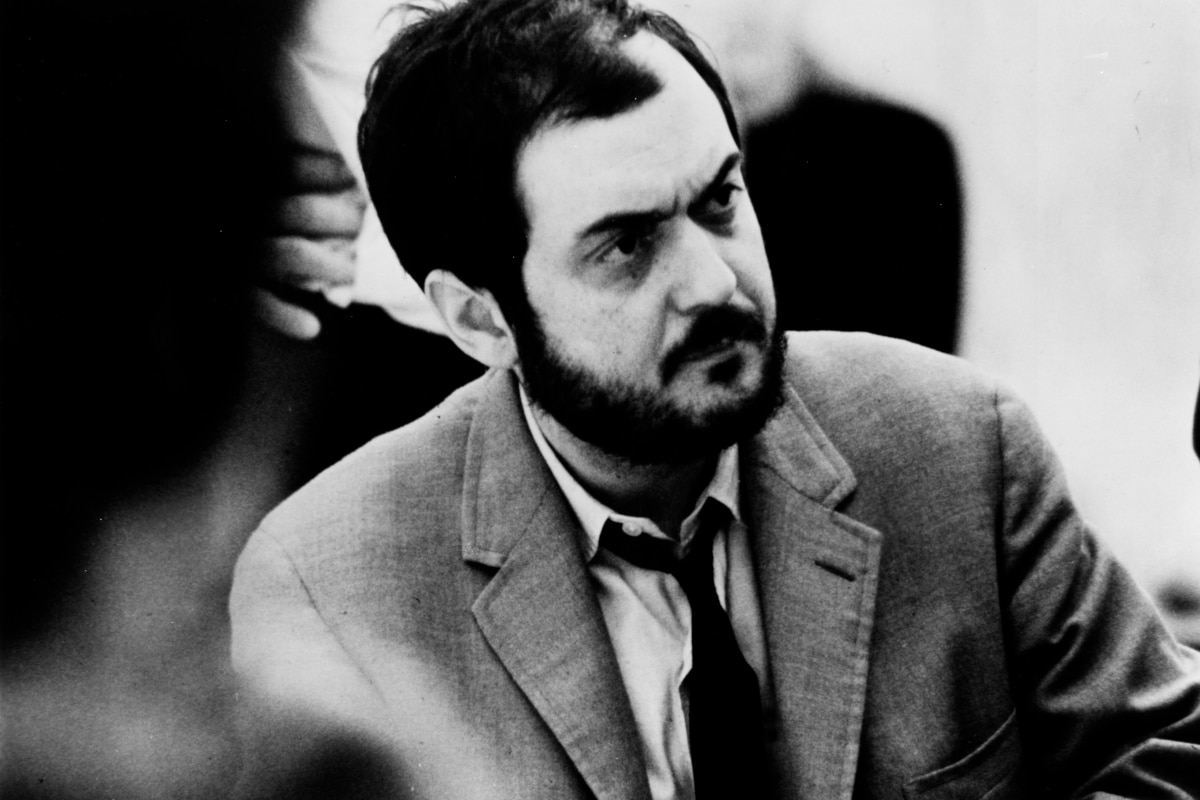
He was Hollywood's ultimate outsider, a relentless perfectionist who demanded complete creative control–and got it. The late Stanley Kubrick was a step ahead of his time; he was one of the first of a new generation of directors whom the French film critics classified as an 'auteur,' one whose work had a signature style and a thoughtfully conceived perspective that broke new ground.
Although he made his feature debut with a low-budget effort entitled Fear and Desire in 1953, Kubrick quickly established himself as an emerging artist before the end of that decade with Paths of Glory (1957), a powerful and universally acclaimed anti-war drama. He even tried his hand at a Hollywood epic and gave the sword-and-sandal genre one of its most satisfying entries with Spartacus (1960). Then he shocked audiences with his adaptation of Vladimir Nabokov's novel about a nymphet named Lolita (1962). But it was his next film, Dr. Strangelove: or How I Learned to Stop Worrying and Love the Bomb (1964), that catapulted him into the ranks of the major filmmakers. In this 'Cold War' comedy, Kubrick dared to make light of the threat of complete nuclear annihilation and, at the same time, raise disturbing concerns about the role of the military in modern government.
Despite some moral backlash, the successes of Lolita and Dr. Strangelove earned Kubrick the freedom to choose his own subjects and, more importantly, to exert total control over the filmmaking process, a rare freedom for any director. The first product of this license was the science-fiction classic (and quintessential late 60s "head" movie), 2001: A Space Odyssey (1968). Five years in the making, this film redefined the boundaries of the genre and established visual conventions, filmic metaphors and special effects technology that have remained standards for the industry well into the ‘90s. As visually hypnotic as it was daring in narrative (little dialogue, no final explanations, a time span of eons), 2001 made Kubrick a cultural hero. Despite initial mixed reviews, it has proven to be as stylistically influential as any film released in the last 30 years.
Further cementing his anti-establishment reputation, Kubrick followed 2001 with another futuristic work, A Clockwork Orange (1971), adapted from the novel by Anthony Burgess. No critic could take an uncommitted stance toward this film about a violent and amoral punk (played by Malcolm McDowell), whose ruthless behavior is reconditioned by the equally diabolical state. Kubrick's camera moved with an audacity unrivaled in contemporary cinema, causing fans to gush unequivocally and detractors to decry what David Thomson called "his reluctance to let a plain or simple shot pass under his name." Anyway you sliced it, there was no denying who was in charge of a Kubrick film.
Barry Lyndon (1975) was a bold attempt to bring modern techniques to bear upon a narrative set in the 18th century. Kubrick spent as much technical effort and expertise recreating the lighting and imagery of Thackeray's novel as he had done inventing a future in his two previous films. Although a commercial failure, Barry Lyndon fits logically into the Kubrick oeuvre, a dour fable of humanity trapped in the same determinism that had colored his previous work. In that respect, he is a latter-day Sophocles, whose characters can never escape their inexorable fate.
Kubrick's adaptation of Stephen King's horror novel "The Shining" is perhaps his most autobiographical work. He had long ago retreated to his Overlook Hotel (Chilwickbury Manor in Buckinghamshire) just as the writer and his family do in the film. Jack Torrance's isolation is Kubrick's, and by choosing a blocked artist as his main character, he shows his fear at the specter of being unable to create. His typically "cold" analysis may have robbed the film of the trademark terror horror fans expect but The Shining is endlessly interesting and pure Kubrick, with Jack the linear descendant of that ape in 2001, brandishing his bone as a weapon.
Kubrick's Vietnam movie, his adaptation of Gustav Hasford's Full Metal Jacket (1987), is essentially two movies in one. The first section, Marine basic training on Parris Island that culminates in the suicide of Private Gomer Pyle (Vincent D'Onofrio), is so powerful that it simply overwhelms the second half, where Kubrick's sets and East London locale struggle as a substitute for Southeast Asia.
The time needed for Kubrick to recharge his creative batteries became increasingly long. Five years passed between Barry Lyndon and The Shining, then seven before Full Metal Jacket, and more than 10 years would pass until Kubrick allowed his next film, Eyes Wide Shut (1999), starring Tom Cruise and Nicole Kidman, to meet the gaze of the public. True to form, the pedantic filmmaker labored excessively, assigning great importance to each and every image the camera would record, and endlessly reshooting scenes until achieving the exact look he desired. His control over every aspect of his films assured his legacy as a great craftsman, but his isolation and monomaniacal intensity may have obscured his genius. Kubrick once said, "I think that one of the problems with 20th-century art is its preoccupation with subjectivity and originality at the expense of everything else." If he had chosen not to reveal much of himself in his films in order to give us the "everything else", we must accept his enormous gifts while lamenting the high price of obsession.