Former monthly contribution by TCM host Ben Mankiewicz to the TCM newsletter Now Playing in December, 2015.
You hardly need me to recommend The Defiant Ones–in fact, if you peruse your stack of 2009 “Now Playing” guides (which you keep, obviously), you'll find I've already written about it.
I do so again to honor one of the most exceptional men I'll ever meet, Theodore Bikel. Theo and I got to know each other at the TCM Classic Film Festival, then on the TCM Classic Cruise. I knew him for only a few years, but it was a friendship worth savoring. Theo was consistently kind, compelling and above all else, interesting. He didn't just tell stories–he owned stories. I didn't have to spend much time trying to understand what I saw in Theo–I saw my father.
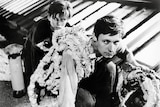
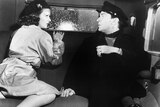
Theo died in the summer at 91, leaving behind a career that defied typical obituaries. How do you summarize a career that included more than 2,100 performances as Tevye in Fiddler on the Roof? Or that earned an Emmy for “Star Trek: The Next Generation”? Or that produced 37 different folk albums in 21 languages? Or that featured a movie debut as Bogart and Hepburn's would-be executioner in The African Queen?
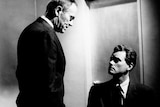
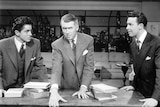
Theo earned his only Oscar nomination for The Defiant Ones, where he played a part perfectly suited to his unflinching sense of social justice: Yes, he's the Southern sheriff chasing Poitier and Curtis, but he's defined by mercy and compassion.

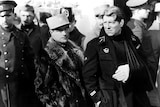
Theo understood the concept of right and wrong from an early age: He was a 13-year-old Jewish kid in March of 1938, when the Nazis marched into Vienna. Hitler and Goering stopped to soak in the crowd at the foot of Theo's building. Swastika flags hung from virtually every window. Former friends–these were his neighbors–had clearly prepared to welcome the conquerors. The point, Theo told me, was clear.
And just in case he didn't receive it properly, it was delivered concisely and malevolently by his school principal: "If our new friends engage in some excesses in the days and weeks ahead, we shall not be inclined to intervene." It was an ominous message to the Jewish kids: You are on your own.
After fleeing with his family to Palestine, Theo eventually started his career in London after the war. Though he was nearly always performing somewhere, Theo never scaled back his activism. He was a union leader for better than three decades and an active participant in the Civil Rights Movement. And though he remained a proud Zionist until the day he died, he never stopped condemning Israel's expansion into the Occupied Territories. Theo refused to listen to critics who tell artists to "shut up and sing."
Amy Goodman, the host of Democracy Now, interviewed Theo the year before he died. She asked him about the current relevance of Tevye's best-known song from Fiddler, "If I Were a Rich Man."
"Poverty is a scourge," Theo said. "Poverty is a curse. And the spread between rich and poor is getting larger and larger, much to the detriment of human dignity in the society in which we live. It cannot be allowed that billionaires fill their pockets while hungry babies cry."
"What can be done about it?" Goodman asked.
"Protest, yell, occupy, if you must. But do not be silent. Do not be quiet. And do not think somebody else is going to fight your fight for you. You have to do it.