Former monthly contribution by TCM host Ben Mankiewicz to the TCM newsletter Now Playing in November 2015.
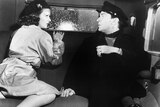
In some ways, And Then There Were None (1945) qualifies as one of the first reality shows. At one point early in René Clair's film, the characters–who've never met–must introduce themselves to one another. And, like contestants on “The Bachelorette,” instead of merely speaking to the person next to them, Clair gives each of them a solo: "My name's Lombard," says Louis Hayward before turning directly to face the camera, "Phillip Lombard."
Maybe “The Bachelorette" isn't the best example, but I suspect neither “The Bachelor” nor “The Bachelorette" has ever been mentioned in the “Now Playing” guide, and I thought it high time to break that streak.
Once the characters are introduced to each other, but more importantly to us, the game begins. The story starts with eight guests traveling by boat to a remote island and the fortress home of a man they've never met: Mr. Owen. But Mr. Owen isn't there–he's delayed, we're told. Instead, greeting the guests is a married couple, the butler and his wife, the cook. So, we have a house of strangers, strangers who begin to die one by one.
But who's the killer? Is it one of the 10? Or is Mr. Owen lurking in the shadows? Trust me, you'll be as baffled as the guests. Compounding the fear and tension is an audio recording, purportedly made by Mr. Owen, essentially accusing each of the guests of some sort of complicity in a murder earlier in their lives. Needless to say, the guests don't trust each other.
And Then There Were None is based on an Agatha Christie novel, “Ten Little Indians.” And fittingly, the centerpiece of the dining room table is a ring with ten ceramic Indians standing in a circle. As each guest is bumped off–by poison, a hatchet, a knife, a gun–one of those ceramic Indians is smashed. Is the house itself, perhaps haunted by a past victim of one of the guests, causing the havoc? Or is someone knowingly shattering the Indians following each murder?
Good luck solving the case. I'd already seen And Then There Were None and it fooled me again. The cast is made up of a who's who of brilliant character actors. In addition to Louis Hayward, Barry Fitzgerald plays a judge accused of sending an innocent man to his execution, Walter Huston is a doctor who may have killed a patient during a drunken surgery, C. Aubrey Smith is a general accused of sending his wife's lover to his death and June Duprez is a young secretary named as the murderer of her sister's fiancée.
But the real question isn't "who's in it?" It's whodunit