Unlike most of his contemporaries in the West German New Wave, theatrical impresario turned filmmaker Rainer Werner Fassbinder was willing to, and in fact interested in, experimenting with television. Early in his film career, the Bavaria-born wunderkind forged an important relationship at Westdeutscher Rundfunk (West Germany's biggest TV station) with Peter Märthesheimer, WDR's resident dramaturg. Schooled in sociology and trained as an editor, Märthesheimer had been charged with attracting new talent to the tube at a time when the medium was considered déclassé, even beneath contempt. Having spotted an intriguing photograph of Fassbinder in the German magazine Stern, posing against the fender of an automobile he had supposedly wrecked, Märthesheimer made sure to see the writer-director's next feature. A screening of Katzelmacher (1969) left him favorably impressed and Märthesheimer found Fassbinder surprisingly receptive to the invitation to work on the small screen - provided WDR finance films he wanted to make. Fassbinder's first foray into television, Das Kaffeehaus (1970), lead to a series of teleplays produced by Westdeutscher Rundfunk, which he alternated with his more widely-seen feature films, among them Why Does Herr R Run Amok? (1970), The Merchant of Four Seasons (1971), and The Bitter Tears of Petra von Kant (1972).
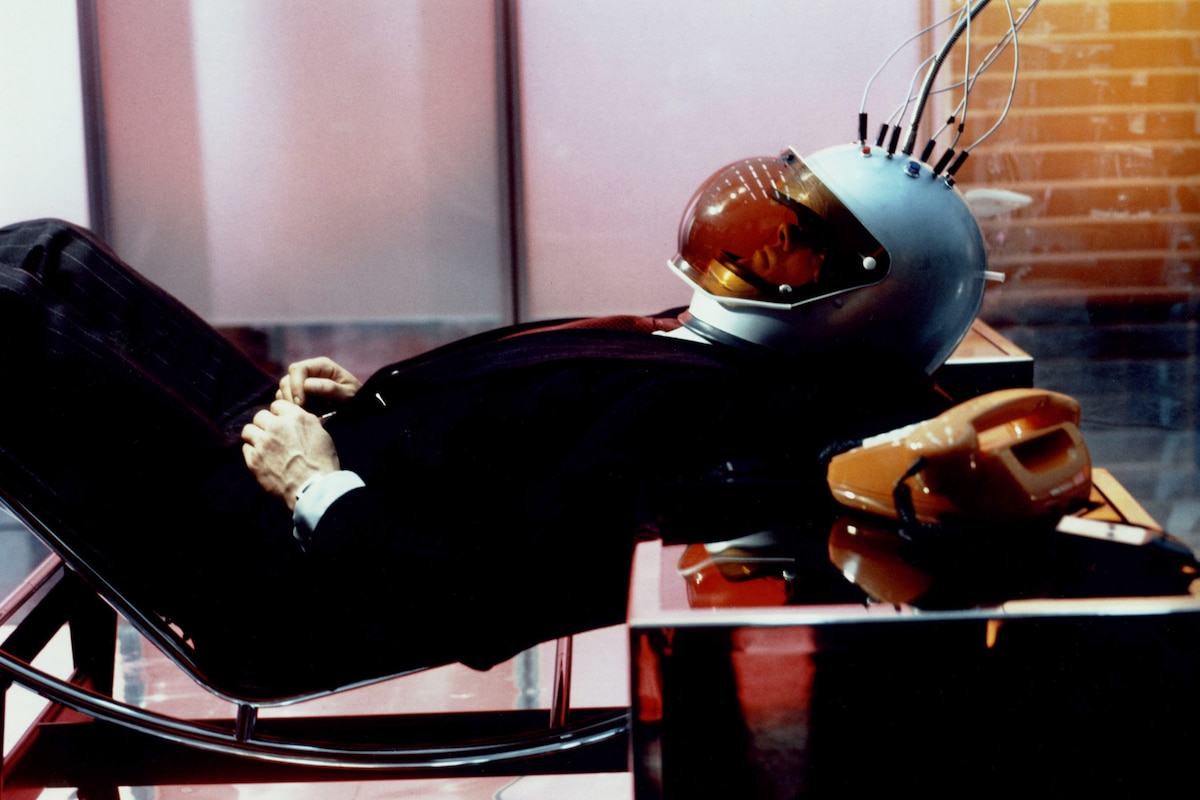
After wrapping preproduction on his most ambitious project to date, the period drama Effi Briest (1974) starring muse Hanna Schygulla, Fassbinder made three back-to-back TV movies, a triptych he capped with the two-part miniseries World on a Wire (Welt am Draht, 1973). Based on the 1964 novel Simulacron No. 3 by American science fiction writer Daniel Galouye (source material as well for the 1999 sci-fi thriller The Thirteenth Floor), World on a Wire takes a bold step into the near future (very near, as automobiles and fashions are about the same as in 1973) to depict a sparkling, corporation-controlled world in which protagonist Fred Stiller (Klaus Löwitsch), an employee of a cybernetics conglomerate, begins to suspect that existence itself is a computer-run virtual reality and everyone believing themselves human beings no more than "thought units." Low tech but high on ideas, World on a Wire may fail to impress fans of Blade Runner (1982) or The Matrix (1999) but it remains for the innately curious (and patient - the two-parter runs 200 minutes) bracing and thought-provoking television, directed with a cunning eye for both design and the nuances of human behavior (in particular, those humans facing the possibility that they are not human at all) in all its forms.
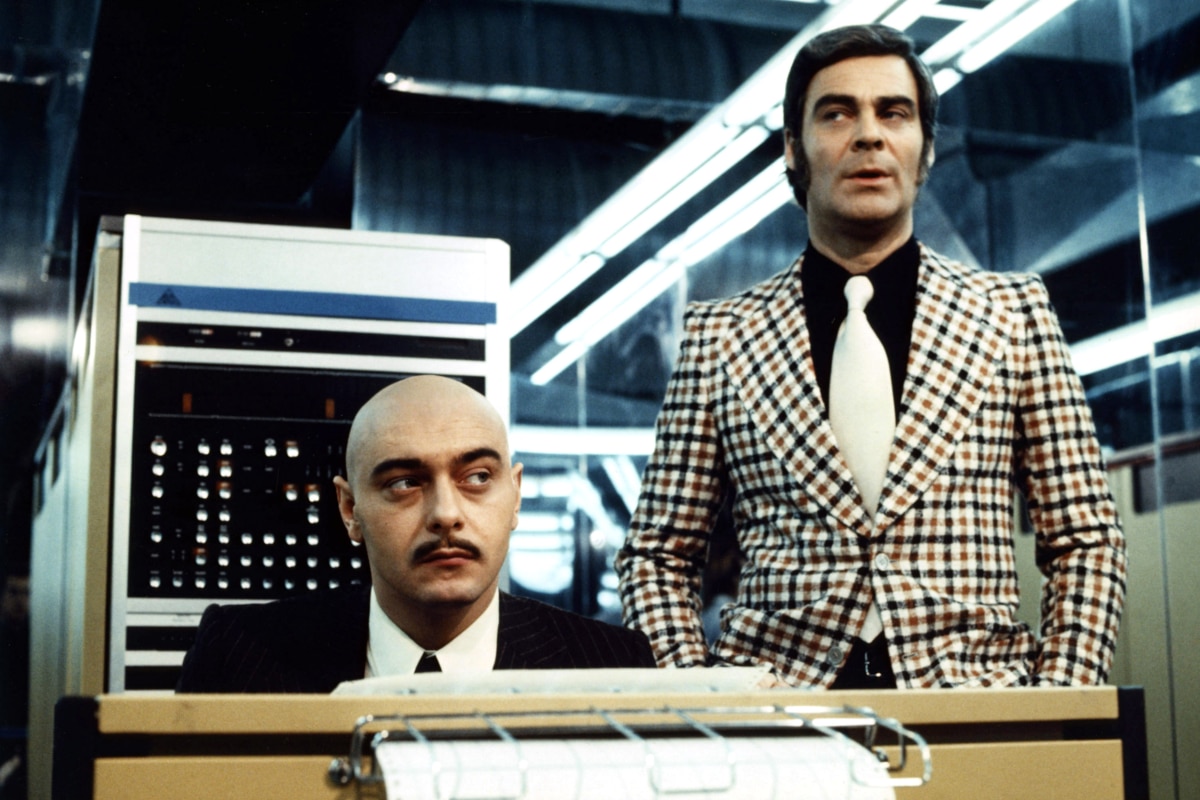
"It's much more than a headache," complains corporation scientist Vollmer (Adrian Hoven), whose sudden death sets World on a Wire in motion. "So much that my head's about to explode." The line cannot, in retrospect, help but evoke David Cronenberg's Scanners (1981) but Fassbinder doesn't need to pop heads to blow minds. Where modern filmmakers would truck in boatloads of CGI, Fassbinder (and production designer Kurt Raab, a frequent collaborator) merely fills his frame with mirrored surfaces, both to evoke the possibility of multiple realities occupying the same space but also to point to the signifier of mankind's essential discomfiture with (and denial of) self-revelation. One senses a kinship to Jean-Luc Godard's Alphaville (1965) in the merger of computers with trench coats and fedoras - Godard's leading man Eddie Constantine even turns up in a cameo, along with such Fassbinder troupers as Margit Carstensen, Günther Lamprecht, Ulli Lommel, Ingrid Caven, Kurt Raab, and Elhedi ben Salem, star of Ali: Fear Eats the Soul (1974). World on a Wire's haunting closing theme is the 1968 early Fleetwood Mac instrumental "Albatross," which sets the perfect note of melancholy for a tale that may end happily or unhappily, depending on your point of view.
Sources:
Understanding Rainer Werner Fassbinder: Film as Private and Public Art by Wallace Steadman Watson (University of South Carolina Press, 1996)
Chaos as Usual: Conversations about Rainer Werner Fassbinder by Juliane Lorenz (Hal Leonard Corporation, 1999)
A Companion to Rainer Werner Fassbinder edited by Brigitte Pencker (John Wiley and Sons, 2012)