"Yuki, you will live your life carrying out my vendetta." A mix of historical drama, martial arts spectacle and pulp moviemaking with new wave panache, the flamboyant revenge drama, Lady Snowblood (1973), brought the popular manga by author Kazuo Koiki to the big screen with a melodramatic flair and stylistic splash.
A successful author of the distinctive style of Japanese comic book known as manga, Koiki had created the icon "Lone Wolf and Cub" series, which had been brought to the screen in a series of hit martial arts thrillers, and would go on to create "Crying Freeman." "I'd created enough male assassins," he explained in a 2015 interview. "It was time for a female." The story of Lady Snowblood is set in the Meiji era, a turbulent period of transition from the feudal past to a modern state with power centralized by an emperor, and follows the elaborate revenge of an innocent woman whose husband and son are murdered in front of her eyes. She's imprisoned after killing one of the murderers and her daughter Yuki is conceived, then born behind bars to be the instrument of her vengeance. She's an asura demon in her mother's words, raised to become a warrior and an assassin and to hunt down the three surviving villains behind her mother's ordeal. "Yuki" is Japanese for snow, a fitting name given the stark, graphic imagery of white snow against a black sky during her birth, and Shurayuki - "snowblood" - is a play on Shirayuki, which is Japanese for "Snow White."
Producer Kikumaru Okada was looking for a project for actress Meiko Kaji, who had just made the hit women-in-prison exploitation film Female Convict 701: Scorpion (1972). According to screenwriter Norio Osada, "He wanted to make full use of her persona to make an even more flamboyant, engrossing and fun film." Okada hired Osada, who had scripted a series of Yakuza movies for Kinji Fukasaku, to adapt Koiki's manga, and filmmaker Toshiya Fujita to direct. Fujita rose through the ranks at Nikkatsu to become a director specializing in youth rebellion films, including Stray Cat Rock: Wild Jumbo (1970) and Stray Cat Rock: Beat '71 (1971), two of Kaji's early successes. It was a change of genre for Fujita whose specialty, according to Marc Salkow, was in portraying misunderstood youth searching for their identity in the world, or what Osasa called "a certain kind of ennui" among the young: "their stifled rage, a rage that has no outlet." He had never made an action film before and he brought an unconventional approach to the inventive storytelling and graphic action scenes.
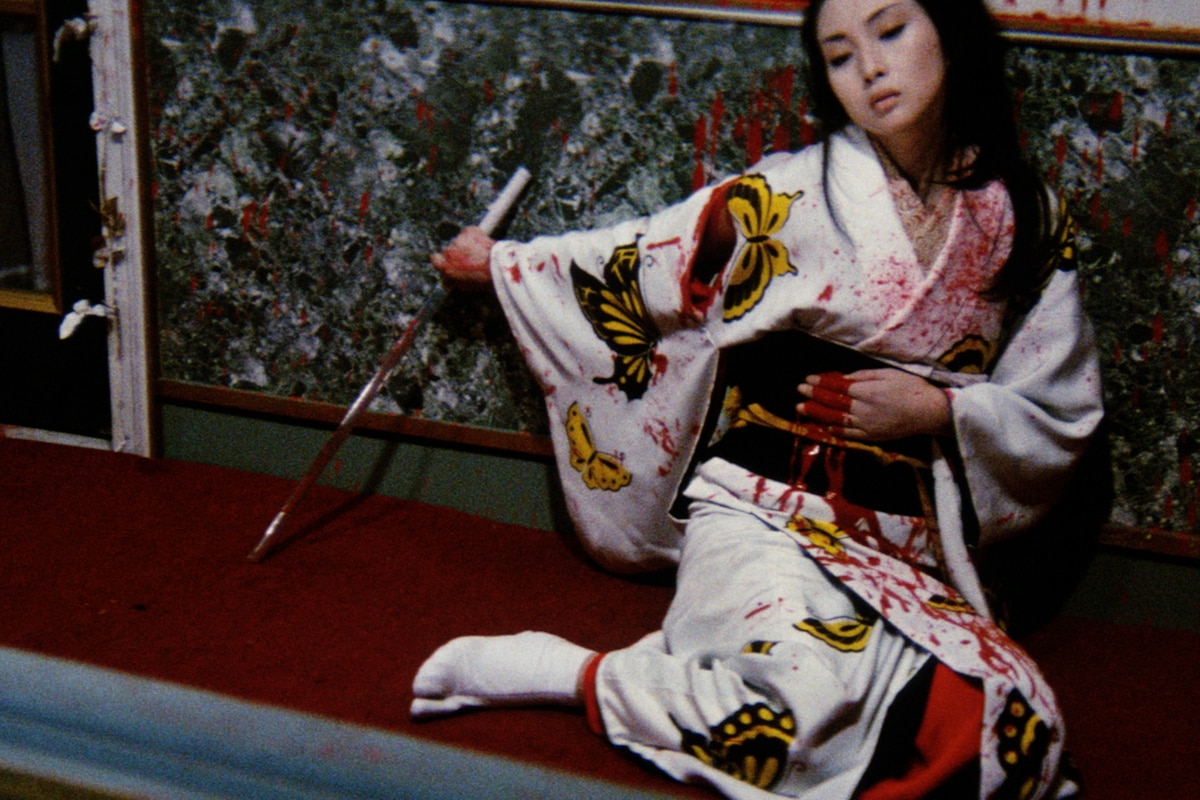
Clad in a demure kimono and armed with a sword hidden in her parasol, Yuki looks like a delicate aristocrat but for her eyes - intense, bloodshot, haunted - and she transforms from proper lady to the fiery Lady Snowblood in the blink of an eye. She's a largely silent figure with simmering fury under her stillness and she's a dervish in action, cutting down thugs and bodyguards with wicked efficiency and ballet grace. Koiki was not involved in the adaptation (screenwriter Osada remembers meeting him only once) or the production, but he praised the casting. "Meiki Kaji was perfect for the role: beautiful and grim, but with a touch of softness." Osada uses a remarkable array of ideas and techniques in his storytelling. The story slips back and forth in time and are nestled in flashbacks. Scenes are composed like serene paintings with delicate, soft colors in one shot and panels from a comic book, with sprays of spurting blood in explosions of crimson and objects reduced to stark graphic images, in another. The manga origins are carried over in the intermittent use of penciled panels to illustrate exposition in the vivid chapter titles (like "Crying Bamboo Dolls of the Netherworlds" and "Umbrella of Blood, Heart of Strewn Flowers") that mark her progress and in the slash cutting that sends the film jumping rapidly back and forth in time. Like the films of Seijun Suzuki a decade before, Lady Snowblood is a pulp revenge melodrama directed as an avant-garde thriller.
Quentin Tarantino was one of the film's many fans and it was his primary inspiration for the Kill Bill films, from the premise of a wronged woman taking violent revenge with a sword, to the complex flashbacks, to the use of animation for exposition (a nod to the use of original "Lady Snowblood" manga panels), to the climax, which evokes imagery right out of the film. He even takes the theme song, "The Flower of Carnage," sung by Meiko Kaji herself, as his own heroine's theme. It's not so much theft as homage, like much of Tarantino's cinema, and he stirs the elements into his own sensibility, but his tribute--and his outspoken love of the film--casts a spotlight on the film decades after its completion. He inspired fans to seek it out and gave the film new life in the U.S.
Sources:
2015 interview with Kazuo Koiki, The Complete Lady Snowblood Blu-ray. Criterion, 2016.
2015 interview with Norio Osada, The Complete Lady Snowblood Blu-ray. Criterion, 2016.
Outlaw Masters of Japanese Cinema, Chris D. I.B. Taurus, 2005.
"Flower of Carnage: The Birth of Lady Snowblood," Marc Walkow. FilmComment.com, January 26, 2016.
IMDb