This article was originally written about programming for the TCM Now Playing newsletter in April 2022.
Show business pedigrees don’t come much more impressive than Juliet Mills’. She is the daughter of actor Sir John Mills (Great Expectations, 1946; Ryan’s Daughter, 1970) and writer-actor Mary Hayley Bell, whose 1959 novel Whistle Down the Wind was made into a movie in 1961, starring Juliet’s younger sister, Hayley Mills (The Parent Trap, 1961; The Chalk Garden, 1964). Her godparents are playwright-actor Noël Coward and Vivien “Scarlett O’Hara” Leigh. Juliet has been married since 1980 to Maxwell Caulfield (Grease 2, 1982; Empire Records, 1995). And, of course, she is a notable actor in her own right, having made her debut as a baby in Coward’s war drama In Which We Serve (1942) and going on to nearly two dozen feature films, including Avanti! (1972) with Jack Lemmon, and numerous television movies and series like Nanny and the Professor, 1970-71.
She joined TCM in April 2022 for screenings of six movies that showcase the range of British cinema in the latter part of the 20th century, featuring a war drama, an adaptation of a literary classic, lush period romances, a Hitchcock thriller and an Academy Award-winning biographical epic. It’s interesting to note how many cast and crew names would reappear multiple times in the films featured in this program.
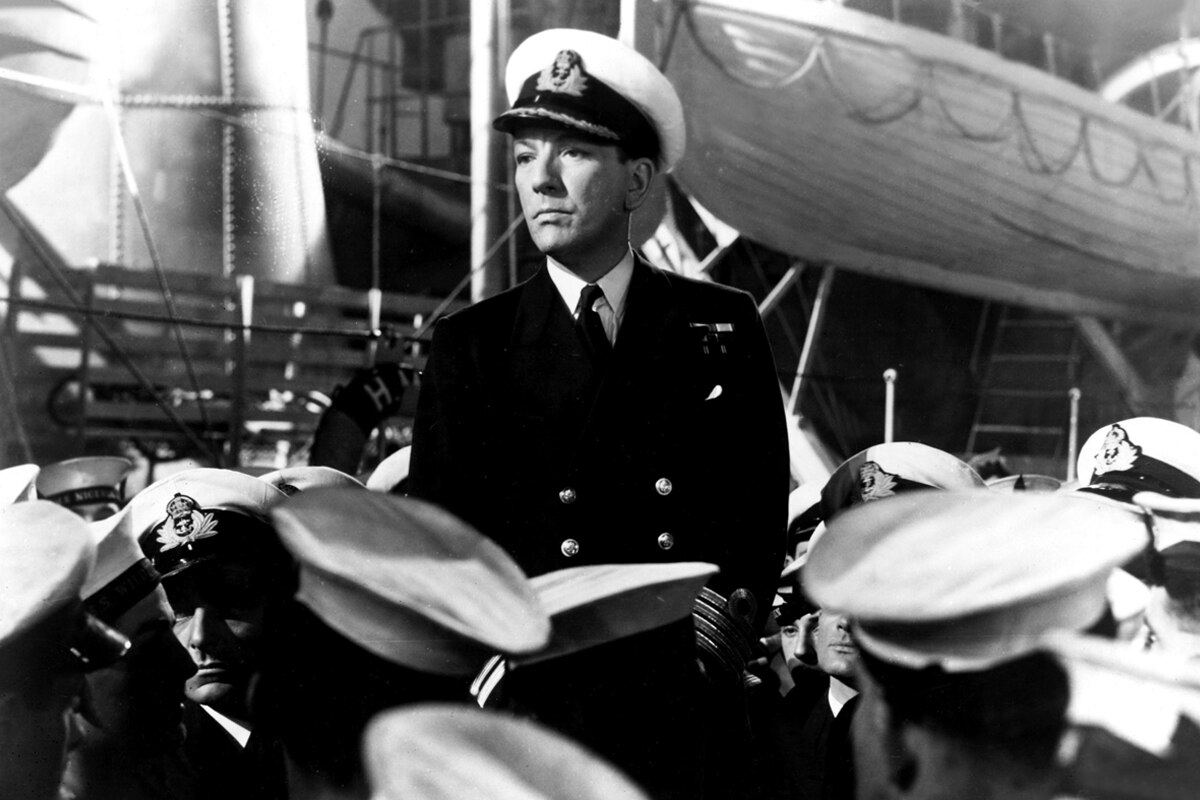
The first night featured three movies that star John Mills. In Which We Serve was an unlikely subject for its writer-director-composer-star Noël Coward, best known for witty, sophisticated plays, songs and performances that Time magazine called “a combination of cheek and chic, pose and poise.” With Great Britain at war with Germany for nearly two years, producers approached Coward to write a patriotic propaganda screenplay. He agreed as long as he was guaranteed complete control.
Coward set to work on a tale of the Royal Navy, inspired by the exploits of Captain Louis Mountbatten and the ship he was commanding when it sunk in the Battle of Crete in May 1941. Coward crafted an unabashedly patriotic work praised for its stark realism and expression of national strength. Although he had experience directing plays, he knew he would need seasoned film professionals for his first screen project. He hired cinematographer and future director Ronald Neame to shoot the film and act as its chief lighting technician. Not very comfortable shooting action sequences, he hired David Lean (The Bridge on the River Kwai, 1957), then known primarily as an editor, to direct the battle scenes while Coward concentrated on working with his actors.
Producers were initially reluctant to allow Coward to cast himself in the role of the ship’s commander, fearing his smoking jacket and cigarette holder image would be at odds with the story. Even if he wasn’t always quite convincing as a stalwart naval officer, the other performances from a fine ensemble cast more than compensated, including Celia Johnson, Michael Wilding and uncredited in his screen debut, Richard Attenborough, who will turn up more prominently on the second night of screenings.
Within just a couple of years, Coward’s co-director on the war picture, David Lean, began his own directing career, making his mark worldwide with the critical and commercial success of his classic love story, Brief Encounter (1945). He followed that with Great Expectations, widely considered one of the best adaptations of Dickens ever brought to the screen and one of Lean’s best films. Neame produced and co-adapted the novel for the screen.
The peerless ensemble cast is headed by John Mills as the adult Pip, an orphan whose education and coming-of-age makes for an enthralling tale, even in this stripped-down version. Luminous 17-year-old Jean Simmons (Guys and Dolls, 1955; Spartacus, 1960) became a star with her role as young Estella, and Sir Alec Guinness (The Bridge on the River Kwai; Star Wars, 1977) made his screen debut. The film won Academy Awards for Guy Green’s black-and-white cinematography and the art direction by John Bryan and Wilfred Shingleton. In 1999, the British Film Institute ranked Great Expectations number 5 on its list of the greatest British films of all time.
The night concluded with one of Lean’s and John Mills’ later works, Ryan’s Daughter (1970), following the scandalous affair between a married Irish woman (Sarah Miles) and a British officer (Christopher Jones) after the 1916 Easter Rising, an armed insurrection against British rule in Ireland. The cast also includes Robert Mitchum as Miles’ older husband and John Mills, in an Oscar-winning supporting role as the mute “village idiot,” but as with most of Lean’s films, particularly the later ones, the real star is the sumptuous visual style. That can be credited largely to director of photography Freddie Young, who also shot Lean’s Lawrence of Arabia (1962) and Doctor Zhivago (1965).
The second evening of programming opened with The Lady Vanishes (1938), Alfred Hitchcock’s penultimate British film before moving to the U.S. The cast is headed by Michael Redgrave, progenitor of a theatrical line to rival the Mills family, including daughters Vanessa and Lynn, son Corin and granddaughters Natasha and Joely Richardson and Jemma Redgrave.
After an elderly traveler disappears from a train, all but one passenger and all of the crew deny having seen the woman. The passenger (Margaret Lockwood) enlists Redgrave’s help to solve the mystery, making for an exciting thriller with engaging characters and wry wit.
The movie was an immediate hit when it opened in London and a huge success in the U.S., convincing David O. Selznick to bring Hitchcock to Hollywood for what proved to be a long and acclaimed career. The Lady Vanishes was named Best Picture of 1938 by The New York Times. Hitchcock received the New York Film Critics Circle Best Director award, the only competitive award he received in his long and hugely successful career. The picture was remade in 1979 starring Elliott Gould, Cybill Shepherd and Angela Lansbury as the titular lady. The BBC also produced a 2013 TV movie based on the same source material, Ethel Lina White’s 1936 novel The Wheel Spins.
As a producer and director, Alexander Korda was at the top of the British film industry, thanks to such films as The Private Life of Henry VIII (1933), Fire Over England (1937) and The Four Feathers (1939). That Hamilton Woman (1941) tells the historical tale (with license, of course) of the romance between the married Emma, Lady Hamilton (Vivien Leigh) and British naval hero Admiral Horatio Nelson (Laurence Olivier) during the Napoleonic Wars. This was the third and final film to pair the real-life couple.
The picture was shot in the U.S. and intended to bolster the image of Great Britain as one of the last, struggling holdouts against Nazi aggression. The hope was that it would help convince the U.S. to enter the war as an ally. While it may have assisted in that cause, it also fostered some unintended wartime consequences. According to film historian Stacey Olster, Korda’s New York offices were "supplying cover to MI-5 agents gathering intelligence on both German activities in the United States and isolationist sentiments among makers of American foreign policy." Korda caught the unwanted attention of the U.S. Senate Foreign Relations Committee, which accused him of espionage and propaganda activities. The producer-director was scheduled to appear before the committee on December 12, 1941, but the bombing of Pearl Harbor days before and the subsequent U.S. entry into the war let him off the hook.
The final night of the program closed with Gandhi (1982), a sweeping epic of the life and work of the leader of the movement for independence from British rule in India, based on his philosophy of nonviolent resistance. Producer-director Richard Attenborough sought for many years to get the film made. David Lean reportedly wanted to film the story but put the idea aside to make Lawrence of Arabia. Attenborough approached Lean with his own version in the late 1960s, and Lean agreed to direct and cast Attenborough in a lead role, but he moved on to Ryan’s Daughter instead.
When it was finally completed and released, Attenborough’s pet project was widely praised for its historical accuracy and for the performance of Ben Kingsley, a British-Gujarati actor little known outside England until this film brought him a Best Actor Academy Award and global recognition.
The immense cast includes well-known Indian and British actors, including John Mills as an early Viceroy of India, Roshan Seth (Mississippi Masala, 1991) as Nehru, American actors Candice Bergen and Martin Sheen, Daniel Day-Lewis in his first adult feature role and 300,000 extras in the funeral scene.
On both nights, TCM also screened as Overnight Features two films from our library that aren’t introduced by Juliet Mills but relate strongly to the program focus. The first is This Happy Breed (1944), a Technicolor family story (what we call a “dramedy” today) that marked David Lean’s first solo directing project. Based on a play by Noël Coward and co-starring John Mills, the film takes place soon after World War I when an English family leaves their working-class London neighborhood for a nicer home in the suburbs. This effort by Coward to depict ordinary family life between two world wars intimidated Lean at first. On In Which We Serve, he could handle the technical challenges of the battle scenes but depended on Coward to direct the actors. This would be his first time taking on that task, and he also had to contend with opening a well-known play for a suitably cinematic experience. He needn’t have worried too much; the picture received high praise from critics and was one of the most successful British releases of the year, launching Lean on a long and successful career. His next project was another adaptation of a Coward play, Blithe Spirit (1945).
The second night featured the Mills clan in another adaptation, this time of a novel by James Hilton, So Well Remembered (1947). Set just after World War II, the story recounts the reminiscences of a small town man (John Mills) as he looks back at the people and events who shaped him over the course of the previous 25 years, including his long friendship with an alcoholic doctor (Trevor Howard) and his persecution by the townsfolk for the crimes committed by his father many years earlier. The cast, a mix of American and British actors under the direction of Edward Dmytryk (later one of the Hollywood Ten targeted by the U.S. House Un-American Activities Committee), includes Juliet Mills as a younger version of one of the characters and little sister Hayley as the same character as an infant.