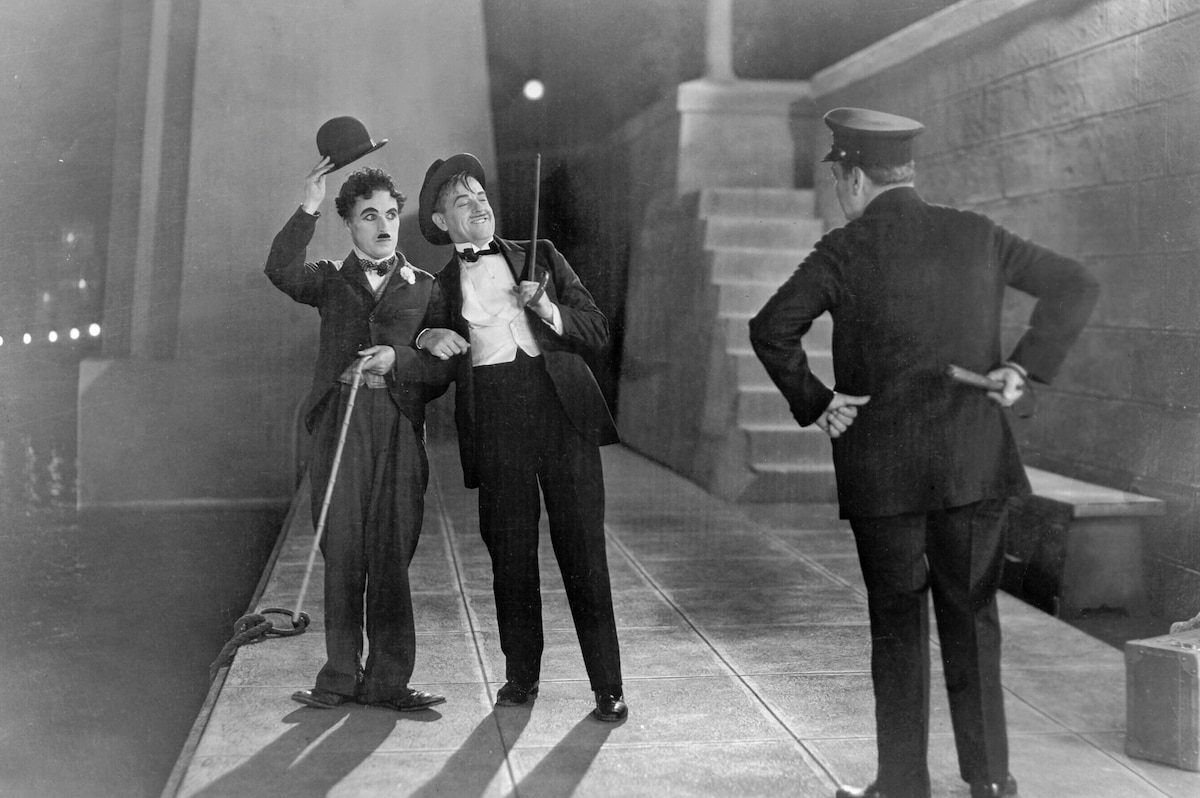

"Nobody in the world but Charlie Chaplin could have done it," a reviewer for the Los Angeles newspaper “The Record” wrote following the first press screening of Chaplin's City Lights (1931). "He is the only person that has that peculiar something called 'audience appeal' in sufficient quantity to defy the popular penchant for pictures that talk." Flying in the face of a film industry revolution, Chaplin had – after months of anxiety-ridden consideration – decided to complete his silent film as it was originally conceived, even though the rest of Hollywood had fully embraced the concept of "talkies." Chaplin's only concession to the sound era in City Lights was the inclusion of music and sound effects. His faith in his instincts was justified by several critics who chose the film as the best of its year, and by its later recognition as perhaps the finest of Chaplin's many masterpieces. Chaplin's unique blend of visual humor and pathos was never more fully realized than in this film, which was added to the Library of Congress’s National Film Registry in 1991.
At first synchronized sound seemed little more than a novelty, with unperfected technology that generated embarrassing results more often than not whenever a character spoke. However, when The Jazz Singer (1927) and The Broadway Melody (1929) became wildly popular and made enormous profits, every studio in town began to wire for sound. Desperate to jump on the talking picture bandwagon, studios began forcing their well-established silent film stars to make talkies. Some of the stars, such as Greta Garbo, survived the transition. Others, however, did not. The careers of actors who had ruled the box office during the height of the silent era, such as Pola Negri, John Gilbert, Karl Dane and Douglas Fairbanks, suddenly came crashing down when audiences, for whatever reason, failed to accept their previously unheard voices on the silver screen. It was a scary and unstable time for everyone in Hollywood.
Chaplin had been one of the top box-office stars for years before City Lights. With the transition of movies to the era of sound, Chaplin worried about how audiences would respond to a silent film, but also how they would respond to him. He felt that The Little Tramp would simply not be the same if he were to talk. The art of pantomime, he feared, would be lost forever with the arrival of sound. City Lights was a big risk. The beloved star and filmmaker wanted to prove that silent films still had relevance in the world when audiences only seemed to want more talkies. The success of City Lights proved that Chaplin was still a relevant and beloved star that audiences were willing to line up around the block to see. It was a major personal triumph that succeeded beyond his wildest dreams. Even though he eventually did make the transition to sound in 1940 with his triumphant anti-war film The Great Dictator, City Lights reminded everyone that a film could be just as funny and touching without spoken dialogue.
Chaplin not only starred in City Lights, but he produced, directed, scored and edited it in addition to co-writing the script. The film's plot is constructed with elegant simplicity. Chaplin's Little Tramp, adrift in an unfriendly big city, befriends both a blind flower girl (Virginia Cherrill) and an alcoholic millionaire (Harry Myers) who treats the Tramp royally when drunk but doesn't even recognize him when sober. Determined to raise the money for an operation that will restore the girl's sight, the Tramp tries jobs ranging from street cleaner to prizefighter before the millionaire offers the needed cash as a gift. Unfortunately, the forgetful millionaire sobers up to believe he has been robbed and the poor Tramp is sent to jail.
The story idea for City Lights began when Chaplin thought up a scenario about a circus clown who loses his sight in an accident. On the advice of his doctor, the clown hides his ailment from his frail daughter, fearing that the shock might be too much for her. The blind clown evolved over time into the character of the blind flower girl. The subplot of the eccentric millionaire who befriends the Tramp, according to Chaplin's autobiography, grew out of an old story idea he had in which two rich members of a gentlemen's club conduct an experiment with a tramp. The rich men pick up the tramp when he is sleeping, lavish him with luxurious treatment and then promptly return him to the street where they found him.
Chaplin initially had a great deal of difficulty casting the crucial role of the Blind Girl. Many actresses applied for the job, but none were suitable for the notoriously meticulous Chaplin. However, one day he saw a film company shooting a scene on a beach in Santa Monica with several women. One of the girls, Virginia Cherrill, was a casual acquaintance, so she waved and asked if she would ever get the chance to work with him. "Her shapely form in a blue bathing suit did not inspire the thought of her playing such a spiritual part as the Blind Girl," said Chaplin. "But after making one or two tests with other actresses, in sheer desperation, I called her up."
To Chaplin's surprise, Cherrill seemed to understand what he was looking for more than any of the other actresses he tried. "I instructed her to look at me but to look inwardly and not to see me, and she could do it," said Chaplin. "Miss Cherrill was beautiful and photogenic, but she had little acting experience." Chaplin, needing to move forward with the production, decided to hire her. For the other important role of the Eccentric Millionaire, Chaplin hired Australian actor Henry Clive (he would later be replaced by Harry Myers).
The movie's highlights include a slugfest between the skinny Tramp and a brawny boxer (Hank Mann) and a touching finale between him and Cherrill that still manages to provoke emotion over 90 years later. It was rare for Chaplin to begin a film with an ending clearly in mind, but in this case, he considered the conclusion to be all-important and constructed the entire film to lead up to this poignant moment. Chaplin himself was quite proud of the finale, calling it in a 1966 interview "a beautiful sensation of not acting, of standing outside of myself. The key was exactly right – slightly embarrassed, delighted… apologetic without getting emotional about it. He was watching and wondering without any effort. It's one of the purest inserts–I call them inserts, close-ups–that I've ever done." The celebrated critic James Agee wrote of this exquisitely wrought final sequence, "It is enough to shrivel the heart to see, and it is the greatest piece of acting and the highest moment in movies."
Producer/Director/Film Editor: Charles Chaplin
Screenplay: Charles Chaplin, Albert Austin, Harry Crocker
Cinematography: Gordon Pollock, Rollie Totheroh
Original Music: Charles Chaplin, Jose Padilla (uncredited)
Principal Cast: Charles Chaplin (The Tramp), Virginia Cherrill (The Blind Girl), Harry Myers (The Millionaire), Allan Garcia (The Millionaire's Butler), Hank Mann (The Boxer), Florence Lee (Blind Girl's Grandmother), Jean Harlow (customer in restaurant, uncredited).
BW-83m.