
It has been rated by various polls as among the 100 greatest movies of all time and the second greatest gangster film ever; fans can recite sections of scenes verbatim and lines from it have been ranked among the greatest bits of dialogue in movie history; critics, filmmakers and audiences have argued that it deserves a place equal to director Martin Scorsese's acknowledged masterpiece Raging Bull (1980). And, in 2000, Goodfellas (1990) was selected by the National Film Preservation Board to be one of the cinema treasures preserved in the National Film Registry of the Library of Congress. Not bad for a movie that initial preview audiences either walked out of in disgust or commented on with extreme negativity.
As much as its style, characters and subject matter have become identified with its creator, Scorsese has said he never had a desire to make just another mob movie. The Godfather saga had already indelibly stamped the genre with perhaps its greatest myth almost 20 years earlier, and any number of imitators of Francis Ford Coppola's epic have looked at the Mafia from a wide range of angles over the years. The unique angle that attracted Scorsese's eye, however, was journalist Nicholas Pileggi's 1986 book “Wiseguy: Life in a Mafia Family,” which in its true story of mobster-turned-informant Henry Hill, focused on the ordinary "soldier" rather than the larger-than-life bosses. With Pileggi's book, Scorsese saw an opportunity to present the story of the common thieves and killers, the guys who follow the orders and carry out the day-to-day criminal tasks, rather than the mythic figure of the Mafia’s elite bosses. Scorsese was also excited about finding a film language that would capture the style of Pileggi's lean, tough, fast-moving journalistic prose.
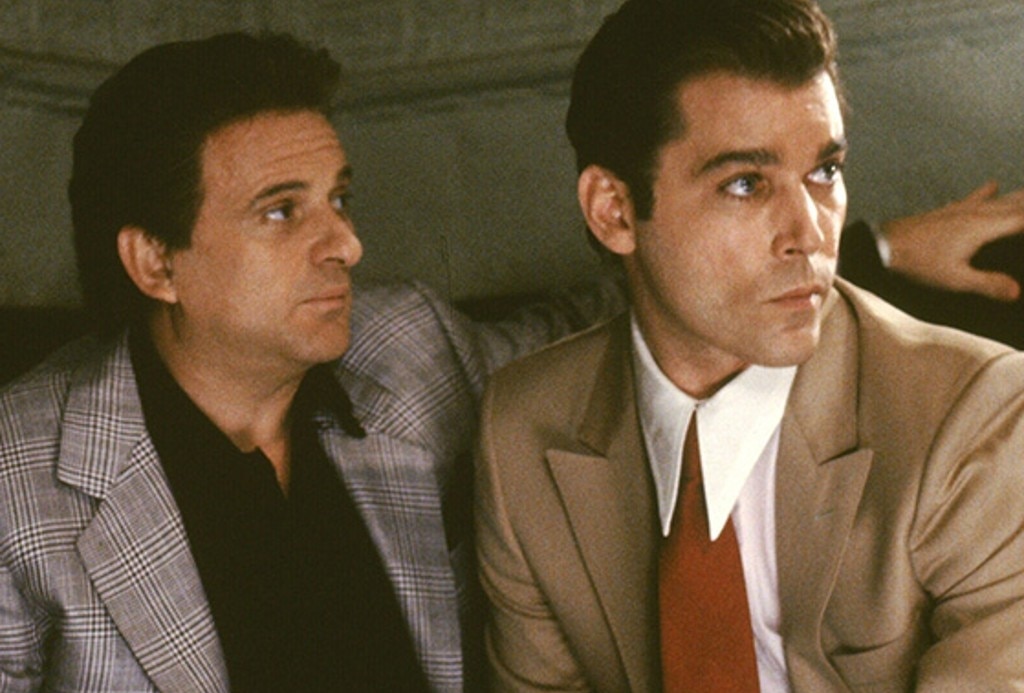
The story follows Hill (Ray Liotta) from his teenage years, staring out the window of his family's apartment at the hoods and crooks operating out of a neighborhood storefront (much as Scorsese had done as a child in Little Italy), longing to be a part of their exciting world. Although half-Irish and therefore unqualified to ever be a "made man" (one officially inducted into the Mafia inner circle through a solemn oath), Hill eventually becomes a trusted and busy soldier of mob boss Paulie Cicero (Paul Sorvino) and falls in with two other henchmen, professional thief Jimmy Conway (Robert De Niro) and sociopathic killer Tommy DeVito (Joe Pesci). The story also relays details of Hill’s marriage to his wife, Karen (Lorraine Bracco), his affair with a hotheaded mistress and his descent into heavy cocaine use and its effects on his job and loyalties. The mere recounting of the plot, however, does little justice to Scorsese's bravura approach to the material, which incorporates freeze frames and jump cuts characteristic of the French New Wave films of the early 1960s, along with voiceovers and fourth-wall breaks that amplify the action and passage of time. Indicative of Scorsese’s style, as well, is his use of popular songs from the decades in which the film is set.
Scorsese hired Pileggi to co-write the script (the first time Scorsese took writing credit since Mean Streets in 1973) and kept much of the language and details from the book intact. Pileggi credits Scorsese with a great deal of help and inspiration in the process: "He was stuck with somebody who really didn't know anything, so he really had to bring me along as far as film was concerned."
For Hill's two partners in crime, Scorsese turned to De Niro and Pesci, the Oscar-nominated stars of Raging Bull. Scorsese actually didn't think he had a part in the movie for a star of De Niro's caliber, but the actor himself suggested he play the supporting role, and his presence helped encourage the studio to boost the budget to $25 million, the most Scorsese was allotted for production up to that point. For the central character, Henry Hill, Scorsese wanted Ray Liotta, who had never carried a major film by himself but who had attracted a lot of attention for his supporting role as Melanie Griffith's dangerous ex in Jonathan Demme's Something Wild (1986). Producer Irwin Winkler was against using Liotta until the actor pulled him aside for a long private talk. There's no record of what was said, but when it was over Liotta had the part.
To prepare for the part, Liotta obsessively listened to tapes of Pileggi's interview with Hill while driving back and forth from New York to his parents' New Jersey home. De Niro talked personally to Hill many times about Jimmy Conway, whose real last name was Burke. According to Hill, De Niro would call him up to five times a day to discuss the minutest detail of every small action or gesture.
Arguably the film's most memorable scene, Tommy goading Henry with the threatening "How am I funny?" banter, was actually an incident that happened to Pesci years before. As with many other scenes (and typical of the way Scorsese usually worked with De Niro), it was improvised between Liotta and Pesci several times and then incorporated into the script. Scorsese decided to capture it in a medium shot rather than intercutting to a lot of close-ups so that he could get the full effect of Tommy's diatribe on all the other characters in the scene.
The cast also includes a number of actors familiar to any fan of the Mafia genre, particularly those who watched “The Sopranos” television series. One such player is Michael Imperioli, who played the major role of Christopher on series, making his third feature film appearance with Goodfellas as a young man who waits on the mob guys in their social club and gets his foot shot by Tommy. The creators of the TV series paid homage to this film by having Christopher do the same thing to a bakery employee and then remarking casually, "It happens."
Scorsese also used members of his own family and not for the first time. His mother, Catherine, makes her third appearance in one of her son's films as Tommy's mother, improvising a kitchen scene with De Niro, Liotta and Pesci. His father, Charles, in his fifth Scorsese film, plays the prisoner who gets chided for putting too many onions in the tomato sauce. Also in the cast, as Jimmy's wife, is Julie Garfield, whose father, John Garfield, often played an early prototype of the New York tough guy in his brief but memorable film career (1938-1951). The U.S. attorney who negotiates with Karen and Henry Hill about entering the Witness Protection Program is played by Edward McDonald, the real-life federal attorney who did the actual negotiating with the Hills.
Following the popularity and critical praise for the film upon its release, Hill couldn't resist letting people know he was the basis for the lead character. Some sources say this was why he was taken out of the protection program, although other sources cite multiple drug arrests as the reason. In the years since the end of this story, Hill had been, among other things, an Italian chef, and once operated a restaurant called Wise Guys. Hill passed away from an undisclosed illness in 2012 at the age of 69. He was the only one of the principals in the famous 1978 Lufthansa heist (a central plot point of the film) still alive. Jimmy Burke lived to see the release of the movie (and claimed De Niro consulted with him frequently, although that has been disputed) but died in prison in 1996 of lung cancer, eight years before he would have been eligible for parole.
Goodfellas received Academy Award nominations for Best Picture, Director, Writing, Editing and Supporting Actress (Bracco). Joe Pesci won Best Supporting Actor, an award he also received from the National Board of Review. The film racked up five Golden Globe nominations, five British Academy Film Awards (including Best Film) and two other nominations from that group, five Los Angeles Film Critics Awards and three New York Film Critics Awards, as well as many other awards and nominations from a number of critics groups and festivals worldwide.
Producers: Barbara De Fina, Irwin Winkler
Director: Martin Scorsese
Screenplay: Martin Scorsese; Nicholas Pileggi (screenplay and book "Wise Guy")
Cinematography: Michael Ballhaus
Art Direction: Maher Ahmad
Film Editing: James Kwei, Thelma Schoonmaker
Cast: Robert De Niro (James 'Jimmy' Conway), Ray Liotta (Henry Hill), Joe Pesci (Tommy DeVito), Lorraine Bracco (Karen Hill), Paul Sorvino (Paul Cicero), Frank Sivero (Frankie Carbone), Tony Darrow (Sonny Bunz), Mike Starr (Frenchy), Frank Vincent (Billy Batts), Chuck Low (Morris 'Morrie' Kessler), Frank DiLeo (Tuddy Cicero), Henny Youngman (Himself), Gina Mastrogiacomo (Janice Rossi), Catherine Scorsese (Tommy's Mother).
C-146m. Letterboxed.