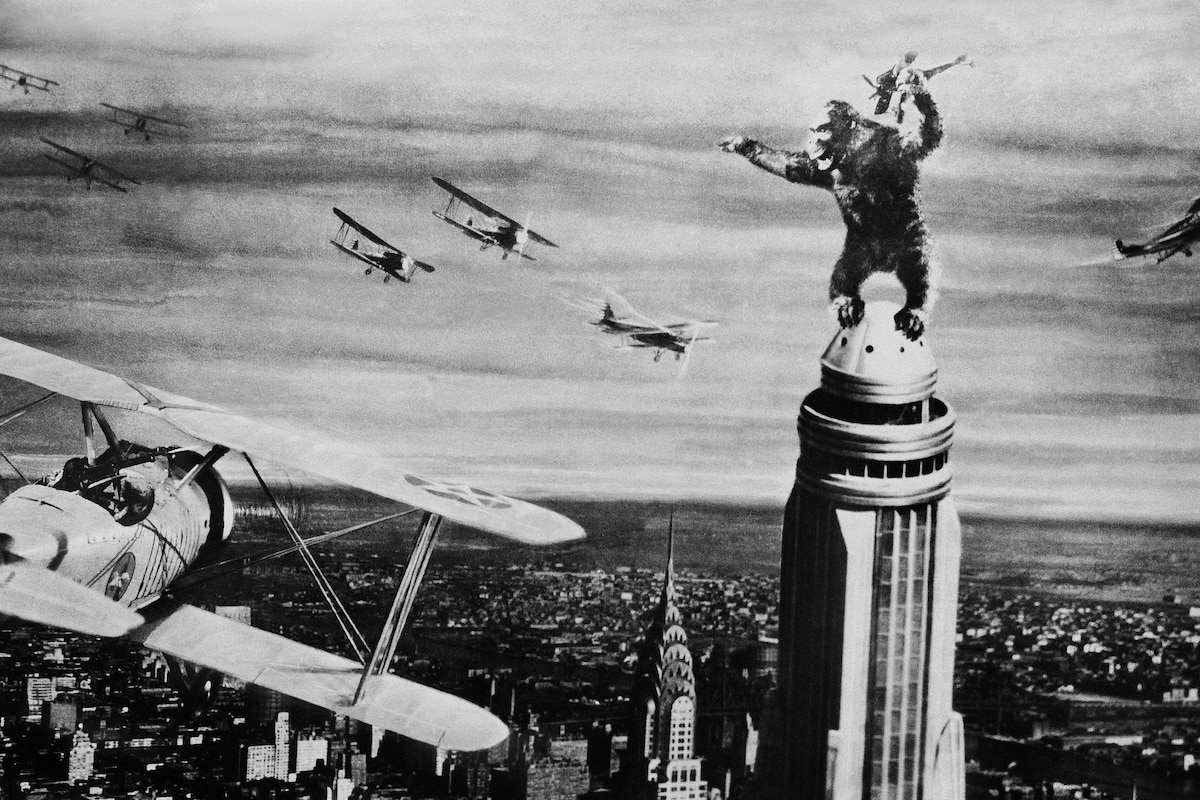

No one could have expected that a movie starring a giant ape would inspire countless imitations, but King Kong (1933) turned out to be a major blockbuster for its era and still remains the "king" of this particular genre. Carl Denham (Robert Armstrong), an arrogant documentary filmmaker, organizes a trek into uncharted territory in the hopes of discovering a unique animal that he can capture, bring back to civilization and exploit for profit. After hiring Ann Darrow (Fay Wray), an attractive blonde, to help him on his mission, Denham leads his crew to the mysterious, fog-enshrouded Skull Island where they encounter something tall, dark and very hairy.
Working with a modest budget, Merian C. Cooper and Ernest B. Schoedsack, the producers of King Kong, had to make do with limited resources in terms of sets. Most of the budget had been allocated to special effects and musical scoring. The jungle, overgrown with gigantic flora, was actually recycled from Schoedsack's previous film, The Most Dangerous Game (1932). He actually began shooting jungle locations for King Kong before The Most Dangerous Game had wrapped, and between setups the crew would rush in to shoot their own jungle scenes. What made the schedule even more hectic was the fact that Fay Wray also starred in The Most Dangerous Game and had to race back and forth between both films. Not surprisingly, her outfit for the jungle sequences in each film is suspiciously familiar.
Originally, co-director Cooper envisioned using a real gorilla for Kong, but once he saw Willis O'Brien's stop-animation for the then-unfinished film called Creation, Cooper knew that the special effects technician could bring his beast to life. O'Brien had built his reputation as Hollywood's top motion-control animator with his first feature-length film The Lost World (1925), starring Wallace Beery. Although in King Kong, the great ape appears to be 40 feet tall, he was actually only an 18-inch model. Kong was a skillful combination of a metal mesh skeleton, a mixture of rubber and foam for the muscle structure and rabbit fur for his hair.
King Kong is often credited as the first film to use miniature rear projections to create special effects sequences. Footage of the actors was projected on a small screen, one frame at a time, behind the models as they were animated. King Kong was the first of any kind to become a hit with an animated leading player. O'Brien's pioneering stop-motion animation would inspire such later special effects artists as Ray Harryhausen and Jim Danforth and pave the way for contemporary CGI effects.
Most sequences in King Kong had to be shot non-stop, often requiring 20-hour workdays. Sometimes the shrubs used to dress the miniature sets actually wilted during filming. At one point, one of the plants on the set flowered. Before a scene could be started, all the lights on the soundstage had to be replaced with new ones to make sure they wouldn't flicker during the scene. The stage had to be sealed, and nobody could leave or enter to prevent any wind from moving the foliage.
O'Brien used three techniques for scenes uniting actors and models. The standard, at that time, was to film the actors in front of a projection screen with the effects footage. That was used for Kong's fight with the tyrannosaurus and the scene in which Carl Denham shoots the Stegosaurus. O'Brien could also matte together actors and models in an optical printer. For those scenes, like the fight with the Pterodactyl, Cooper shot the actors first, then filmed the models with the actors' side of the screen matted out.
The third technique was Cooper and O'Brien's innovation for King Kong. Cooper filmed the actors, then O'Brien projected the image one frame at a time on a screen behind the models. That's how they filmed Kong's removal of Wray's clothing. Originally, Cooper had wires attached to her clothes to pull them off her body. The model's movements were then matched to hers. Unfortunately, O'Brien and Cooper forgot to patent their approach, thereby losing a fortune.
For the scenes of Wray in Kong's hand, the hand was attached to a crane and raised ten feet. First a technician put her in the hand and closed the fingers around her. Then the hand was lifted for filming. She would later say her terror in those scenes was real. The more she struggled, the looser the hand's grip grew. When she thought she was about to fall, she had to signal Cooper to stop filming.
Among its many innovations was that King Kong was one of the first films to have a musical score composed specifically for it and one of the most influential. The film was one of Max Steiner's first Hollywood assignments, leading the way to a long career in which he would write music for everything from Casablanca and Now, Voyager (both 1942) to the teen romance A Summer Place (1959). His use of themes in the film, including a love theme for Ann and Kong, was extremely influential.
As wildly popular and profitable as King Kong was on its first release in 1933, the censors sharpened their scissors on the big gorilla for its 1938 re-release and demanded that 29 scenes from the original version be cut before the film could be granted a seal of approval. For example, the bloody carcasses of five men dying in the jaws of the Brontosaurus were edited so that the beast only claimed three victims. Three lives were more acceptable to the Hays Office. The scene in which Kong holds an unconscious Ann captive in his massive palm while gently peeling off her dress like a linen banana was completely unacceptable to the new morality. This scene was altogether eliminated for the 1938 release.
Other scenes that were deleted included Kong chomping down on a New Yorker and dropping a woman from the Empire State Building. Despite these crucial cuts, most of the edited scenes were eventually restored to King Kong. However, O'Brien's title creation is still impressive, particularly in his first appearance, and Fay Wray still has one of the best screams in Hollywood history; it's one that has chilled audiences in such classic horror flicks as Doctor X (1932) and The Vampire Bat (1933).
Director: Merian C. Cooper/Ernest B. Schoedsack
Producer: Merian C. Cooper, Ernest B. Schoedsack, David O. Selznick
Screenplay: Merian C. Cooper, Edgar Wallace (story), James Ashmore Creelman, Ruth Rose
Cinematography: Edward Linden, Kenneth Peach, J. O. Taylor, Vernon L. Walker
Music: Max Steiner
Art Direction: Carroll Clark, Alfred Herman, Van Nest Polglase
Special Effects: Willis O'Brien, Harry Redmond Jr.
Cast: Robert Armstrong (Carl Denham), Fay Wray (Ann Darrow), Bruce Cabot (Jack Driscoll), Frank Reicher (Captain Englehorn), Sam Hardy (Charles Weston), Noble Johnson (Native chief), James Flavin (Briggs).
BW-105m. Closed captioning. Descriptive Video.