
According to late-TCM host Robert Osborne, the April 4, 1960 telecast of the Academy Award ceremony was the last time during the first 60 years that the motion picture industry sponsored the annual proceedings. It is not difficult to see why. The financial burden of putting on the show had become too heavy, and due to MGM's dual big wins with Gigi (1958) and Ben-Hur (1959), it had become increasingly difficult to convince studios to pay for an expensive telecast that largely showcased a rival studio's pictures.
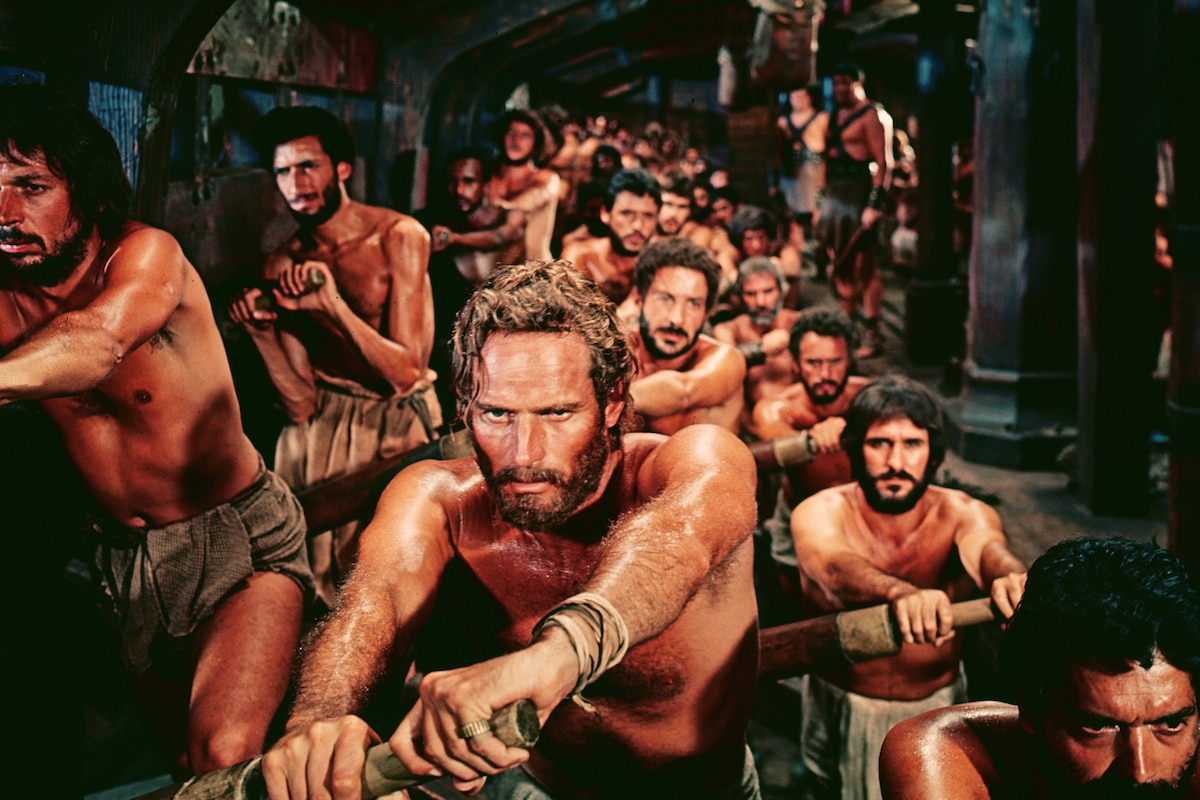
But despite MGM's exalted position in Hollywood, the studio's decision to remake Ben-Hur: A Tale of the Christ (1925) was risky. The inspiration was influenced by Cecil B. DeMille's remake of his 1923 silent film The Ten Commandments, a huge box-office success for Paramount in 1956. The MGM brass figured a remake of their 1925 sword and sandal epic would most likely reap similar profits. But at the time, the once-mighty studio was teetering on financial ruin. The competition with television and the effects of the 1948 consent decrees, which divested the studios of their theater chains, had its greatest impact on mega-studios like MGM. So the decision to pour $15 million into a project that had been filmed once already had a few Hollywood insiders suspicious. Nevertheless, Ben-Hur turned out to be an enormous financial and critical success, grossing $37 million domestically and $80 million worldwide in its initial run. It broke box-office records everywhere, sustaining Leo the Lion's famous roar above the bankruptcy wolves for another decade or so.
Producer Sam Zimbalist approached acclaimed filmmaker William Wyler in 1957 to direct. Wyler at first thought he was joking. Up to this point, Wyler was known for literate, often intimate, character-driven dramas, and he was reluctant to take on a production he felt more suited to the likes of the bombastic Cecil B. DeMille. But once he had become convinced, impressed primarily with the theme of the Jewish people fighting for their freedom, he committed himself fully to the process. He was determined to give the 54-year-old Zimbalist the "intimate epic" he was seeking; one whose abundant action and spectacle would not overshadow the personal story of one man's path from bitterness and revenge to love and forgiveness. Zimbalist would eventually collapse during production, dying of a heart attack 40 minutes after leaving the set and complaining of chest pains.
Ben-Hur was the biggest and most complex undertaking of Wyler's career (with the biggest pay-off, setting him up financially for life). It was also the grandest, most expensive production the motion picture industry had seen up to that point, using more people, bigger sets and inspiring more news stories and publicity hype than ever before. And, of course, there is that justly famous chariot race. Coupled with its reputation as a thinking man's epic, a big picture with a personal drama at its core, Ben-Hur displaced the more superficial standard for the genre to that time, the DeMille-directed The Ten Commandments (1956), to achieve lasting fame as the quintessential costume epic.
More than 300 sets were built on location at the Cinecitta studios in Rome for Ben-Hur. They were constructed following 15,000 sketches and covered more than 340 acres. The set for the city of Jerusalem took up 10 square blocks. Altogether, the production used about 40,000 cubic feet of lumber, more than a million pounds of plaster, and 250 miles of metal tubing. Ben-Hur's house was constructed of wood frame covered with stucco painted to look like stone. Sculptors cast more than 200 pieces of statuary to supplement the thousands of props used from Cinecitta's warehouse.
The chariot arena was built by more than 1,000 workers beginning in January 1958, according to some reports. It was 2,000 feet long by 65 feet wide and covered 18 acres, the largest single set in motion picture history to that time. Reputedly, 40,000 tons of white sand was imported from Mexico for the track. Famed stuntman Yakima Canutt was brought in to coordinate all the chariot race stunt work and train the drivers. Heston was among the first to begin training, arriving on location a few months ahead of scheduled shooting. He was also there to do costume fittings.
Andrew Marton directed the chariot race with three 65mm cameras at his disposal, which were also heavy; it took four men with steel bars to move them. The larger format film proved to be an issue. The standard close-up lens for 35mm photography was 100mm; it became, in the wide-screen process, a 200mm lens, which could not be focused closer than 50 feet. After a few days of shooting, Marton realized the most effective way to shoot in the arena would be to have the cameras right in the midst of the race, necessitating a camera car that moved with the chariots. Marton said Boyd and Heston did all their own driving, although for the scene where Judah's chariot flips over a crashed one, Canutt's son Joe was brought in. The shot where Messala's body is dragged behind and under his own chariot was tried first with a dummy, but it looked bad. Boyd was protected with some steel pads and did it himself.
At the time, writer Gore Vidal was under contract to MGM and brought in to work on Karl Tunberg's script. He agreed, with the stipulation that the studio let him out of the last two years of his contract. Earlier versions of Tunberg's script had been tweaked by noted playwrights S.N. Behrman and Maxwell Anderson, but Wyler still felt it needed work, especially to lend a more classic tone to the dialogue. He and Zimbalist next hired British playwright Christopher Fry, who at last delivered what Wyler felt was needed, changing such lines as "Did you enjoy your dinner?" to "Was the food to your liking?" Fry did a substantial amount of work on the script, but neither his name nor Vidal's, Behrman's or Anderson's appear on the credits.
Once it came time for the Academy Awards, Ben-Hur led the pack with 12 nominations. It eventually won 11 Oscars, losing the screenplay category only because of a credit dispute among its screenwriters, Karl Tunberg and Christopher Fry. Tunberg, former president of the Writers Guild, got sole screenwriting credit, even though Fry, who was on the set with director William Wyler throughout the production, worked extensively on the script as well. Vidal, who contributed to the screenplay, was also denied credit by the Writers Guild. Ben-Hur still holds the title of a single movie with the most Oscar wins, although it’s tied with both Titanic (1997) and The Lord of the Rings: The Return of the King (2003).
When Charlton Heston appeared on the list of nominees for Best Actor, many in Hollywood were surprised because they didn't think his performance matched the caliber of Jack Lemmon's in Some Like It Hot, Laurence Harvey's in Room at the Top or even James Stewart's in Anatomy of a Murder. Lemmon's chances, in particular, were probably hampered by the fact that Some Like It Hot failed to score a Best Picture nomination and comedies are usually overlooked as serious contenders. Despite that minor controversy, columnists predicted that Heston would enjoy an easy chariot ride to the winner's podium on Oscar night, since everyone expected a landslide victory for Ben-Hur.
Indeed, Heston did win for the night, and he even managed to surprise some head honchos when he included in his acceptance speech gratitude towards the film's uncredited writer, Christopher Fry. It was the Writers Guild, specifically, that was angry with Heston for mentioning Fry, after all the trouble that the Guild went through over determining screenplay credit. But Heston insisted that Fry had been on the set regularly, helping him with his characterization. Upon meeting with the press after his acceptance speech, a reporter asked Heston backstage which scene in Ben-Hur he enjoyed filming the most, apparently alluding to the chariot race that had everyone in Hollywood talking for months. The winner quickly responded, "I didn't enjoy any of it. It was hard work." Heston did like winning though and commented to his fellow winner and director, William Wyler, "I guess this is old hat to you." Wyler, a three-time winner, retorted, "Chuck, it never gets old hat."
Producer: Sam Zimbalist
Director: William Wyler
Screenplay: Karl Tunberg
Production Design: Edward C. Carfagno
Cinematography: Robert Surtees
Costume Design: Elizabeth Haffenden
Film Editing: Ralph Winters
Original Music: Miklos Rozsa
Principal Cast: Charlton Heston (Judah Ben Hur), Stephen Boyd (Mesala), Jack Hawkins (Quintus Arrius), Haya Harareet (Esther), Hugh Griffith (Sheik Ilderim)
C-223m. Letterboxed. Closed captioning. Descriptive video.