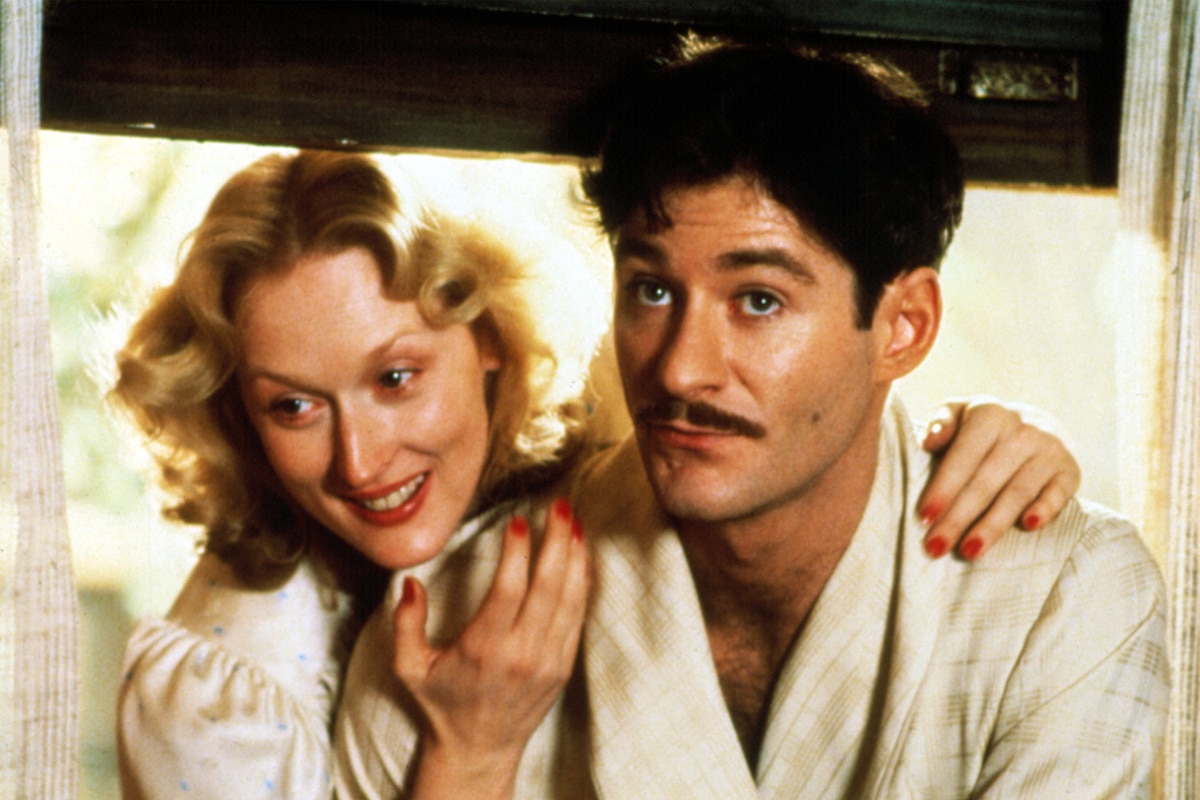

Alan J. Pakula's Sophie's Choice (1982), from William Styron's novel about the after-effects of Holocaust evil, gives us one of cinema’s most memorable incarnations of survivor's guilt. If Meryl Streep had inscribed no performance other than this film's tortured Polish woman who can't forgive herself for continuing to live while witnessing so much wrenching death, it would have insured her place in film history. Sophie is forced to make many choices – not between life and death, but between death and even worse death. History, despite its overwhelming presence, isn't what gives Sophie's Choice its power. It's Streep's tragic heroine tearing at our hearts, as she lives and relives the agony she can never shake for long. She throws herself into desperate, fleeting breakouts of sex and alcohol, revolving around her Jewish American lover, Nathan (Kevin Kline), equally damaged in different ways.
Life, intoxicating as it can get during these brief, heady interludes, is never a match for death. Sophie's tragedy is that she can't see how heroic she has been, and is. She thinks of herself as a failure. Streep's pale-skinned delicate features become a geography of human torment. Her immersion into the character of Sophie includes an immersion into the Polish language - not just impersonation, but internalization. Connecting with her own inner guttural sounds, her flawed, heavily accented English is pitch-perfect. It's also a matter of pulling a primal depth of sound from her gut that contributes to Sophie's innate earthiness, liveliness and integrity, though she’s never able to escape being engulfed by an undertow of sadness.
Streep’s performance isn’t just an ambulatory accent; she's a personification of soul-sickness, weariness and too much experience of the wrong kind, from the day her stomach convulses when she learns that the respected law professor father in Cracow– who she adored and whose love she craved, whose speeches she dutifully typed–was a rabid anti-Semite who helped devise the Final Solution. Being sympathetic to the Resistance but stopping short of getting actively involved doesn't keep her from being rounded up with her two small children and stuffed into an Auschwitz-bound boxcar, a Polish Catholic as doomed as the Jews she accompanies. Streep is all the more affective for having chosen to let us see the control Sophie exercises - most of the time.
Much of what she says is with her eyes, sometimes candid, sometimes breaking the gaze of her friend and confessor, Peter MacNicol's young observer figure and Styron surrogate, Stingo. He literally gives the film much of its voice, as narrator and innocent novice who comes to Brooklyn from Virginia in 1947 to become a novelist, touchingly following in the footsteps of Thomas Wolfe and, inevitably in his literary style, Faulkner. Structurally, he's necessary. He's the one who hears Sophie's secrets, hitherto hidden parts of her past she can't divulge to Nathan – including one final soul-destroying one. Not that Styron–or Pakula–gives the Southern writer the best of anything. Of the character's romantic ardor and talent with language there is no doubt. But he's a bit of a pipsqueak, a blank slate.
Pakula, of Polish-Jewish lineage, has said that if his father hadn't come to America, his family might well have perished at Auschwitz. Certainly, there is conviction in his film's measured progression of moods. Its problematic flashbacks from the novel never break the momentum – although a lot of the tension in them comes from the frozen alertness and fear in Streep's eyes as Sophie, hating herself more and more each time she falls back on survival reflexes. Pakula and his cinematographer, Nestor Almendros, take a chance by contrasting the desaturated Agfacolor-like concentration camp sequences with Sophie's recollection of them in closeup, face framed by spun-gold hair, lips painted scarlet, visage bathed in icy blue light that reinforces her self-image as a walking corpse, a vision of dead loveliness. It's an aesthetic gamble that wins. We understand viscerally why the young writer becomes drawn to her and longs to supplant Nathan as her lover.
Today, Sophie and Nathan would be considered codependent enablers for their shared sado-masochism. They're love and death in the same package. Since Sophie and Nathan have befriended the writer named Stingo, and drag him from his solitude into their restored Victorian Brooklyn rooming house to party and join their spirited capers, the element of betrayal is present in spades, too. After Sophie drinks with Stingo when Nathan isn't around, Nathan accuses Stingo of moving in on "his girl" and accuses Sophie of letting him. Nathan's paranoia on this score isn't altogether unfounded. Still, the brilliant, impulsive and, on rare occasions, tender Nathan's roller-coaster ups and downs suggest that not all is well with him either as he seesaws between manic elation and murderous depression. Nathan's extremes contrasts Kline with Streep's detailing – her brilliant, seemingly improvisatory way of sometimes letting the faintest curl of an extended finger, or a vocal hesitation, or a distracted tugging at a loose strand of her golden hair do the talking. She's cool but avoids mannerism. With Nathan, you quickly just wait for the next outsized gesture. Pakula, ever sensitive to mood, charges the emotional air with tense expectation.
Kline's is a performance appreciated for its choices and even subtlety, partly because Nathan's paranoid schizophrenic mood swings make us uncomfortable, squirmy. MacNicol's Stingo does, too, because whatever else he is–sensitive, good, chivalric–he's also something of a drip. It was Streep who recommended Kline to Pakula even before she was cast as Sophie. Cloaked in inevitability as her Oscar-winning performance is, it's illuminating to recall that Streep was far from a shoo-in for the role. Styron went on record as favoring Ursula Andress as Sophie. Pakula's first choice was Liv Ullmann for her ability to project the foreignness that would add to her appeal in the eyes of an impressionable, romantic Southerner. Ullmann went on to other projects when Pakula took two years to fashion the screenplay. Polish actress Magda Vasaryova, Barbra Streisand, Marthe Keller and Streep (like Pakula, a Yale Drama School grad) threw their hats in the ring. Finally, Streep prevailed, a Slavic Blanche DuBois, gallantly but vainly trying to outrun her conviction that she owes the universe a death – hers.
Producers: Keith Barish, Alan J. Pakula
Director: Alan J. Pakula
Screenplay: Alan J. Pakula; William Styron (novel)
Cinematography: Nestor Almendros
Art Direction: John J. Moore
Music: Marvin Hamlisch
Film Editing: Evan Lottman
Cast: Meryl Streep (Sophie Zawistowski), Kevin Kline (Nathan Landau), Peter MacNicol (Stingo), Rita Karin (Yetta), Stephen D. Newman (Larry Landau), Greta Turken (Leslie Lapidus), Josh Mostel (Morris Fink), Marcell Rosenblatt (Astrid Weinstein), Moishe Rosenfeld (Moishe Rosenblum), Robin Bartlett (Lillian Grossman), Eugene Lipinski (Polish professor), John Rothman (librarian).
C-151m. Letterboxed.