
"A story of two old people going up and down an African river... Who's going to be interested in that? You'll be bankrupt." So spoke British producer Alexander Korda to American producer Sam Spiegel upon learning that Spiegel wanted to film “The African Queen.” Korda wasn't alone in his skepticism. The novel by C.S. Forester had been making the Hollywood rounds since its 1935 publication. Columbia originally bought it as a vehicle for Charles Laughton and his wife Elsa Lanchester. When that duo instead made The Beachcomber (1938), a similar story, the deal fell through. Warner Bros. then bought it for Bette Davis and David Niven, but that deal also unraveled before the property ultimately found its way to Spiegel. "It will give John [Huston] the kind of commercial hit he had when he made The Maltese Falcon [1941]," Spiegel boasted to “The New Yorker” before shooting even began. But Spiegel would turn out to be right: the roughly $1.3 million gamble turned out to be not only a critical success, earning four Oscar nominations, but a huge commercial hit, pulling in $4.3 million in its first release.
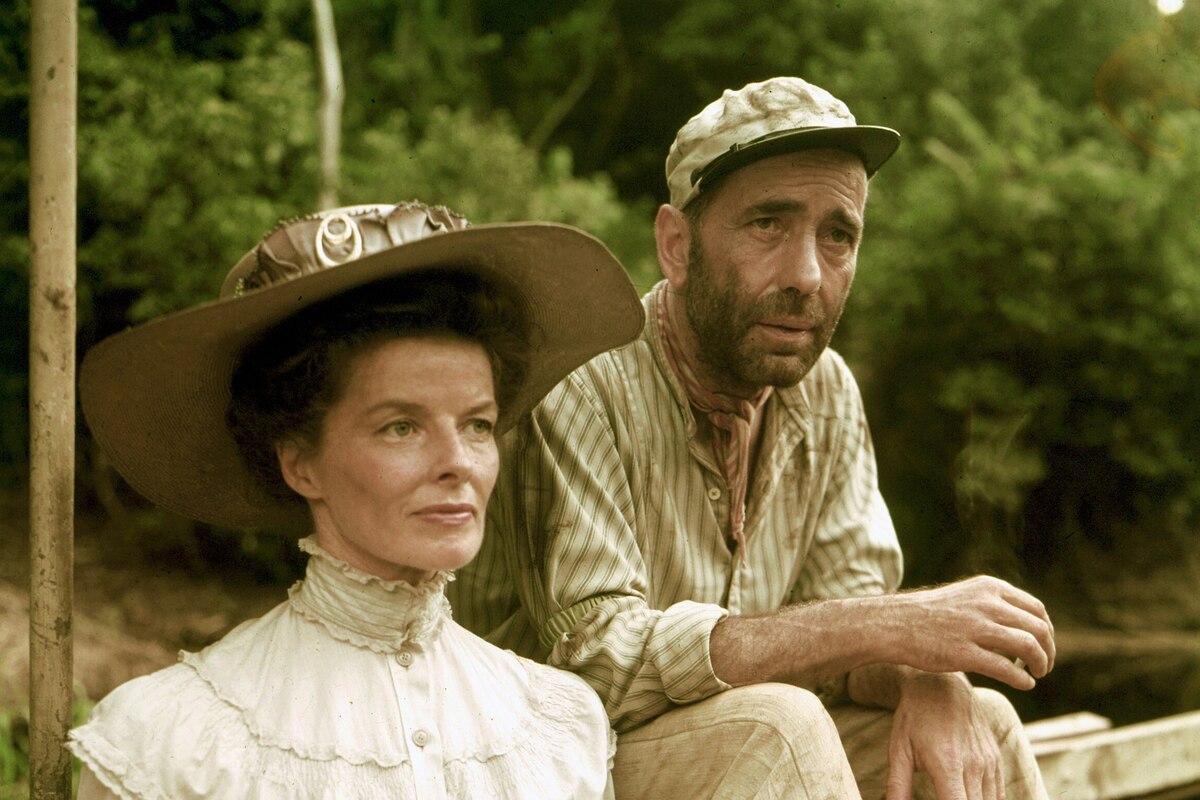
The African Queen (1951) is set at the beginning of WWI. German troops set fire to an African village, resulting in the death of an English missionary. His straightlaced sister Rose (Katharine Hepburn), now alone, is taken aboard a riverboat, the African Queen, by its gin-soaked Canadian skipper, Charlie Allnut (Humphrey Bogart). Allnut would love to sit out the war just drinking and smoking, but Rose convinces him otherwise; newly invigorated and desiring revenge, she persuades him to take her downriver where they will try to destroy a German U-boat using homemade torpedoes. Along the way, the unlikely pair falls in love.
The location shoot in the African Congo turned out to be one of the most difficult, most legendary and most recounted in Hollywood history. To start, the company arrived in Africa without a finished script. James Agee had collaborated with Huston on the screenplay, but a heart attack kept Agee from flying to Africa for the shoot and from writing the film's ending. Instead, Peter Viertel came in to help, and he later related his run-ins with Huston in his novel “White Hunter, Black Heart,” a thinly disguised expose of the making of The African Queen and its director who would rather hunt elephants than shoot film. (Clint Eastwood directed a film version of that book in 1990, playing the Huston character himself.) Hepburn's entertaining 1987 book “The Making of the African Queen” also details Huston's obsession with hunting. One day he even convinced Hepburn to join him, and he inadvertently led her into the middle of a herd of wild animals from which they were lucky to escape alive.
Bogart hated Africa immediately and was miserable, but Hepburn adored it, calling it "utterly divine." Bogie complained about everything: the heat, the humidity, the dangers, the food. "While I was griping," said Bogart in a later interview, "Katie was in her glory. She couldn't pass a fern or berry without wanting to know its pedigree, and insisted on getting the Latin name for everything she saw walking, swimming, flying or crawling. I wanted to cut our ten-week schedule, but the way she was wallowing in the stinking hole, we'd be there for years." Huston loved being in Africa just as much as Hepburn, which further irritated Bogart. Huston took his time with everything and was in no rush to leave. Whenever it would rain, which was often, Huston would go off hunting with his rifle, obsessed with bagging his ever-elusive elephant.
Other location problems included sun, rain, snakes, scorpions, crocodiles, tsetse flies, hornets, huge biting-black ants and constant humidity which created mildew everywhere. Further, the African Queen's engine had problems: rope would get tangled in its propellers, sound from the generator would interfere with shots. One night the Queen sank, and it took three days to raise the boat and get it ready again. There also were no toilets except the outhouse back at camp. The food was OK but the dishes were washed in infected river water and virtually everyone in the cast and crew got sick – except for Bogart and Huston, which they attributed to the fact that they basically lived on imported Scotch. Bogart later said, "All I ate was baked beans, canned asparagus and Scotch whiskey. Whenever a fly bit Huston or me, it dropped dead."
Bogart’s wife, actress Lauren Bacall, helped out on-set by preparing lunches for the cast and crew since she was the only one not directly involved in the filming. Bogart was miserable – the jungle noises kept him up at night along with the scorching heat and humidity, and he and Huston drank too much. Bacall did her best to be cheerful and make their accommodations as homey as possible. Slowly but surely she forged a friendship with Hepburn, while Bogie worried about whether or not they would ever get out of Africa.
Bacall also played nursemaid to the cast and crew whenever anyone got sick, which was often. There was dysentery, malaria and bites from all sorts of bugs to deal with. One night a crew member even came down with appendicitis. Bacall saved the day by being the only one who had thought to bring antibiotics, which were given to the man before he was rushed to the closest hospital in Stanleyville for emergency surgery. Even the stoic Hepburn finally succumbed to illness towards the end of shooting, though she had taken every precaution imaginable.
But in Hepburn's memoir, the shoot nonetheless comes off as a grand adventure, led by Huston, a man with a strong but odd personality. Hepburn was frustrated with Huston's lack of interest in discussing the script–which Hepburn thought had major problems–before leaving for Africa. Finally he "ambled" up to her hut one morning and began to talk the script over with her. "We had long and amiable arguments," wrote Hepburn. "Nothing much was done, really, and I seemed to be happy. I found that I could be quite honest with John about what I thought, and I also found that where I had good ideas he would take them. Where I was just worrying and confusing the issue, he would say, 'Let it alone.'"
As Hepburn found out from Bogart, Huston's nickname was "the Monster" for the way he tended to treat people around him. He enjoyed seeing his actors suffer, it seemed. Simply deciding to shoot in the Congo was one way of torturing everybody. Another example was the scene in which Bogart finds his body entirely covered with leeches. (The scene was actually shot in the studio in London). Bogart insisted on using rubber leeches. Huston refused, and he brought a leech-breeder to the studio with a tank full of them. This made Bogart queasy and nervous – qualities Huston wanted for his close-ups. Ultimately, rubber leeches were placed on Bogart, and a close-up of a real leech was shot on the breeder's chest. Hepburn observed these kinds of incidents and later wrote of Huston, "I never did see him go to the outhouse. Maybe he never did. Wouldn't surprise me a bit. Would explain a great deal."
Still, for all Huston's oddities and the pranks that he and Bogart pulled on Hepburn (such as writing dirty words in soap on her mirror), she came to respect his talent deeply. One episode in particular won her over for good. The director had been dissatisfied with Hepburn's performance, finding it too serious-minded. He came calling at her hut one day and suggested that she model her performance on Eleanor Roosevelt – to put on her "society smile" in the face of all adversity. Huston left the hut, and Hepburn sat for a moment before deciding, "that is the goddamnedest best piece of direction I have ever heard." Hepburn, Bogart, Huston and Agee went on to earn Oscar nominations, and Bogart won the Best Actor Academy Award for the first and only time in his career.
Producer: Sam Spiegel, John Woolf
Director: John Huston
Screenplay: James Agee, John Huston, Peter Viertel, C.S. Forester (novel)
Cinematography: Jack Cardiff
Film Editing: Ralph Kemplen
Art Direction: Wilfred Shingleton
Music: Allan Gray
Cast: Humphrey Bogart (Charlie Allnut), Katharine Hepburn (Rose Sayer), Robert Morley (Rev. Samuel Sayer), Peter Bull (Captain of Louisa), Theodore Bikel (First Officer), Walter Gotell (Second Officer).
C-105m. Closed captioning.