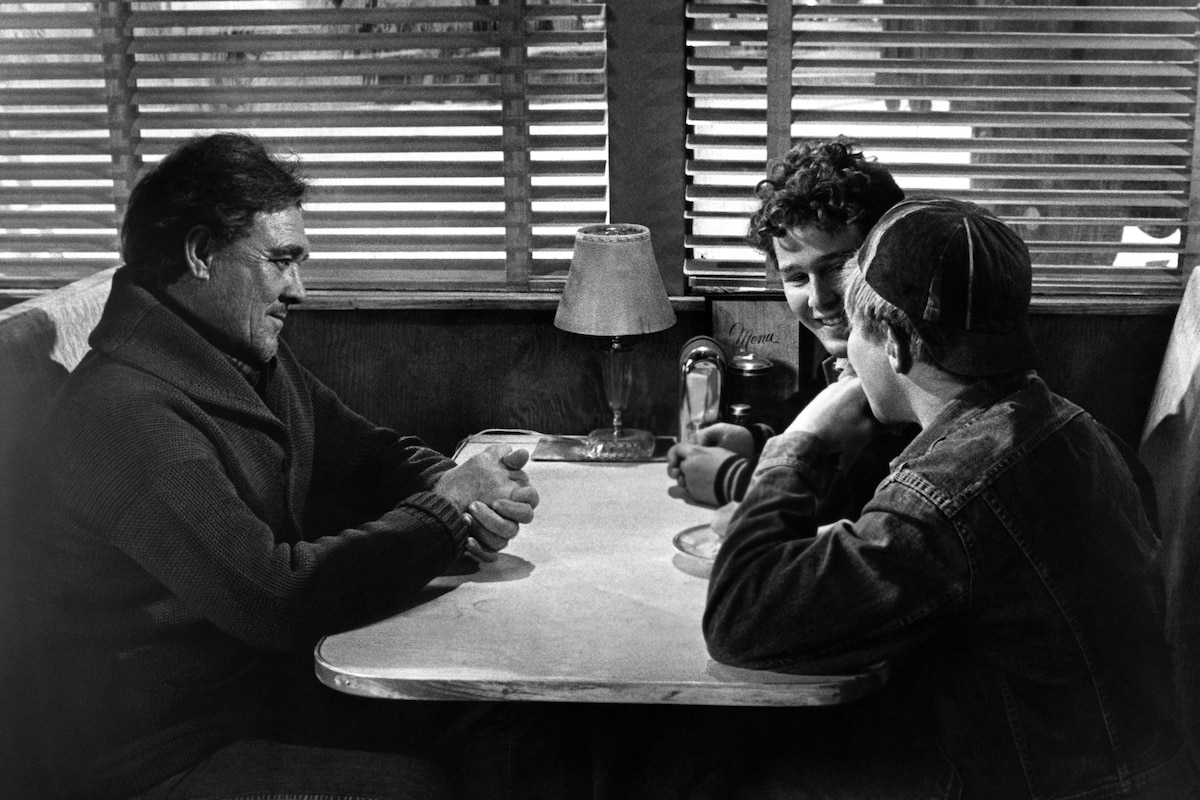

In the early 1950s, Sonny Crawford (Timothy Bottoms) is coming of age in the desolate town of Anarene, Texas. Sonny's closest friends are his high school buddy Duane Jackson (Jeff Bridges) and his surrogate father Sam the Lion (Ben Johnson), whose tough-minded integrity stands in contrast to everyone around him. Eager to experiment with sex, Sonny begins an affair with his coach's wife (Cloris Leachman). However, his understanding of the world is thrown into question when Sam the Lion suddenly dies and his relationship with the coach's wife proves emotionally complicated.
One could argue that Peter Bogdanovich never topped The Last Picture Show (1971), his second feature and surely one of the great films of the 1970s. This is due not only to Bogdanovich's direction, but also the strength of the original source material (the 1966 novel of the same title by Larry McMurtry), its excellent ensemble cast and its gritty black-and-white cinematography by the Hollywood veteran Robert Surtees.
A basic part of the film's success arises from its authentic portrayal of small-town life, which it derives from the novel. Texas-born writer Larry McMurtry has had an unusually close, career-long relationship with the film medium. His first novel “Horsemen, Pass By” in 1961 was adapted into Martin Ritt's Hud (1963). The reason for this is not difficult to fathom: McMurtry's depictions of small-town life in the West, with their unsparing but compassionate examination of stunted lives and their ironic echoes of the Western genre, offered strong material for filmmakers interested in exploring adult subjects. Other significant adaptations of McMurtry novels include Terms of Endearment (1983), the TV miniseries Lonesome Dove (1989), Texasville (1990)–a sequel to The Last Picture Show–and The Evening Star (1996).
The novel “The Last Picture Show,” like McMurtry's previous works, attracted some controversy upon its publication in 1966 due to its unusually frank treatment of sex. The difference between this novel and so many of the steamy potboilers that were in vogue at that time is that McMurtry showed how people relate to each other through sex, and also how repressive social mores regarding sex warp individual characters' lives. For example, even though the character of Jacy, played by Cybil Shepard, is depicted as shallow and manipulative, we come to understand how she is a product of established social attitudes towards gender and class differences. In the same vein, one of McMurtry's main themes is the burden of masculinity in the modern West. One can in fact trace a direct line from “The Last Picture Show” as a novel to Annie Proulx's short story "Brokeback Mountain" and its acclaimed film version, for which McMurtry and his creative partner Diana Ossana wrote the Academy Award-winning screenplay adaptation.
Another aspect that contributes to the film's enduring appeal is its remarkable ensemble of actors, including many younger performers whose careers took off significantly as a result of the film. Though Jeff Bridges’ fame eventually eclipsed his co-star Timothy Bottoms, Bottoms continued a career of unique, interesting characters in a variety of genres. Due to his uncanny resemblance to former President George W. Bush, Bottoms appeared both in the short-lived Trey Parker/Matt Stone satirical sitcom “That's My Bush!” in 2001 and the all-too-serious Showtime docudrama DC 9/11: Time of Crisis in 2003. Randy Quaid, who leaves an indelible impression in his small role as the goofy, leering Lester Marlow, also appeared in Peter Bogdanovich's directorial debut Targets (1968) and collaborated with the director again in What's Up Doc? (1972) and Paper Moon (1973). Eileen Brennan first made her mark in the off-Broadway musical “Little Mary Sunshine” and appeared on “Rowan and Martin's Laugh-In,” but her most famous role is undoubtedly Captain Doreen Lewis in Private Benjamin (1980).
Cybill Shepherd was working as a model when she was selected for the role of Jacy in The Last Picture Show. Her lack of acting experience caused considerable concern among the film's producers, though one could argue that she works well in the film both in terms of the character she portrays and because her fresh beauty is necessary to motivate the reactions of the other characters. Her next two films with Bogdanovich, Daisy Miller (1974) and At Long Last Love (1975), were legendary flops, but she attracted a new fan base with the cult hit TV series Moonlighting in 1985. She cemented a name for herself as the star of “Cybill” in 1995, a bitter television comedy about a never-quite-successful actress in Hollywood. This role earned her an Emmy for Lead Actress in a Comedy Series.
The choice of Ben Johnson for the role of Sam the Lion is key to the film's impact on more than one level. Not only was he a fine actor, but he was closely associated with the Western throughout his career, working with directors such as John Ford and Sam Peckinpah. This helps translate the novel's subtle underlying commentary on the Western genre into purely cinematic terms, as do the clips of films such as Red River (1948) and Winchester '73 (1948) onscreen in the film's aging, soon-to-be-closed movie theater. Both Johnson and Cloris Leachman won Oscars for their supporting roles. Bridges and Ellyn Burstyn also received nominations, as did Robert Surtees' cinematography and Bogdanovich and McMurtry's screenplay adaptation. The film itself was nominated for Best Picture. The 127-minute "director's cut" of the film restores about seven minutes of footage taken out before the film's initial theatrical release.
The full episode of The Plot Thickens: I’m Still Peter Bogdanovich during which The Last Picture Show is discussed is below:
Producers: Stephen J. Freidman, Bert Schneider and Harold Schneider.
Director: Peter Bogdanovich.
Director of Photography: Robert Surtees.
Screenplay: Peter Bogdanovich and Larry McMurtry.
Editing: Donn Camern.
Production Design: Polly Platt.
Cast: Timothy Bottoms (Sonny Crawford), Jeff Bridges (Duane Jackson), Cybill Shepherd (Jacy Farrow), Ben Johnson (Sam the Lion), Cloris Leachman (Ruth Popper), Ellen Burstyn (Lois Farrow ); Eileen Brennan (Genevieve ), Sam Bottoms (Billy), Sharon Ullrick. (Charlene Duggs), Randy Quaid (Lester Marlow), Joe Heathcock (The Sheriff), Bill Thurman (Coach Popper), Barc Doyle (Joe Bob Blanton), Jessie Lee Fulton (Miss Mosey).
BW-127m. Letterboxed. Closed captioning.