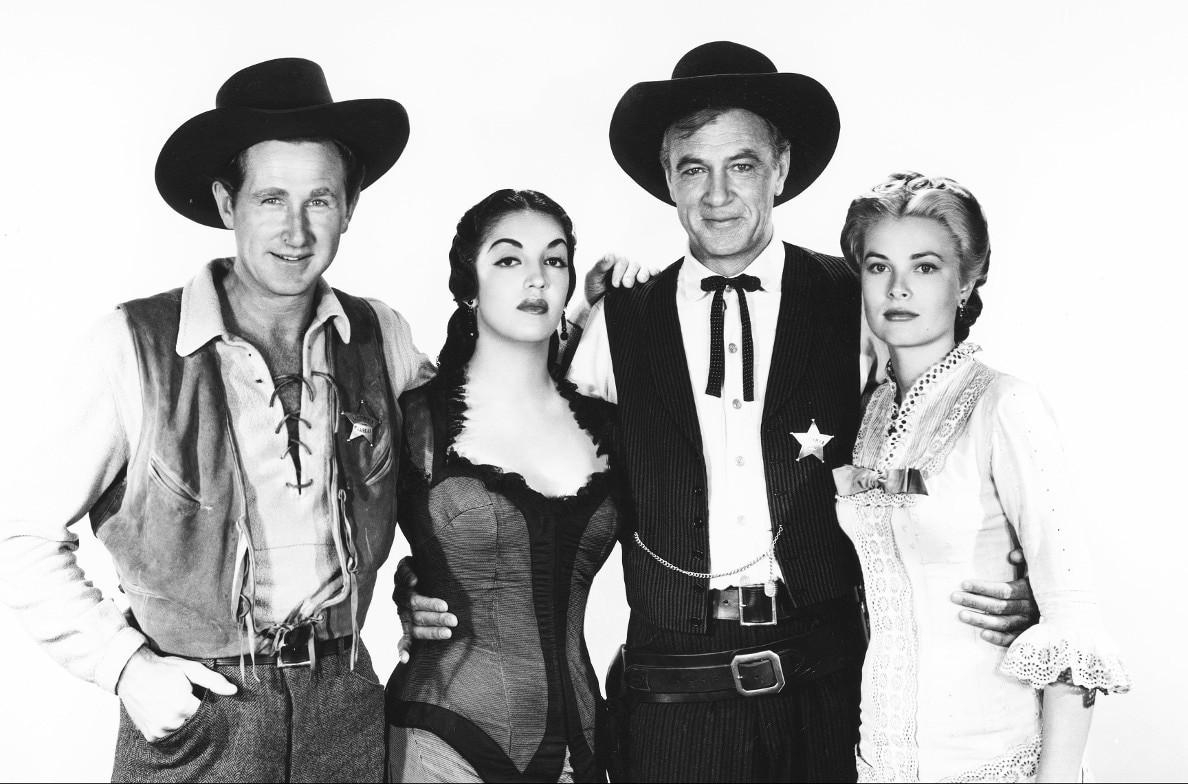

Marshall Will Kane (Gary Cooper) is looking forward to his honeymoon with his new bride, Amy (Grace Kelly). But as he and his wife prepare to leave town, Kane is informed that Frank Miller (Ian MacDonald), his former nemesis, is out of jail and on the way to Hadleyville for a showdown with him. Not one to back down from a confrontation, Will decides to postpone his honeymoon and face the murderous outlaw and his gang. However, as the lone sheriff attempts to enlist some of the townspeople to help him, he quickly discovers that no one is willing to risk their life beside him. As the minutes tick away toward the final showdown, he prepares to meet his fate alone.
Producer Stanley Kramer was lucky to have secured the services of director Fred Zinnemann for High Noon. Given the film's tight production schedule and a total budget of $750,000, there was no room for extravagance or experimentation. Zinnemann had to memorize every shot and its exact place in the overall picture. As Zinnemann recounted, "Fortunately, from the old days in MGM's Shorts Department, I was used to 'making' the movie in my own head long before the actual shooting." His ability to plan shots prior to shooting saved a great deal of time and money.
Zinnemann and company shot a large part of High Noon on the Columbia "ranch," the company's backlot in Burbank, which was right next door to the Warner Brothers studio. By shooting in Burbank and the Los Angeles area, Zinnemann used the L.A. trademark smog to his advantage. For one thing, it made the sky look blindingly white which was just how Zinnemann wanted it to appear in contrast to Will Kane's black clothes. In preparation for the film's visual look, Zinnemann and photographer Floyd Crosby also studied the Civil War photographs by Mathew Brady. This grainy, flat light approach ran counter to how most Westerns were shot, particularly the sagebrush sagas of John Ford (My Darling Clementine, 1946) and Howard Hawks (Red River, 1948).
Gary Cooper was not the first choice to play Will Kane. In fact, he was much further down on a list that included Marlon Brando, Montgomery Clift, Charlton Heston and Gregory Peck, who turned it down because he did not think the film could match his earlier Western, The Gunfighter (1950). It was even reported that John Wayne was offered the role, although he also nixed it. At the time he was offered the lead in High Noon, Cooper's career was in decline and so was his health. He was plagued with stomach ulcers, lower back troubles and a recurring hip problem that flared up frequently, impairing his walk. His various ailments made film shooting difficult for him, but he once again proved his professionalism by not allowing his physical hardships to stop him from working long, hard hours.
Aside from physical problems, his emotional state was not much better. Separated from his wife, and at the end of a passionate affair with actress Patricia Neal, Cooper looked older than his 50 years. His gaunt and haggard appearance worked to his advantage - he required almost no make up for his role. But one of the reasons Cooper took the part was because it represented what his father, a Montana state Supreme Court justice, had taught him: that law enforcement was everybody's job.
Twenty-two year-old novice actress Grace Kelly made her first significant film appearance in High Noon. She disparaged her own performance, feeling that she was too stiff and wooden as Amy Kane. But Zinnemann thought her inexperience was appropriate for the role that was rather limited in scope. As Zinnemann said, "[Kelly] at the time wasn't equipped to do very much...She was very wooden...which fitted perfectly, and her lack of experience and sort of gauche behavior was to me very touching–to see this prim Easterner in the wilds of the Burbank Columbia backlot–it worked very well."
Rumors began flying as soon as Cooper and Kelly met on the set of High Noon. The two actors were notorious for enjoying romantic liaisons with their co-stars. In public, Cooper stated his admiration for Kelly's acting when he said, "She was very serious about her work...She was trying to learn, you could see that. You can tell if a person really wants to be an actress. She was one of those people you could get that feeling about." For her part, Kelly was equally complimentary of Cooper. She said in an interview, "He's the one who taught me to relax during a scene and let the camera do some of the work. On the stage you have to emote not only for the front rows, but for the balcony too, and I'm afraid I overdid it. He taught me the camera is always in front row, and how to take it easy..."
In his biography, “A Life in the Movies,” Zinnemann noted, “[High Noon] seems to mean different things to different people. (Some speculate that it is an allegory on the Korean War!) [Stanley] Kramer, who had worked closely with [Carl] Foreman on the script, said it was about 'a town that died because no one there had the guts to defend it.' Somehow this seemed to be an incomplete explanation. Foreman saw it as an allegory on his own experience of political persecution in the McCarthy era. With due respect I felt this to be a narrow point of view. First of all, I saw it simply as a great movie yarn, full of enormously interesting people. I vaguely sensed deeper meanings in it; but only later did it dawn on me that this was not a regular Western myth....To me it was the story of a man who must make a decision according to his conscience. His town–symbol of a democracy gone soft–faces a horrendous threat to its people's way of life....It is a story that still happens everywhere, every day....The entire action was designed by Foreman and Kramer to take place in the exact screening time of the film - less than ninety minutes."
High Noon proved to be a huge critical and popular success when released and garnered seven Oscar nominations, including Best Picture prior to the 1953 Academy Awards ceremony that year. It won statues for Gary Cooper (Best Actor), Best Film Editing, Best Music Score and Best Song ("Do Not Forsake Me, Oh My Darlin'"), which was performed in the film by Tex Ritter. (It also became a hit for Western balladeer Frankie Laine). Kramer noted in his biography, “It's a Mad, Mad, Mad, Mad World: A Life in Hollywood,” that “High Noon's defeat in the Oscar race by Cecil B. DeMille's circus picture, The Greatest Show on Earth, had to be largely political, and I'm not referring to the unspoken old-boy politics of Hollywood's inner circle. I still believe High Noon was the best picture of 1952, but the political climate of the nation and the right-wing campaigns after High Noon had enough effect to relegate it to an also-ran status. Popular as it was, it could not overcome the climate in which it was released. Carl Foreman, who wrote it, had by then taken off for England under a cloud of accusations as a result of his political beliefs. Between the time he turned in the script and the time the Academy voted, we all learned that he had been a member of the Communist Party, but anyone who has seen the picture knows that he put no Communist propaganda into the story. If he had tried to do so, I would have taken it out."
Producer: Stanley Kramer, Carl Foreman
Director: Fred Zinnemann
Screenplay: Carl Foreman, based on the story "The Tin Star" by John W. Cunningham
Cinematography: Floyd Crosby
Editing: Elmo Williams
Music: Dimitri Tiomkin
Art Direction: Ben Hayne
Cast: Gary Cooper (Marshal Will Kane), Grace Kelly (Amy Kane), Thomas Mitchell (Jonas Henderson), Lloyd Bridges (Harvey Pell), Katy Jurado (Helen Ramirez), Otto Kruger (Judge Percy Mettrick), Lon Chaney, Jr. (Martin Howe), Harry Morgan (Sam Fuller), Ian MacDonald (Frank Miller), Lee Van Cleef (Jack Colby), Sheb Wooley (Ben Miller).
BW-85m. Closed captioning.