
Legend has it that Oxford professor John Ronald Ruel Tolkien was grading examination papers one day in the early 1930s at Pembroke College when he scribbled absently on a blank page, "In a hole in the ground there lived a hobbit." A veteran of World War I and a former employee of the Oxford English Dictionary (where he had been tasked with hunting down the Germanic origins of words beginning with the letter "w"), Tolkein would channel his fascination with Norse and Finnish mythology, philology, Germanic literature, historic fiction, William Shakespeare, Charles Dickens, George MacDonald and such "hollow earth" adventures as H. Rider Haggard's “She” and Jules Verne's “Journey to the Center of the Earth” into his 1937 children's novel “The Hobbit.”
Wildly successful upon its publication, the book – the story of a quest and war in the time between the dawn of fairies and the dominion of mankind – inspired Tolkien's publishers to demand a follow-up, further adventures for his denizens of "Middle Earth." Committed to his full-time academic vocation, Tolkien consented but warned publishers George Allen and Unwin that his progress would be slow. It took J. R. R. Tolkien 12 years to complete “The Lord of the Rings,” a massive work of epic high fantasy, a mythopoeia that surpassed the imaginative other worlds of Edgar Rice Burroughs and Robert E. Howard. Though Tolkien had conceived of “The Lord of the Rings” as a self-contained work, his publishers divided the lengthy tome into three parts to be published sequentially between 1954 and 1955; during that period, the author aged from 45 to 63 years old.
Various attempts to adapt “The Lord of the Rings” for cinema were broached over the ensuing years, both leading up to and past Tolkien's death in 1973. At one point, the Beatles hoped to divert some of their shared fortunes into a film adaptation, ideally with Stanley Kubrick at the helm, but Tolkien was disinterred in what the Fab Four might do to his narrative. Few filmmakers who considered taking on such a project were fooled into thinking mounting Tolkien's tale would be an easy thing. But John Boorman (having dabbled in fantasy with his Wizard of Oz-inspired Zardoz) declared that he would make an attempt and bring it in under 100 minutes. When Boorman's plans fell through, animator Ralph Bakshi (whose 1977 feature Wizards was influenced by the Middle Earth books) struck a deal with Tolkien's daughter to bring her father's trilogy to the big screen in animated form. Bakshi's The Lord of the Rings (1978) combined the first two books–The Fellowship of the Ring and The Two Towers–into a single feature, with plans to handle “The Return of the King” as a sequel. Clocking in at two hours and 12 minutes, The Lord of the Rings was the first fully rotoscoped animated feature, shot live with actors in Spain and augmented with cell painting to strike an eerie balance between traditional animation and live action. (Among Bakshi's crew of young animators was a young, uncredited Tim Burton.) Though the $4 million feature grossed over $30 million, Bakshi's sequel never materialized.
Bakshi's The Lord of the Rings exerted great influence. An adaptation of “The Hobbit,” made for television via conventional animation by Arthur Rankin and Jules Bass, had beat The Lord of the Rings to the public in 1977; it was followed by a small screen cartoon adaptation of The Return of the King (1980), again courtesy of Rankin-Bass. Among the legion of fantasy fans inspired by the Bakshi feature was a young New Zealander named Peter Jackson, a self-professed film fanatic who had completed his first feature, Bad Taste (1987), at age 22. Interested in remaking the original King Kong (1933) with state of the art computer-generated animation, Jackson saw the project put on hold at Universal due to the pending release of two big budget/big monster remakes: Joe Johnson's Mighty Joe Young and Roland Emmerich's Godzilla (both released in 1998).
In his frustration, Jackson renewed his interest in the Tolkien saga and won production rights from producer Saul Zaentz, who had backed the Bakshi film. Striking a deal with Disney-owned Miramax, Jackson began laboring over the adaptation, with the agreement being that two films would be necessary to tell the tale properly. Jackson and partner Fran Walsh produced a 90-page treatment, which was adapted by the team with screenwriter Philippa Boyens. As location scouting began in New Zealand, Miramax grew wary of a budget that promised to rise in excess of $150 million (with $15 million having already been spent in pre-production) and suggested that Jackson consider blending the whole of the Tolkien saga into one film. Jackson refused and Miramax granted him permission to shop his scripts elsewhere.
Executives at New Line Cinema were much more receptive to the idea of a sprawling adaptation that would give “The Lord of the Rings” its proper due and went the extra mile of suggesting to Jackson that he make three films instead of two. After a lengthy period of pre-production, principal photography for The Lord of the Rings began in October 1999, with the plan being to complete the trilogy as one complete project but to release it in three parts. Casting ideas and options for The Fellowship of the Rings (2001) ran the gamut from the inspired (Sean Connery as the wizard Gandalf, David Bowie as the half-elf Elrond) to the quizzical (Vin Diesel as the mighty Aragorn, a role turned down by Daniel Day-Lewis, Nicolas Cage and Russell Crowe).
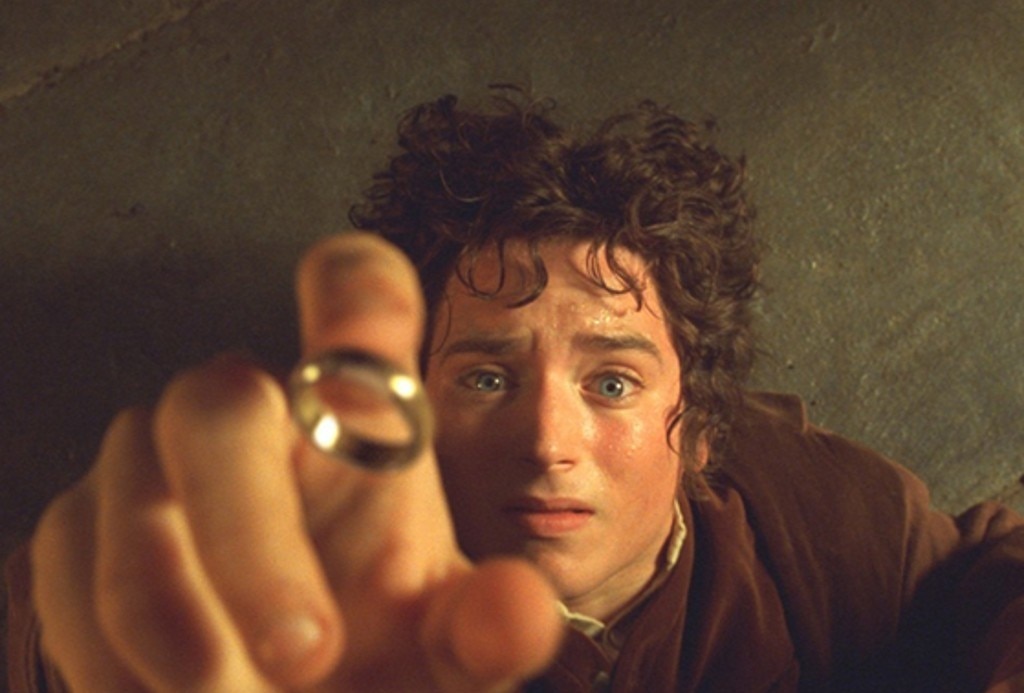
Interested less in star wattage than in fitting the right actor to the right role, Jackson settled on a mix of veteran (but hardly superstar) performers (Ian McKellen as Gandalf, Viggo Mortensen as Aragorn, Sean Bean as the tragic and penitent Boromir) and newcomers (principally American actor Elijah Wood as hobbit protagonist Bilbo Baggins) and Orlando Bloom (soon to emerge as a star in his own right in Disney's Pirates of the Caribbean franchise). Support casting was no less inspired, with Cate Blanchett retained to play the elf Galadriel and former Hammer horror star Christopher Lee (an authority on Tolkien, who acted as a technical advisor) offered the pivotal role of the evil Saruman, the lord of the title, whose dastardly actions have set, at the top of The Fellowship of the Ring, the trilogy in motion.
Shooting The Lord of the Rings would last for 18 months, most of it spent on location in New Zealand's never-filmed conservation areas and national parks, where Jackson felt certain he could achieve his aesthetic goal of "Ray Harryhausen meets David Lean." (Jackson and his crew also went through more than a thousand miles of film to complete the entire trilogy.) Given the breadth and scope of the production, casualties were relatively few and minor. Christopher Lee broke his hand during filming while Viggo Mortensen fractured two toes while shooting repeated takes of one scene and suffered facial bruising while surfing off the New Zealand coast during his down-time. Liv Tyler, as the Elf princess Arwen, stabbed herself in the right thigh on camera while Sean Astin (cast as Bilbo's amanuensis Samwise Gamgee) impaled his foot on a shard of glass while wading into Mavora Lakes (substituting for Tolkien’s Nen Hithoel).
Some painful blunders even made it into the finished film, perhaps none more indelibly than Gandalf's painful encounter with a low-hanging ceiling beam; actor Ian McKellen misjudged his angle of passage under the beam and conked his head but his ability to act through and use the pain for the purpose of the scene so impressed Jackson that he left the moment intact. Shooting The Fellowship of the Ring proved to be such a bonding experience for Wood, McKellen, Mortenson, Astin, Bean and their castmates who comprised the filmic fellowship that eight of the nine had the elvish character for "nine" tattooed somewhere on their bodies; actor John Rhys-Davies (as the fellowship's token dwarf, Gimli), demurred but offered up his stunt double in his place.
Sources:
Peter Jackson: A Filmmaker's Journey by Brian Sibley (Harper Collins, 2006)
The Lord of the Rings: The Making of the Movie Trilogy by Brian Sibley (Houghton-Mifflin, Harcourt, 2002)
Lord of Misrule: The Autobiography of Christopher Lee by Christopher Lee (Orion, 2004)
"Kingdom Come: Graham Fuller Hails Peter Jackson's Monumental Tolkein Triptych" by Graham Fuller, Film Comment, Jan/Feb 2005