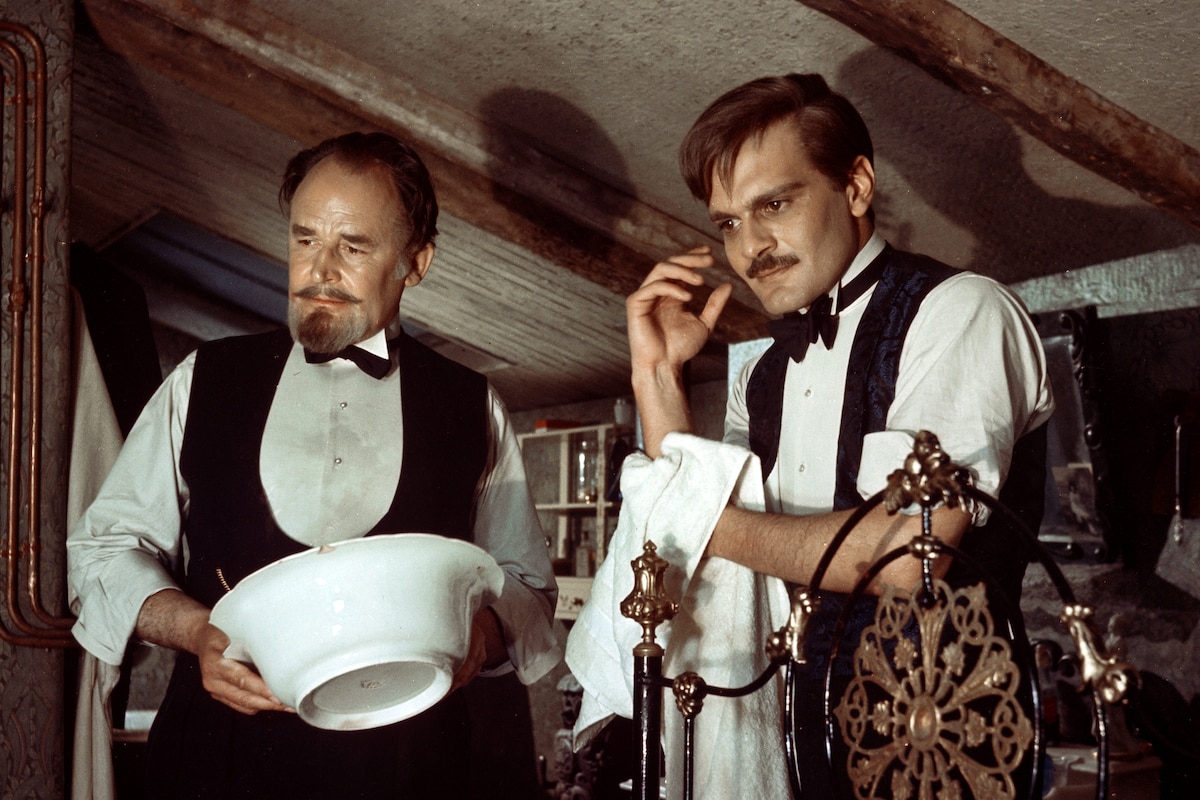
Promising young surgeon Yuri Zhivago (Omar Sharif) is happily married to a wife (Geraldine Chaplin) from a good family when a world war, the Russian Revolution and his growing passion for the beautiful Lara (Julie Christie) disrupt their lives. Though Lara inspires his greatest poetry, they are kept apart by the forces of history until Zhivago defies the Soviet government to flee with his love to the snowbound countryside of his youth. There, they snatch a few moments of happiness until she vanishes with their infant daughter, leaving Zhivago to spend the rest of his life searching for her. Years later, his half-brother, Yevgraf, tracks down a young factory worker who knows little of her past except for her passion for music and poetry, which she inherited from her father.
To cast the film, Lean turned to many of his old favorites, including Alec Guinness, who had appeared in Great Expectations (1946) and Lawrence of Arabia (1962), and Ralph Richardson (Alexander Gromeko), who had appeared in Breaking the Sound Barrier (1952). MGM executives wanted established stars in the leads, originally suggesting Paul Newman as Zhivago and Sophia Loren (producer Carlo Ponti's wife) as Lara.
Lean's first choice for the title role was Peter O'Toole, who had risen to stardom with his performance in Lawrence of Arabia. Having suffered through two years of shooting in the desert, however, O'Toole was loath to commit to a similarly grueling film shoot in what promised to be dauntingly cold climates, so he turned the film down. That triggered a rift between the director and star that would last until 1988, a few years before Lean's death. With O'Toole unwilling to make the film, Lean turned to the other actor who had risen to stardom in Lawrence: Egyptian actor Omar Sharif. The casting was a surprise to everybody, including Sharif. He had asked his agent to propose him for the role of Pasha, the student revolutionary who becomes Zhivago's nemesis. Tom Courtenay would earn an Oscar nomination for his performance in the role.
After considering several other actresses for the lead, Lean chose British newcomer Julie Christie over the studio's objections. He based his choice on a few clips from Darling (1965), which was currently in production and would go on to win her international acclaim and an Oscar; a small role in Young Cassidy (also 1965); and one scene in Billy Liar (1963), in which she played opposite Courtenay. Lean also had to fight to cast Geraldine Chaplin, daughter of the legendary Charlie Chaplin, as Zhivago's wife, Tonya. With the exception of an uncredited bit in her father's Limelight (1952), it was her first appearance in an English-language film. She had only made two other films, both in France.
Initially, Ponti wanted to shoot the film in the Soviet Union. He abandoned that idea out of fear that the Soviet authorities would try to control the film. Lean then considered Yugoslavia and the Scandinavian countries, but after visiting them with production designer John Box and continuity girl Barbara Cole, he decided they would be too cold. He also feared the corrupt Yugoslav bureaucracy would make shooting there too expensive.
When projected costs of shooting in Hollywood proved too high, Lean and Ponti moved the production to Spain, which had recently emerged as a viable production location, particularly since the Spanish Army was available for extra work in military scenes at little cost. In fact, the inhabitants of many Spanish towns and villages were often employed as extras. Other blockbusters shot in the region included El Cid and King of Kings (both 1961), not to mention portions of Lawrence of Arabia. The film's principal location in Spain was the C.E.A. Studios, near Madrid's international airport. John Box and his crew spent six months turning the 10-acre studio into a reproduction of Moscow between 1905 and 1920. Included in the set were a half-mile-long paved street, trolley lines, an authentic replica of the Kremlin, a viaduct with real train engines, a church and more than 50 businesses. Publicists touted the set as the largest ever built for a film.
For Zhivago's trip through the Russian Steppes, Box constructed sets in the mountains north of Madrid. This required diverting the course of a river to fit Lean's vision and building miles of fresh railroad tracks. Lean originally wanted to shoot each of the film's scenes in the appropriate season, so he scheduled a 10-month shoot. Unfortunately, he arrived in Spain during one of the country's mildest winters ever. After repeated delays that added $2.5 million to the budget as he waited for snow, he finally had to shoot during the warmer months.
Many winter scenes were shot in the summer, when actors had to withstand temperatures climbing to 116 degrees while muffled in Russian furs. Costume designer Phyllis Dalton had to keep a strict watch over the extras to make sure none of them were shedding layers of clothing to cool off. Sharif would later note, "We had an army of make-up assistants who every two minutes came and dabbed you because we were sweating profusely."
For scenes near Zhivago's country estate in the spring, the crew had planted 7,000 daffodil bulbs, but with the mild winter, they started blooming in January. They had to dig up the bulbs, put them into cold storage and replant them later. Not only did the mild winter mean no snow, the fields started turning green too early. The crew used white paint, plaster dust and even white plastic sheets to create many of the film's snow-filled vistas. For the scenes in which Zhivago and his family suffer through a torturous train ride to their summer home in the Urals, the company shot in Finland and Canada with the full cooperation of Finnish State Railways and the Canadian Pacific Railway Company.
Although Lean had championed Christie to studio executives, during early days of filming, he had a hard time getting what he wanted out of her. Rather than give her time to explore the role, he kept at her to get exactly what he wanted. When they returned to the hot Spanish locations after time in icebound Finland, she finally collapsed under the pressure. Gradually, however, they developed a working rapport. Lean took to visiting her in her apartment in Madrid and was quick to accept her suggestions for the script. By the time production had finished, they had forged a lasting friendship, though they would never work together again.
At the climax of Lara's sleigh ride with Komarovski, played by Rod Steiger, she had to slap him when he tried to kiss her. She kept anticipating the kiss, so, with Lean's approval, Steiger made it a little more physical when they did the scene. Then, when she slapped him, he impulsively slapped her back with his glove. Lean kept it in the film because Christie's startled response was so honest and dramatically powerful.
It took two years to film Doctor Zhivago. Over 800 craftsmen in three countries worked on the film. The final production budget was $14 million, twice what the film's backers had agreed to. Doctor Zhivago premiered in New York City on December 22, 1965, in time to qualify for the 1965 film awards. The film got an added publicity boost during post-production when Darling (1965), a searing look at the rise of a young model in swinging London, opened and made Christie an international star.
When the film received only mixed reviews, MGM President Robert O'Brien committed another $1 million to advertising. Publicity trumpeted the picture as a cross between War and Peace (1956) and Gone With the Wind (1939). They even suggested that exhibitors play only music from the film before and after screenings and not sell concessions while the picture was running, though it's doubtful that any theatre managers gave up the chance for lucrative profits in that area. Helped by strong word-of-mouth, the film took off at the box office, becoming MGM's second-highest grosser, behind Gone With the Wind but ahead of the 1959 version of Ben-Hur.
Doctor Zhivago finally returned to his homeland in 1988, when Mikhail Gorbachev allowed it to be published there as part of his "glasnost" policy. In 1994, the Soviet Union finally agreed to allow the film to be shown. It premiered to record attendance and glowing reviews
For the film's 30th anniversary in 1995, the Turner Entertainment Company created a new print to be used for a theatrical reissue and new home videos. Over the years, the heavy demand for prints around the world had left the original negative worn and scratched, forcing MGM to use duplicate negatives for some sequences. Fortunately, the original negative had not suffered from color degeneration, so technicians simply had to create new printing masters that eliminated the scratches They also returned to the original sound elements to create a new soundtrack that was then recorded in DTS Digital Stereo. When the new version premiered at the Academy of Motion Picture Arts & Sciences some viewers thought the film looked even better than it had at its premiere.
Director: David Lean
Producer: Carlo Ponti
Screenplay: Robert Bolt
Based on the novel by Boris Pasternak
Cinematography: Freddie Young
Editing: Norman Savage
Art Direction: John Box
Music: Maurice Jarre
Cast: Omar Sharif (Yuri Zhivago), Julie Christie (Lara), Geraldine Chaplin (Tonya), Rod Steiger (Komarovski), Alec Guinness (Yevgraf), Tom Courtenay (Pasha), Ralph Richardson (Alexander Gromeko), Siobhan McKenna (Anna Gromeko), Rita Tushingham (The Girl), Klaus Kinski (Kostoyed), Jack MacGowran (Petya)
C-180m.
