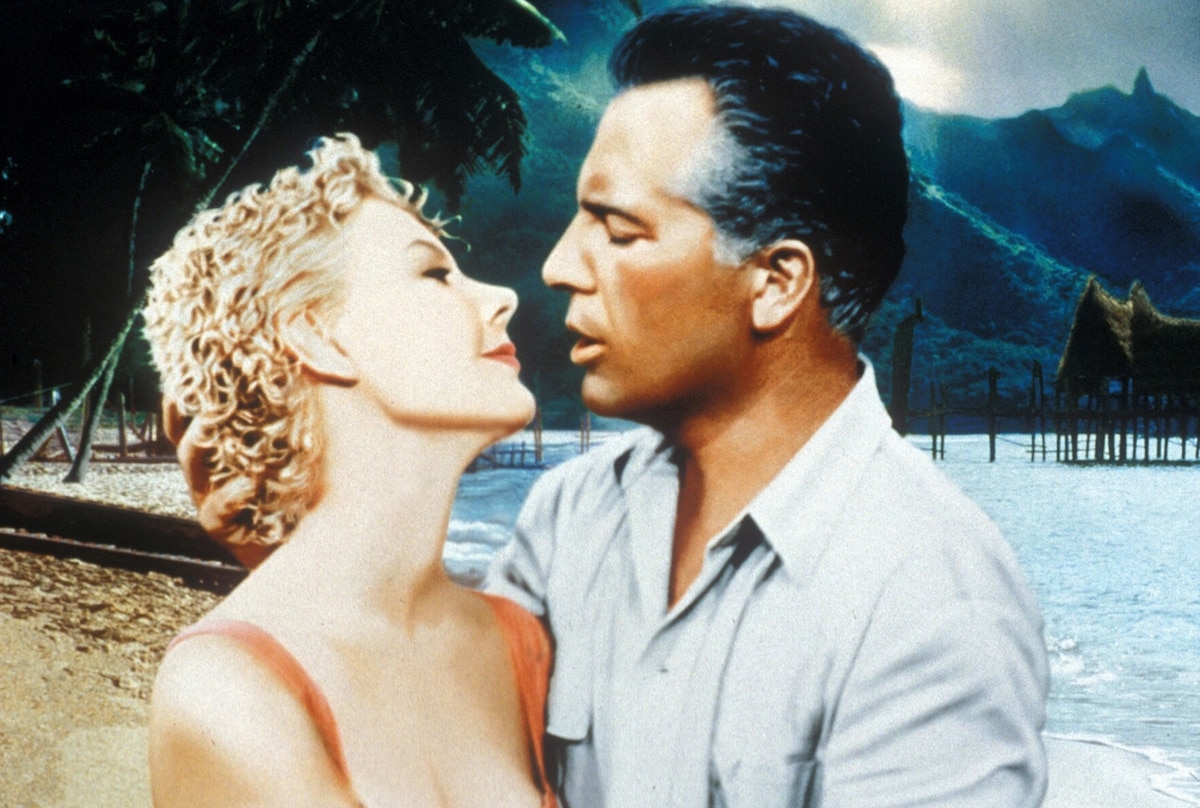
After the box office and critical success of the film version of The King and I in 1956, Richard Rodgers and Oscar Hammerstein scored an even bigger hit with their widescreen rendition of South Pacific in 1958. And though the film was far from their biggest critical success, with over $17 million in rentals it would remain their biggest box-office hit until The Sound of Music shattered box office records seven years later.
South Pacific was born when Navy lieutenant James A. Michener found himself stationed on a small Pacific island in 1945. Out of boredom, he wrote a group of stories based on his wartime experiences, then compiled them as Tales of the South Pacific, which won the 1947 Pulitzer Prize. Joshua Logan, who would eventually direct the show, thought the book had stage potential and suggested it to Rodgers. At first, they saw "Fo' Dolla," the tale of an upper-crust naval officer in love with a native girl, as the main plot. But when they learned that Metropolitan Opera star Ezio Pinza was interested in trying Broadway, they focused instead on "Our Heroine," about the romance between a French planter and a Navy nurse, using "Fo' Dolla" as a subplot. For leading lady, they wanted Mary Martin, who was then starring in the national tour of Annie Get Your Gun, but first they had to convince her that she could hold her own vocally opposite Pinza. Eventually, they created a score in which the romantic leads never sang together. But the songs and the intelligent treatment of a serious topic, racial prejudice, were so strong, that hardly anyone noticed the lack of any conventional romantic duets. South Pacific was a triumph that ran five years, won a Pulitzer Prize of its own and generated intense interest in Hollywood.
Wanting to protect their work, however, Rodgers and Hammerstein decided to produce the film versions of their great shows themselves, starting with Oklahoma! in 1955. Since each film received their personal attention, by the time they started working on South Pacific in 1957, they couldn't use the show's original leads. Although many thought Martin too old for the role by then, they would have used her if Pinza hadn't died. With his passing, they didn't think there was an actor strong enough to hold his own as her love interest. Ultimately, the only member of the original Broadway cast to make it to the film was Juanita Hall, who had won a Tony for her performance as Bloody Mary, the island con artist whose daughter falls in love with an American officer. The only other performer who had done South Pacific on stage was Ray Walston, who had played comic relief Luther Bills in the touring company and in London.
With Logan signed to direct, they started searching for the perfect leading lady. Many in Hollywood thought Doris Day was ideal, but Logan was afraid that she would simply play herself. When he turned up at the same Hollywood party as Day, he hoped he might see her spontaneous side, particularly when other guests urged her to sing. But her refusal to do an impromptu number convinced him she just wasn't right for the role.
Then entrepreneur Michael Todd suggested his wife, Elizabeth Taylor. When the songwriters protested that she wasn't a singer, he told them she sang around the house all the time. They arranged an interview, and Taylor showed up looking fit, thin and freckled from time outdoors - exactly what they were looking for. But when they asked her to sing, she was so intimidated by Rodgers that she could barely squeak out a note. When Logan took her down to the lobby, Todd was waiting and she greeted her husband with a full-voiced rendition of "I'm in Love With a Wonderful Guy." Suddenly, she was wonderful, but Logan couldn't convince Rodgers to give her another chance, nor did they want to have their female lead dubbed.
Finally, Mitzi Gaynor, a veteran of film musicals, put in a bid for the role and even offered to do a screen test. It took two tests -- for the second one, Rodgers changed the key of her song and slowed it a bit -- but she won the role. Logan's friends warned him that he'd have to hold her back or she'd overplay the role and bury it in cuteness, but she turned in a solid, professional performance.
She was also the only one of the four leads to do her own singing. After listening to Hall's pre-recorded songs, Rodgers and Hammerstein decided they didn't like the way her voice had changed since the Broadway run and insisted on dubbing her with Muriel Smith, an opera singer who had played Bloody Mary in London. There was no question about dubbing John Kerr, who played the lieutenant involved with Hall's daughter; he was a dramatic actor with no musical ability. But he worked so hard at matching the pre-recorded vocals that many viewers still insist he did his own singing.
The biggest vocal disappointment was Rossano Brazzi, cast as the French planter. Rodgers and Hammerstein had been enthralled with his performance as Katharine Hepburn's romantic interest in Summertime (1955) and had insisted that he could sing the role. Brazzi was so excited that he even cut a record in his native Italy. But when the songwriters heard it, they realized they'd made a mistake. They hired another opera star, Giorgio Tozzi, to record his songs. Only Brazzi was none too pleased with the decision. When it came time to film his numbers on location in Hawaii, he kept making mistakes, complaining that he couldn't sing to "this god##mn cheap sh#t voice" (recounted in Joshua Logan's biography, Movie Stars, Real People, and Me). Logan only got him to do the scenes right when he threatened to find another actor.
Otherwise there was only one problem during the location filming. The Navy had supplied extras, landing craft, trucks, jeeps and uniforms free of charge. But when Logan needed to film Kerr and Walston's arrival on Bali Ha'i, with thousands of extras greeting them, the cutter the Navy had supplied was so decrepit it kept breaking down. They had to get a second ship and shoot an extra day that put the film thousands of dollars over budget.
That was more than made up for by South Pacific's strong performance at the box office, particularly in England, where it ran for five years at one theatre. That engagement alone was enough to pay the $6 million budget. But the critics were less than pleased. Many complained that Mary Martin should have been cast in the role she'd made famous on Broadway. Others complained about Logan's decision to use tinted photography for some of the musical numbers.
And Logan agreed with them. He'd suggested the idea as a way of visually blending the musical numbers with the film's exotic, natural locations. Just in case it didn't work, he wanted to film them two ways: once with color filters and once with natural color. Producer Buddy Adler supported that decision at first, but then he told Logan that the lab could take out the tinting if they didn't like it. What he didn't tell him was that the process would take three months. Logan shot the whole film with tinted musical sequences, then realized during previews that they didn't work. But when he asked to have them removed, he found out that it couldn't be done in time to meet the film's bookings, so it went out with the tinting. In his memoirs, he would write that he wanted to picket each showing of the film with a sign reading, "I DIRECTED IT, AND I DON'T LIKE THE COLOR EITHER!"
Producer: Buddy Adler
Director: Joshua Logan
Screenplay: Paul Osborne
Based on the Play by Oscar Hammerstein II, Richard Rodgers and Logan, from the book Tales of the South Pacific by James A. Michener
Cinematography: Leon Shamroy
Art Direction: Lyle Wheeler, John DeCuir, Walter M. Scott, Paul S. Fox
Music: Richard Rodgers
Cast: Rossano Brazzi (Emile De Becque), Mitzi Gaynor (Nellie Forbush), John Kerr (Lt. Cable), Ray Walston (Luther Billis), Juanita Hall (Bloody Mary), France Nuyen (Liat), Tom Laughlin (Buzz Adams), Ron Ely (Co-Pilot), Doug McClure (Pilot in Hospital).
C-158m. Letterboxed. Closed captioning.