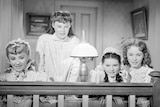
James Dunn was not the only actor to receive an Oscar for his work on A Tree Grows in Brooklyn (1945). The Motion Picture Academy's Board of Governors also voted a special award to Peggy Anne Garner for "Outstanding Juvenile Performance." Her prize was a half-sized Oscar dubbed the "Oscarette" by Bob Hope. Though no specific film was associated with the award, most industry members knew that it was in honor of her deeply felt performance as Francie.
Children were big box-office during Hollywood's Golden Age. Performers like Mickey Rooney and Shirley Temple often led polls of the most popular stars, and child soprano Deanna Durbin was credited with saving Universal Studios from bankruptcy in the 1930s. Originally, there were no specific Oscar categories for juveniles. Nine-year-old Jackie Cooper was nominated for Best Actor for Skippy in 1931. When Temple became a major star in 1934, the Board of Governors decided it was unfair to make her compete with adult actors. Instead, they voted her the first Special Juvenile Award. The honor was not a yearly affair, but rather was reserved for special occasions.
In all, 12 youngsters won the award, including Rooney, Durbin, Judy Garland and the last winner, Hayley Mills, for Pollyanna (1960). With the days of studio production on the wane and television taking over most family viewing, there was little need for the Special Juvenile Award after that. In 1973, Tatum O'Neal became the youngest Oscar winner to that time when she was named Best Supporting Actress for Paper Moon.
Although some "Oscarette" winners like Temple, Rooney and Garland went on to adult stardom, most saw their careers fade as they reached their teens. That's what happened to Garner. After her 20th Century-Fox contract ended in the late 1940s, offers started drying up. Eventually, she moved to New York to study at the Actors Studio and pursue stage work, but she never made it back to stardom. At times, she had to work as a real estate salesman to make ends meet before dying of pancreatic cancer in 1984 at the age of 52. Ironically, the year she won her special Oscar, the Board of Governors considered another child star who would have a much bigger future in film. The actress Garner beat out was Elizabeth Taylor in National Velvet (1944).