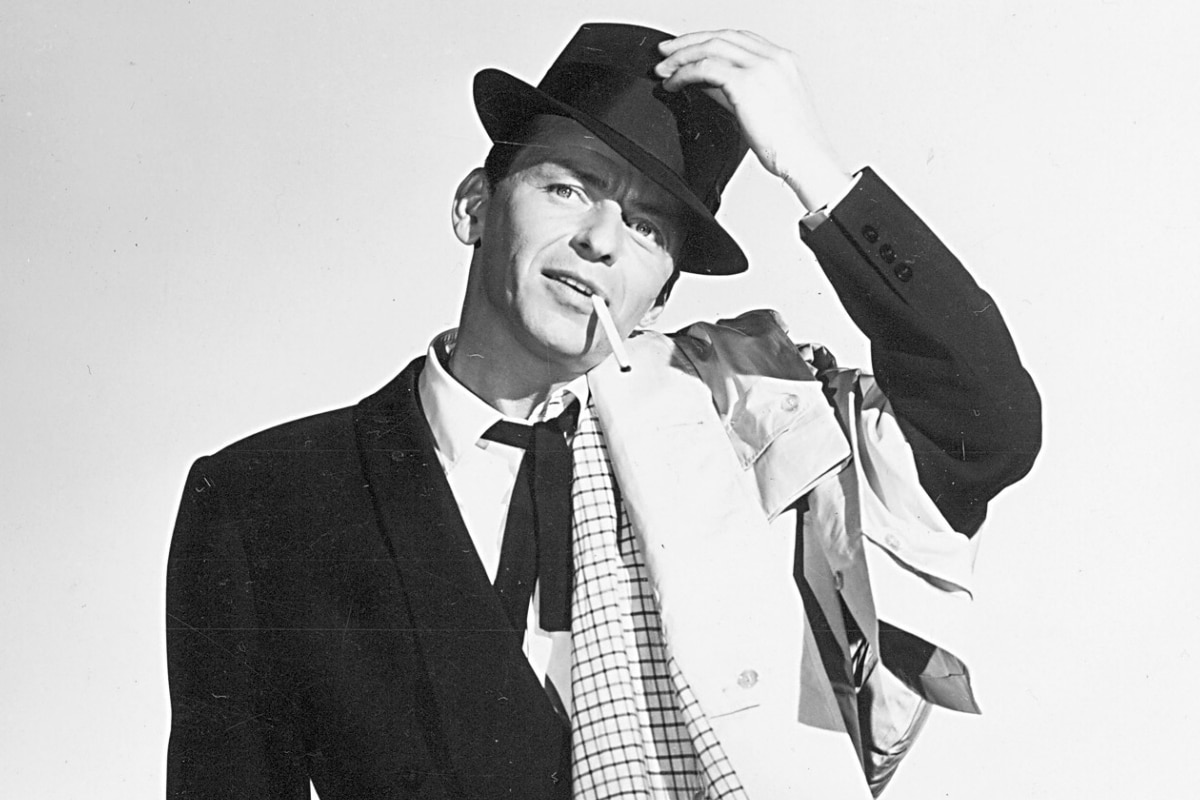
The first, and possibly the greatest American musical superstar, Frank Sinatra was inarguably one of the most successful, multi-talented entertainers of the 20th Century. Starting out as a crooner with bandleaders like Tommy Dorsey in the late-1930s, by 1942 "Sinatramania" had swept the country, and his live performances were causing riots. Just as suddenly, a combination of damaged vocal cords, reputed ties to organized crime and a torrid romance between the still married Sinatra and actress Ava Gardner conspired to end Sinatra's reign by 1950. In one of the most incredible career resurrections of all-time, he reinvented himself with an Oscar-winning performance in From Here to Eternity (1953), followed by a string of era-defining hit records with Capitol, such as “Come Fly with Me!” and “Frank Sinatra Sings for Only the Lonely.” Sinatra cultivated his larger-than-life persona with his celebrity buddies, the "Rat Pack," who were immortalized in the hip crime-comedy Ocean's Eleven (1960), and rubbed shoulders with the likes of President John F. Kennedy. Although he retired briefly in the early 1970s, Sinatra returned soon after to thrill longtime fans with more sold-out concerts and chart-topping albums right up until his 80th birthday. Over the course of his 60-year career, Sinatra elevated popular music to an art form while he attained the status of legend, “The Chairman of the Board.”
Born on December 12, 1915, in Hoboken, NJ, Francis "Frank" Albert Sinatra was the only son of Italian immigrants Natalie "Dolly" and Anthony Martin Sinatra. His father worked as captain with the Hoboken Fire Department and boxed on the side, while his mother was a noted figure in the local Democratic Party but also performed then-illegal abortions behind closed doors—a risky enterprise that landed her in jail on more than one occasion. Although he had never learned to read music, Sinatra taught himself to sing by ear and after seeing Bing Crosby perform, the young Sinatra announced his intention to become a professional singer to his skeptical parents in the early 1930s. Given permission by his mother, the teenager dropped out of high school and eventually joined a trio of young vocalists, called The Three Flashes, who were willing to take on another singer. Renamed the Hoboken Four, they went on to win first prize, in the form of a six-month touring contract, on the popular "Major Bowes' Original Amateur Hour" radio program. Sinatra's time with the group was short-lived, however, and before long he was back home and working as a singing waiter and MC at a local resort for $15 a week.
Not long after recording his first demo record titled "Our Love" in early 1939, Sinatra signed with bandleader Harry James until he was lured away by competing bandleader Tommy Dorsey. Under Dorsey's leadership, Sinatra's public exposure increased exponentially, as did his own vocal ability. The relationship was a strained one from the start, as his contract with Dorsey entitled the bandleader to a full third of Sinatra's lifetime earnings as an entertainer. Although Billboard magazine had voted him Best Male Vocalist of 1941, Sinatra increasingly chaffed under his serf-like deal with Dorsey and sought to escape the confines of their agreement. After buying out of his contract—a mystery-shrouded event that ignited rumors of payoffs, coercion and mob connections which would dog Sinatra for the rest of his days—the vocalist embarked on a solo career the likes of which the entertainment world had never seen before.
Sinatra exploded onto the scene as a solo artist with his historic opening at New York's famed Paramount Theater, where he performed to throngs of screaming "bobby soxers"—young female fans of swing music in general, and Sinatra, in particular. Newly signed to Columbia, the record company enjoyed brisk sales during the musician's strike of 1942-44 by re-releasing Sinatra's earlier recordings made with James' band. Stoked by the crooner's endless touring and radio performances, "Sinatramania" reached its zenith in 1944, with what would be called "The Columbus Day Riot" after 35,000 fans went berserk trying to gain entrance to Sinatra's sold-out return to the Paramount. It took literally hundreds of police to subdue the frenzied crowd. Deemed unfit by the U.S. military, due to a perforated eardrum suffered during his traumatic birth, Sinatra did not serve during World War II. His nearly ubiquitous presence in the media during that time, in part, allowed Sinatra to become the obsession of millions of lonely young women across the country, while generating resentment from many jealous servicemen overseas.
Sinatra's domination of the entertainment world continued on all fronts as the war neared its end. For Columbia, he released his first concept album, “The Voice of Frank Sinatra,” which spent weeks at the No. 1 position on the Billboard charts. Having initially signed with RKO a few years prior, Sinatra increased his visibility—as well as his per film salary—with a growing list of movie appearances for MGM. A typical role for Sinatra during this period was that of a wide-eyed innocent, charmingly unaware of his appeal to the fairer sex. It was an onscreen persona he exploited to the fullest in a series of movies alongside hoofer Gene Kelly that began with the musical romantic-comedy Anchors Aweigh (1945). Also well-received was the feel-good post-WWII romance It Happened in Brooklyn (1947), co-starring English actor Peter Lawford, who would become a close friend of Sinatra's for years to come. Then, just as quickly as he had ascended to superstardom, the performer began an equally precipitous decline as the decade neared its end.
The downslide in Sinatra's popularity began in 1947, with widespread rumors of his association with mobsters like Lucky Luciano; exacerbated—if not completely fabricated—by the likes of newspaper publisher William Randolph Hearst who notoriously despised the singer's then-liberal political leanings. Both concert attendance and record sales had slipped, and a film that miscast him as a priest, The Miracle of the Bells (1948), left skeptical audiences unconvinced. Although his second effort with Kelly, On the Town (1949), met with success, Sinatra's fall from grace continued into the next decade with feature flops like Double Dynamite (1951) and Meet Danny Wilson (1952). What audiences did not see was more behind the scenes turmoil in the form of hemorrhaged vocal chords suffered during an earlier live performance, which noticeably roughened his famously velveteen voice.
Sinatra's marriage to his first wife, Nancy Barbato, was also in shambles, due in no small part to his torrid affair with film beauty Ava Gardner. Following his divorce from Barbato, Sinatra embarked on a notoriously stormy marriage to Gardner, one that effectively ended in separation two years later, followed by their eventual divorce. Having lacked a hit record for a number of years and relegated to recording such novelty songs as "Mama Will Bark" in 1951, the crooner was dropped by MCA and Columbia in 1952. To even the most casual observer, it seemed as if Sinatra's meteoric career had all but burned itself out.
Always a fighter himself, Sinatra's salvation came in the form of an irrepressible scrapper named Angelo Maggio. The big-budget adaptation of James Jones's best-selling novel From Here to Eternity (1953) was expected to be one of the most anticipated movies of the year, and nearly every star in Hollywood wanted a part in it. First suggested by Gardner, whose star was on the ascension, Sinatra saw the role of the doomed Private Maggio as his ticket to a much-needed comeback. So hungry was he for the part that after the initially cast Eli Wallach dropped out of the role, Sinatra agreed to cut his usual fee to a mere $8,000 in order to seal the deal. It was a gamble that yielded spectacular results, as Sinatra's moving performance in the drama about the loves and lives of a group of soldiers in the days leading up to Pearl Harbor not only reinvigorated his career, but also won him an Academy Award for Best Supporting Actor. Sinatra was back.
Sinatra attacked his second chance with gusto when he signed a one-year contract with Capitol Records, where he was soon partnered with conductor-arranger Nelson Riddle. In collaboration with Riddle, the performer literally reinvented himself as a vocalist, crafting the classic Sinatra sound by deftly employing dramatic string arrangements with a deeply personal, idiosyncratic vocal styling. Emboldened by his Oscar win, Sinatra built upon his screen success, going on to become one of the biggest movie stars of the era with several memorable roles. As the star of the crime-noir Suddenly (1954), he plays a would-be assassin holding a small-town family hostage as he awaits his victim: the President of the United States. Sinatra then stunned audiences and critics alike with his portrayal of a heroin addict in Otto Preminger's controversial The Man with the Golden Arm (1955), for which he earned another Best Actor nomination. At this point, Sinatra was conquering on all fronts, winning a Best Actor Golden Globe for his performance as a charming womanizer in Pal Joey, earning rave reviews for his turn in the underrated The Joker is Wild (both 1957), then picking up the first of his many Grammy Awards for the album “Come Dance With Me!” in 1959.
The desert boomtown of Las Vegas had long been a profitable business opportunity as well as a personal playground for Sinatra, who, in the early-1950s, acquired a percentage of the Sands Hotel, where he enjoyed a lucrative exclusive engagement contract for a number of years. As usual, Sinatra's social life continued to grab nearly as many headlines as his performances. Originally referring to a group that gathered around Humphrey Bogart, Sinatra and his hip celebrity pals Dean Martin, Sammy Davis Jr., Peter Lawford and Joey Bishop were dubbed the "Rat Pack" by Bogart’s wife, actress Lauren Bacall. The group frequently mixed business with pleasure, both partying and performing at the Sands and other glitzy locales on the Vegas Strip throughout the Swinging '60s. The very definition of sophisticated cool during the era, the Vegas heist comedy Ocean's Eleven (1960) was considered the definitive Rat Pack movie, although several others would follow.
Sinatra continued to deliver solid performances in several notable films. One of the most memorable of his career was Sinatra's turn as the stalwart, perceptive Bennett Marco in the political psychodrama, The Manchurian Candidate (1962), a film that eerily foreshadowed the assassination of JFK a year later. After clowning his way through Robin and the 7 Hoods (1964) with the Rat Pack, Sinatra hit box-office gold with the WWII action-adventure Von Ryan's Express (1965) and made his directorial debut with None But the Brave (1965), another wartime actioner. That same year, he won an Emmy for his televised special "Frank Sinatra: A Man and His Music" (NBC, 1965), then picked up a pair of Grammys two years later for his hugely popular album “Strangers in the Night.” In addition to his victories as an entertainer, Sinatra became a winner in the business world as well. In addition to his earlier arrangement with the Sands—which had earned him $100,000 for each week he performed—and his holdings in Cal Neva, he had made shrewd investments in such areas as charter airlines, music publishing, radio, restaurants and real estate.
A successful marriage, however, remained an elusive goal for Sinatra, who was still in love with his ex-wife Gardner. He raised eyebrows and sent the tabloids into a printing frenzy with his 1966 marriage to ingénue Mia Farrow, nearly 30 years his junior. The unlikely union ended soon after the actress angered Sinatra by choosing the lead role in director Roman Polanski's Rosemary's Baby (1968) over a supporting part in his police-drama The Detective (1968). Farrow was served with divorce papers while shooting the classic horror movie—which went on to become a cultural phenomenon, while The Detective performed respectably at the box office before ultimately fading into obscurity. By the end of the decade Sinatra began to wind down his career as a film star with B-movie efforts like the private-eye thrillers Tony Rome (1967) and its sequel Lady in Cement (1968). His music endeavors still provided him with hits, such as the 1969 anthem "My Way." Written by Paul Anka specifically for Sinatra, it told the story of a man looking back on his eventful life with no regrets. It was a sentiment the 52-year-old entertainer could identify with. His fans felt the same, and it soon became the song most identified with Sinatra throughout the remainder of his career.
The time and tastes were definitely changing, and after starring in the Western comedy Dirty Dingus Magee (1970), Sinatra would not be seen in a feature film for a decade. Showing outward signs of fatigue for the first time, he dramatically announced his retirement at the end of a 1971 concert. In 1973, Sinatra returned and released another hit album, appropriately titled “Ol' Blue Eyes is Back.” Without skipping a beat, he was selling out massive concerts at venues like Madison Square Garden and once again performing in Las Vegas. Eventually he resumed his film career—however briefly—with a highly-praised performance in the crime-thriller The First Deadly Sin (1980), opposite Faye Dunaway. Having embraced the Republican Party in the years after a falling out with JFK and his brother, Senator Robert F. Kennedy, Sinatra was an avid supporter of former film star Ronald Reagan during the 1980 Presidential election, stumping just as hard for the Gipper as he had for Kennedy. Outside of politics, though, Sinatra continued to do what he did best, break concert attendance and sales records, release popular albums like “Trilogy: Past Present Future” and “L.A. is My Lady” and score TV ratings gold with an appearance in a 1987 episode of the hit series "Magnum, P.I." (CBS, 1980-88).
Sinatra's youngest daughter, Tina Sinatra, later produced the biographical TV miniseries "Sinatra" (CBS, 1992). Starring Phillip Casnoff as the eponymous crooner, Gina Gershon as first wife Nancy, Marcia Gaye Hardin as Ava Gardner and Nina Siemaszko as Mia Farrow, it benefited from the full cooperation of the Sinatra clan. Although his voice had long since lost its lustrous sheen, he thrilled longtime fans and reached a new audience with the 1993 album “Duets,” which boasted collaborations with a diverse array of musical all-stars, including Barbra Streisand, Gloria Estefan and U2's Bono. Back in the public eye to a degree he had not enjoyed in years, Sinatra continued to tour around the world, although his failing health and fading memory were causes of concern for family members like his fourth and final wife, Barbara Marx. A dangerous fall on stage in 1994 preceded his final concert appearances at Japan's Fukuoka Dome in December of that year. After being presented with a Lifetime Achievement Award by Bono at the 1994 Grammy ceremony, Sinatra sang publicly for the last time before a select crowd at a private function in February of 1995.
Mere days after his gala 80th birthday celebration, Sinatra was dealt a devastating emotional blow by the death of longtime friend and collaborator Dean Martin. His final years were spent in seclusion as both a mild heart attack and stroke further contributed to his rapidly declining health. On May 14, 1998, Sinatra reluctantly relinquished his hold on a life he had lived to the fullest when he suffered a heart attack at the age of 82. Encouraged by Barbara to keep fighting, Sinatra's reported final words revealed a man who saw even the Grim Reaper as an adversary to overcome: "I'm losing." The icon's death sent the country into a nationwide period of shock and mourning not seen since the passing of Elvis Presley and John Lennon. That following night, the lights on the Las Vegas Strip were dimmed in his honor, while luminaries as varied as President Bill Clinton and pop star Elton John expressed their profound respect and appreciation for the great entertainer. Following a private ceremony attended by the likes of Gregory Peck, Tony Bennett, Tony Curtis, Kirk Douglas and Sophia Loren, Sinatra was buried near his parents in a small cemetery in Cathedral City, CA, near his compound in Rancho Mirage.
(Edited: August 2026 by Quatoyiah Murray)