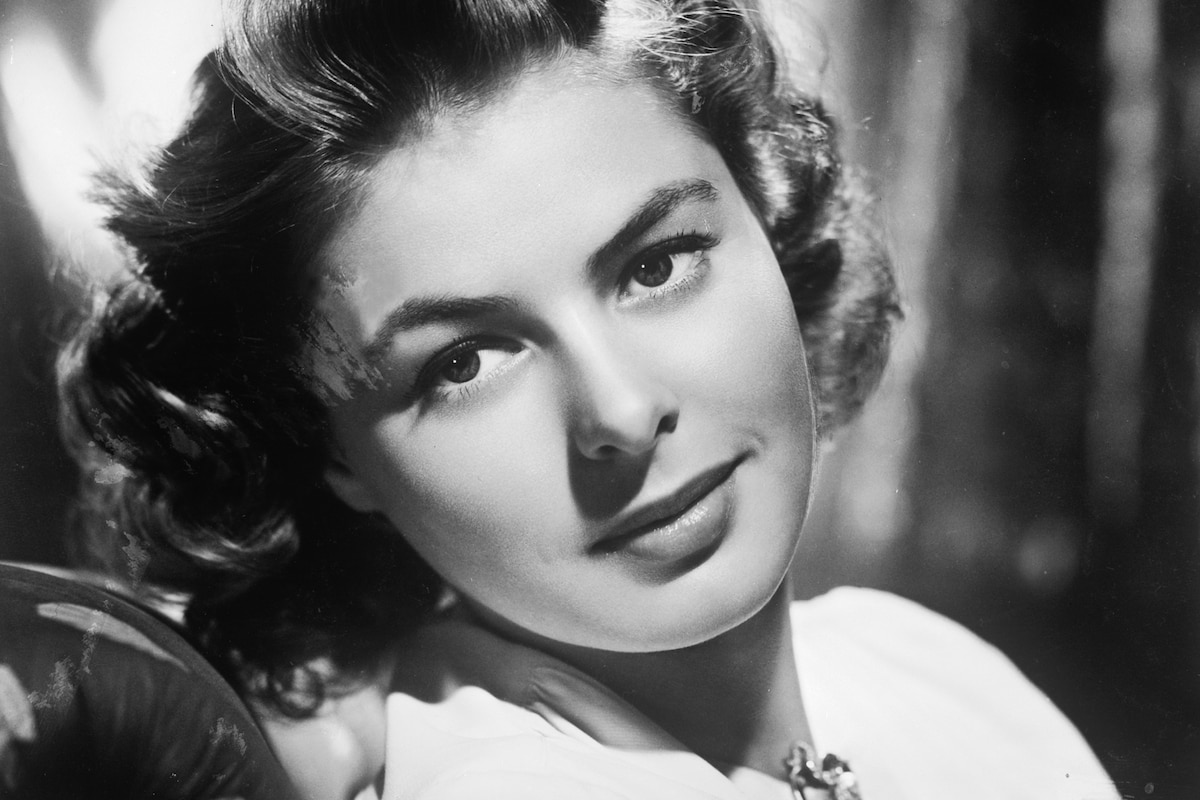
The incomparable Ingrid Bergman has been celebrated for her ethereal beauty, charisma and natural-born talent. Her evolution as an actress—from Swedish ingenue to Hollywood movie star to a central figure in Italian Neorealism and back to Hollywood—was truly extraordinary. Every step along the way, Bergman’s focus was always seeking the roles that inspired her creatively and challenged her as a performer. Bergman was born August 29th, 1915, in Stockholm, Sweden. Both of her parents died when she was quite young. Her photographer father had made her the subject of many photographs and home movies. Accustomed to being in front of a camera, the young Bergman eventually took an interest in acting.
While still in her teens, Bergman studied at the Royal Dramatic Theatre in Stockholm. The public first caught a glimpse of Bergman when she appeared as an extra in Landskamp (1932). A few years later, she would secure her first speaking role and onscreen credit in The Count of the Old Town (1935). Bergman secured a three-year contract with Svensk Filmindustri and landed her first leading role in Ocean Breakers (1935). That same year, she appeared in the romantic drama Swedenhielms (1935), one of several films she would make with director Gustaf Molander. Bergman credited Molander with guiding her through her formative years as an actress. Bergman recalled, “Gustaf especially taught me how to underplay, to be absolutely sincere and natural… on the set he gave me a great sense of security.” Bergman soon became Sweden’s most promising young actress.
The turning point in Bergman’s career came with her performance in Molander’s Intermezzo (1936), a romantic drama about an extramarital affair between a pianist and a violinist. Intermezzo was a sensation in Sweden and was exported stateside, where it caught the attention of Kay Brown, assistant to studio executive David O. Selznick. Brown was impressed with Bergman’s performance, and Selznick bought the rights to the film with the intention of bringing Bergman to Hollywood. Bergman’s performance in Intermezzo also caught the attention of Joseph Goebbels, Germany’s Minister of Propaganda, who was actively looking for talent. She was cast in the German film The Four Companions (1938) as part of a two-year contract with the German studio UFA. Bergman’s husband Petter Lindstrom, with whom she had her first child, advised her to abandon the UFA contract and reconsider Selznick’s offer. She took his advice and traveled to Hollywood to begin what would become the most lucrative period of her career.
Selznick planned to have the English-language remake—now titled Intermezzo: A Love Story (1938)—follow the Swedish original as closely as possible. It was a winning formula that repeated well with Bergman and her co-star Leslie Howard’s on-screen chemistry. Bergman returned to Sweden to make June Night (1940), fulfilling her contractual obligation to Svensk Filmindustri. She then settled back into Hollywood, learned English fairly quickly and stood her ground when Selznick insisted on giving her a glamour makeover. Bergman refused to lighten her hair or pluck her eyebrows. The studio’s publicity department pivoted and promoted their new star’s natural beauty. Bergman signed a seven-year contract with Selznick International Pictures but wouldn’t make another film there for several years.
What followed was a series of profitable loanouts to other studios, like in Columbia Pictures’ Adam Had Four Sons (1941). About her unique approach to acting, her co-star Fay Wray said, “She seemed not to be an actress, but a reality… Ingrid had a quality that was spiritual and physical at the same time. She seemed real, not like she was performing at all.” At MGM, Bergman starred in Rage in Heaven (1941) with Robert Montgomery and George Sanders. When she became a contender for a role in Victor Fleming’s Dr. Jekyll and Mr. Hyde (1941), she was more enthusiastic about playing Ivy the barmaid rather than Dr. Jekyll’s fiancée Beatrix. Fearing this would tarnish her “good girl” image, she received pushback but ultimately convinced Fleming to cast her in the role.
Selznick negotiated with Warner Bros. to have Bergman star in Casablanca (1942). When Bergman learned about the arrangement, she wasn’t too thrilled. She’d been anticipating getting the lead role in For Whom the Bell Tolls (1943), and Casablanca was not a picture she was excited about. However, her role as Ilsa Lund, played opposite her co-stars Humphrey Bogart and Paul Henreid, would become her most memorable one. Bergman recalled, “A film I definitely would not have selected was Casablanca, and it is my best-loved, best-remembered film.” Shortly after Casablanca wrapped, she got her wish to star in For Whom the Bell Tolls, an adaptation of Ernest Hemingway’s novel. The project was her first Technicolor film and her first physical transformation for a role. It earned Bergman her first Oscar nomination.
Back at MGM, Bergman was cast as Paula in George Cukor’s costume drama Gaslight (1944), starring Charles Boyer and Joseph Cotten. She almost didn’t get the role when MGM and Selznick disagreed over whether top billing should go to Boyer or Bergman. Not willing to lose the opportunity, Bergman convinced Selznick to reconsider. A wise move on her part because the role helped secure her very first Oscar win. The following year, Bergman finally returned to Selznick International Pictures to make Spellbound (1945), her first collaboration with the master of suspense, Alfred Hitchcock. Bergman replaced Dorothy McGuire for the role of Dr. Constance Petersen opposite Gregory Peck.
Shortly after, Bergman transformed herself into Clio, the scorned half-Creole character in Sam Wood’s historical drama Saratoga Trunk (1945). She also secured the plum role of Sister Mary Benedict in Leo McCarey’s The Bells of St. Mary’s (1945), RKO’s follow-up to the highly successful Going My Way (1944) starring Bing Crosby. In preparation for the part, Bergman spent time with McCarey’s aunt, the nun who served as inspiration for Sister Mary. She earned her third Academy Award nomination for her performance. Bergman then made two more films with Hitchcock. The first was the spy thriller Notorious (1946), starring Cary Grant and Claude Rains. The film is best known for Grant and Bergman’s on-screen chemistry and for the classic Hitchcockian plot device known as the MacGuffin. Notorious was the last of Selznick’s loanouts for Bergman, who decided not to renew her contract once it expired. Eager to work with Bergman again, Hitchcock cast her in his independently produced historical costume drama Under Capricorn (1949).
As a free agent, Bergman hoped to have more control over her projects. One of her biggest dreams was to play the role of Joan of Arc. Selznick had dangled the opportunity in front of Bergman throughout her contract but never fulfilled his promise. By 1948, Bergman had taken it upon herself to make her dream a reality and was cast in Victor Fleming’s historical adaptation. About playing the lead in Joan of Arc (1948), Bergman said, “All my life I dreamed of playing her… she became the character I liked to play most. She, too, was a timid child, but with great dignity and courage.” Joan of Arc received seven Academy Award nominations, including one for Bergman.
Looking to take her career in a new direction, she wrote a letter to Italian neorealist director Roberto Rossellini, expressing interest in working with him. A Rossellini-Bergman project was presented to Samuel Goldwyn, who ultimately passed on the idea. Howard Hughes, who had recently purchased RKO and was pursuing Bergman, agreed to finance the project. Their first collaboration was Stromboli (1950). Filmed on location on a volcanic island, Bergman was in for a rude awakening as the working conditions on Stromboli were vastly different from the Hollywood studio system she had grown used to. Also, during production, Bergman’s extramarital affair with Rossellini resulted in a pregnancy and the end of her marriage to Lindstrom. Shortly after the divorce, she married Rossellini in 1950, a scandal that effectively blacklisted her from Hollywood and caused ire among the public in America, where Stromboli bombed at the box office. She would work primarily in Europe for the foreseeable future.
Rossellini had a radically different filmmaking style, one that Bergman learned to adapt to. Bergman went on to star in Rossellini’s Europa ’51 (1952), Joan of Arc at the Stake (1954) and Fear (1954). Their most acclaimed collaboration was Journey to Italy (1954), which reunited Bergman with her Rage in Heaven co-star George Sanders. After another pregnancy that resulted in twin girls, Isotta Ingrid Rossellini and actress Isabella Rossellini, Bergman and Rossellini’s marriage ended in 1957, and by that time, Bergman was making her way back to Hollywood. Director Anatole Litvak and 20th Century-Fox’s Darryl Zanuck campaigned for Bergman to get the female lead in Anastasia (1956). It was a gamble considering Bergman’s reputation in the industry and the investment the studio was putting into the film. But the gamble paid off, and Anastasia was a hit. The release came on the heels of the success of Fox’s The King and I (1956), starring Deborah Kerr and Bergman’s Anastasia co-star Yul Brynner. Both Kerr and Bergman were nominated for Best Actress for their respective roles. Bergman won, receiving her second Oscar.
At the ceremony, Cary Grant accepted Bergman’s Oscar on her behalf. The success of Anastasia and Grant’s public support for his Notorious co-star helped boost Bergman’s public image once again. Grant made it his mission to work with Bergman on his upcoming film Indiscreet (1958), a romantic comedy directed by Stanley Donen. At that time, Bergman had committed to making Mark Robson’s The Inn of the Sixth Happiness (1958) in England, so the setting of Indiscreet was changed to London to accommodate the actress.
The second phase of her Hollywood career was not as successful, but Bergman remained active in film and on the stage, which had continued since her debut in the 1940 play “Liliom.” Onscreen, she appeared in films like Goodbye Again (1961), The Yellow Rolls-Royce (1964) and Cactus Flower (1969). She co-starred in two dramas with Anthony Quinn, The Visit (1964) and A Walk in the Spring Rain (1970), and she played eccentrics in A Matter of Time (1976) and From the Mixed-Up Files of Mrs. Basil E. Frankweiler (1973). In 1974, she joined the prestigious cast of Sidney Lumet’s Murder on the Orient Express, an Agatha Christie-Hercule Poirot mystery, a role that earned her another Academy Award nomination, but this time for Best Supporting Actress, which she won, becoming one of the few actresses with three Oscars.
For her final cinematic performance, Bergman returned to Scandinavia to work with another famous Swede with a similar name: Ingmar Bergman. Autumn Sonata (1978) was a fitting swan song for the actress. In the film, she delivers one of her best performances opposite Liv Ullmann, as the two play a troubled mother-daughter duo. Working with Ingmar was a challenge but ultimately rewarded her with her final Academy Award nomination. Bergman began battling with cancer in 1973, though she fought off the disease long enough to complete a TV movie, A Woman Called Golda (1982), in which she portrayed Israeli Prime Minister Golda Meir. The performance earned her an Emmy, her final honor. She died on August 29, 1982, at midnight on her 67th birthday.
(Edited: August 2026 by Quatoyiah Murray)