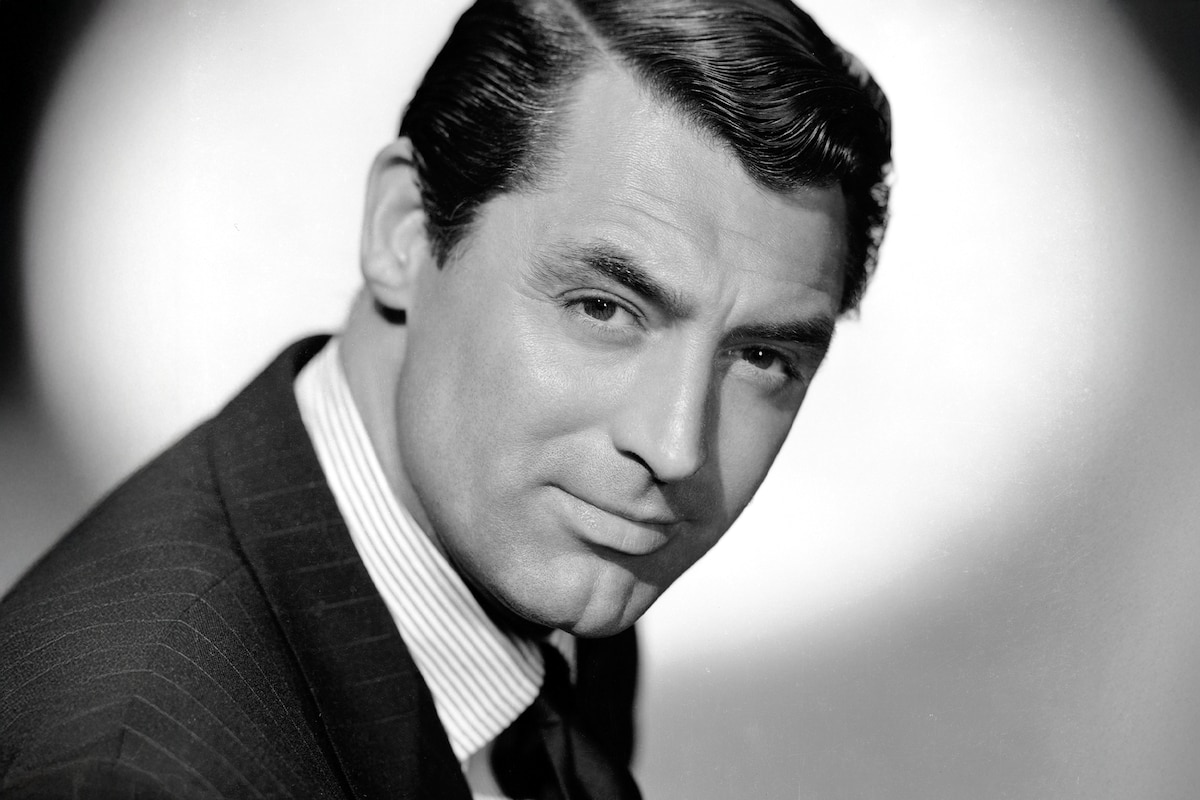
Portraying gentlemen of timeless elegance, it’s challenging to believe that Cary Grant's fate could have been anything but that of the massive superstar he became. Standing just over six feet tall, with dark hair, a deep cleft chin and a thick neck, Grant seemed to have stepped out of a J.C. Leyendecker drawing, growing more appealing with age, as the character of his face took on distinct sculptured angles. As with most actors, the honing of his craft was an evolution. During an era where actors were locked into unwavering studio contracts, when Grant's contract with Paramount Pictures came to an end in 1936, flexing his box-office power, Grant freelanced, collaborating with studios of his choice for the remainder of his career, one of the first actors to enjoy the privilege. He earned two Academy Award nominations during his markedly successful career, which spanned three decades with over 70 films. Iin 1970, at the age of 66, he was presented with an honorary Oscar by Frank Sinatra. By 1999, Grant was cemented further in Hollywood history, being named the second greatest male actor on The Greatest Screen Legends list by the American Film Institute.
Grant's onscreen persona was a sharp departure from his true-life identity of Archibald Leach. Born in Bristol, England on January 18, 1904, Grant's alcoholic father Elias and mother Elsie, described as controlling and overbearing, had a volatile relationship, contributing to Grant's life of instability. At the age of 11, he arrived home to find his mother absent. He was told by his family that she traveled to a resort for much-needed rest. As time passed, Grant understood that Elsie would not return. It wasn’t until years later as an adult that Grant learned she was committed to a sanatorium by his father. “I was not to see my mother again for more than twenty years, by which time my name was changed and I was a full-grown man living in America, thousands of miles away in California,” Grant stated in his biography.
At the age of 16, Grant traveled with The Pender Troupe to New York, eventually making his way to California along with a throng of theatrical actors with expectations of success following the new medium of sound in the movies. In Los Angeles, Grant met film director Marion Gering, who introduced him to the head of production at Paramount, B.P. Schulberg. A successful screen test at Paramount landed him his first appearance in a short film, Singapore Sue (1932), in which he played a sailor. followed by his feature film debut, This Is the Night (1932). At Paramount, he was also christened with a new stage name, as Archie Leach was deemed unsuitable for a young man already showing promise as a romantic lead. For a few years, that was all he was required to do, and he did it very well opposite such top stars as Marlene Dietrich (Blonde Venus, 1932) and Mae West (She Done Him Wrong, 1933; I’m No Angel, 1933), each of whom later claimed to have discovered him.
His success grew over the next few years and 20 pictures, but “Cary Grant” did not begin to fully emerge on screen until Sylvia Scarlett (1935), opposite Katharine Hepburn under the direction of George Cukor. The offbeat gender-bending comedy was a legendary flop in its time, but it made great use of Grant’s comic timing, athleticism and roguish nature, recalling his rough-and-tumble vaudeville years and suggesting there was something more complex and intriguing going on under the fancy dinner jackets Paramount wrapped him in. The picture, however, was a box-office failure, marking a setback for Hepburn and Cukor, but Grant came out unscathed, getting the best reviews. MGM quickly snatched him up to play opposite Jean Harlow, one of the studio’s biggest stars and leading sex symbol of the 1930s, in the World War I love triangle Suzy (1936). This is one of the few times Grant played an outright amoral cad but not the only time he sang on screen. He duets with Harlow (or rather her voice double) on the Oscar-nominated “Did I Remember?”
After only five years in the studio stables, Grant broke his contract in 1937 to become a free agent rather than beholden to one studio. He chose his own films, directors and scripts. His timing was impeccable—his next dozen films, made in only four years—defined the Cary Grant persona, proving him amazingly versatile playing shady, slapstick and serious. Grant and Hepburn reunited in films such as the marital mix-up Holiday (1938) and the definitive screwball comedy, Bringing Up Baby (1938). On paper, that film would seem a challenging sell, with its cast of characters including Skippy, a wire fox terrier known from The Thin Man (1934), and Nissa, a trained leopard that Hepburn claimed Grant was deathly afraid of. Though highly regarded today as a quintessential comedy, Bringing Up Baby tanked at the box office, damaging Hepburn’s reputation as a star until she would reunite with Grant a few years later.
Grant found continued success playing opposite leading lady Irene Dunne. Their first pairing together in The Awful Truth (1937) was a box-office smash, garnering six Academy Award nominations, including Best Picture, and earning a Best Director Oscar win for Leo McCarey. The film is credited with Grant finding his screen personality, which is ironic considering he and the cast were leery of McCarey's unconventional directing tactics that encouraged his actors to ad-lib scenes, a practice Grant found unnerving enough to attempt to back out of the production. Clearly, McCarey's direction was resoundingly successful, producing organic dialogue while Grant found his own voice through ad-libbing, which he would expertly continue to do throughout his career. After the success of The Awful Truth, Grant would go on to co-star with Dunne again in the three-time Oscar-nominated My Favorite Wife (1940), as well as Penny Serenade (1941), which would garner Grant an Oscar nomination for Best Actor.
Rounding out Grant’s screwball comedies was the ever-abiding His Girl Friday (1940) with Rosaline Russell. Directed by Howard Hawks and written by Charles Lederer, the dialogue measures at 240 words per minute (90 being the average), with claims, in certain instances, that it borders on 300 wpm. Russell was said to have hired her own writer to beef up her dialogue when ad-libbing lines, a practice which by this point in his career, Grant had mastered. Russell wrote in her autobiography “Life is a Banquet,” “Cary loved to ad-lib. He’d be standing there leaning over, practically parallel to the ground, eyes flashing, extemporizing as he was in with another ad-libber; I enjoyed working that way too. So in His Girl Friday we went wild, overlapped our dialogue, waited for no man. And Hawks got a big kick out of it.”
Grant continued successfully honing his craft with films like Gunga Din (1939), which offered him a divergent action film role and was considered a commercial success, and Only Angels Have Wings (1939), while experimenting in new directions throughout the 1940s. He played a navy officer in Destination Tokyo (1944); a cockney drifter in None But the Lonely Heart (1945), a role that earned him his second Oscar nomination for Best Actor; and songwriter Cole Porter in Night and Day (1946). His comedic and domestic films of this era also include Mr. Lucky (1943), The Bachelor and the Bobby-Soxer (1947), The Bishop's Wife (1947), Mr. Blandings Builds His Dream House (1948) and I Was a Male War Bride (1949).
He even moved into the realm of thrillers after he formed a successful working relationship with Alfred Hitchcock, becoming his lead actor in some of the director’s most iconic, highly regarded films: Notorious (1946), To Catch a Thief (1955) and North by Northwest (1959). Grant and Hitchcock reportedly had their professional squabbles, but their respect for one another created a legendary pairing. Hitchcock's faith in Grant's interpretations was so devout that direction was minimal. Hitchcock would say of Grant, “Knowing Cary is the greatest association I’ve had with any film actor. Cary’s the only actor I ever loved in my whole life.”
By the 1950s, though Grant continued working on A-list projects—including People Will Talk and Monkey Business (both 1952), An Affair to Remember (1957), Indiscreet (1958) and Operation Petticoat (1959)—his box-office power had begun to wane. He starred in the 1960s sex comedy That Touch of Mink (1962), co-starring Hollywood’s girl next door and consummate virgin Doris Day, which was a sizable financial success, grossing over 17 million dollars. Grant, who was particular about aesthetics, added personal items on set, holding up filming for a day until doorknobs he disapproved of were replaced. Day found Grant’s personality cold, stating in her autobiography, “Doris Day: Her Own Story,” “Of all the people I performed with, I got to know Cary Grant least of all. He is a completely private person, totally reserved, and there is no way into him…Not that he wasn't friendly and polite— he certainly was. But distant. Very distant.” Grant’s devotion to privacy was more than likely due to rumors of his sexuality fueled by his one-time long-term roommate, actor Randolph Scott.
After appearing in Stanley Donen’s Charade (1963) and Charles Walter’s Father Goose (1964), Grant starred in his final film, Walk Don’t Run (1966), the same year his daughter Jennifer, with his fourth wife Dyan Cannon, was born. “I retired when I became a father because I didn’t want to miss any part of my daughter growing up. Jennifer is the best production I ever made,” Grant wrote in the book, “Evenings with Cary Grant.” Following years of underlying trauma, personal conflict and failed marriages, Grant sought enlightenment through psychedelic therapy using LSD in the 1950s, after being introduced to it by his third wife of 13 years, actress, writer and psychotherapist, Betsy Drake, whom he starred with in two films, Every Girl Should be Married (1948) and Room for One More (1952). He became one of the first public figures to discuss the drug’s benefits before it became widely popular in the 1960s. On November 29, 1986, at the age of 82, while on a tour for his one-man show “A Conversation with Cary Grant,” Grant fell ill and died of a stroke.