This article was originally written for the Star of the Month programming in the TCM Now Playing newsletter in April 2019.
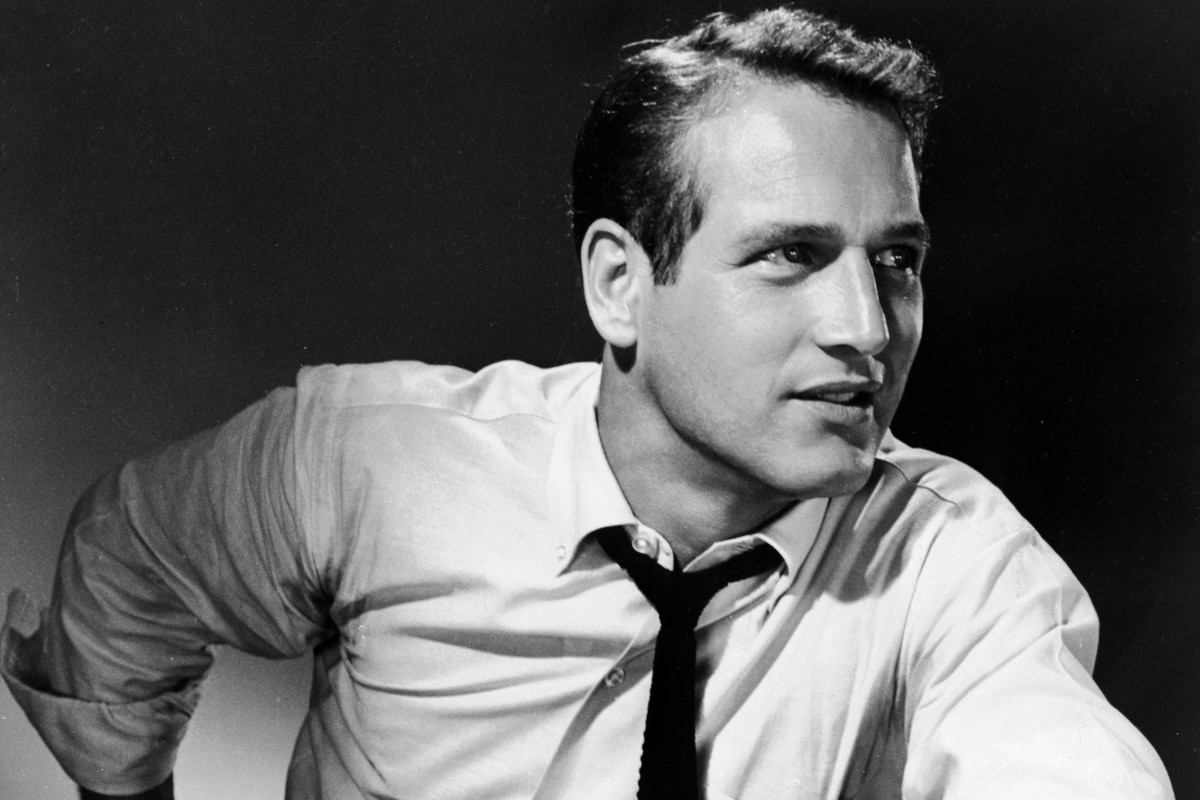
At the apex of his career, Paul Newman was considered the handsomest and most popular actor in the movies. With his electric-blue eyes and the chiseled features of a Greek god, he combined striking looks and magnetic charm with an authentic acting ability to match.
Newman had a special gift for creating characters who were morally ambiguous and self-serving. The ads for Hud (1963), one of his best performances, describe his character as "The man with the barbed-wire soul." Also memorable in his rogue's gallery of anti-heroes is his self-destructive criminal turned professional boxer in Somebody Up There Likes Me (1956) and the defiant prisoner of Cool Hand Luke (1967). Later in his career, he took on crusty character parts.
Paul Leonard Newman was born in Shaker Heights, Ohio, on January 26, 1925. He was the second son of Arthur Sigmund Newman Sr., who ran a sporting goods store, and his wife, Theresa. His father was the son of Polish Jewish emigrants and his mother was born in what is now Slovakia. Newman's brother, Arthur, would become a producer and production manager.
Paul Newman became intrigued with theater at an early age, acting in school plays from the age of seven and in productions at the Cleveland Play House beginning at age 10. After graduating from high school in 1943, he briefly attended Ohio University before enrolling in the U.S. Navy during World War II. He was turned away from pilot training because of color blindness and served in the Pacific theater as a radioman/gunner.
After the war, Newman completed a Bachelor of Arts degree in drama and economics at Ohio's Kenyon College. He acted with summer stock companies and attended the Yale School of Drama before relocating to New York City in 1951 with his first wife, Jackie Witte, whom he had married in 1949. He studied with Lee Strasberg at the Actors Studio and acted on numerous television shows, including a musical production of Our Town (1954) starring Frank Sinatra. He also gained experience on the Broadway stage in such plays as “Picnic” in 1953 and “The Desperate Hours” in 1955.
Newman made his Hollywood film debut at Warner Bros. wearing an abbreviated toga in The Silver Chalice (1954), a quasi-Biblical epic that he loathed. He later declared that in this film he "gave a clinic in bad acting," and swore to never again appear in a movie in which he had to wear a "cocktail dress."
Ironically, the tragic death of James Dean in 1955 opened up significant career opportunities for Newman, who took on meaty roles once intended for Dean, including real-life boxer Rocky Graziano in Somebody Up There Likes Me (1956) and outlaw Billy the Kid in The Left-Handed Gun (1958).
Newman also scored strongly in The Rack (1956) as a former inmate in a Korean War prison camp who is accused of collaborating with the enemy. He polished his credentials as a romantic leading man in such films as The Helen Morgan Story (1957), opposite Ann Blyth, and Until They Sail (1957), co-starring Jean Simmons.
The Long, Hot Summer (1958), an adaptation of two short William Faulkner stories, was a fateful film for Newman, since it reintroduced him with Joanne Woodward, who had worked as an understudy in Broadway's “Picnic.” In early 1958, shortly after making the Faulkner film, Newman divorced his first wife and married Woodward.
Newman would act in nine more theatrical movies with his wife, including Paris Blues (1961), co-starring Sidney Poitier and Diahann Carroll, and The Drowning Pool (1975), with Anthony Franciosa and Melanie Griffith. Newman also served as producer and director of a handful of Woodward's starring vehicles, beginning with Rachel, Rachel (1968), in which he drew a lovely performance from Woodward that earned a Best Actress Oscar nomination. The film also brought Newman (as producer) a nomination for Best Picture.
Newman received the first of nine Oscar nominations as Best Actor for the film version of Tennessee Williams' Cat on a Hot Tin Roof (1958), in which he and Elizabeth Taylor play a sizzling, dysfunctional duo. His other Best Actor nominations were for The Hustler (1961), Hud (1963), Cool Hand Luke (1967), Absence of Malice (1981), The Verdict (1982), The Color of Money (1986) and Nobody's Fool (1994). He was nominated in the Supporting Actor category for Road to Perdition (2002).
His only acting Oscar came for The Color of Money (1986), a Martin Scorsese-directed sequel to The Hustler, in which Newman plays the same character, some 20 years older. However, Newman won an honorary award in 1986, "in recognition of his many and memorable and compelling screen performances and for his personal integrity and dedication to his craft." And, in 1994, he was honored with the Academy's Jean Hersholt Humanitarian Award for outstanding contributions to humanitarian causes.
The many philanthropic causes with which Newman was associated included Newman's Own, a food company from which he donated all profits to charity; Safe Water Network, a nonprofit organization that develops sustainable drinking water; and SeriousFun Children's Network, a global program for children with serious illnesses.
Newman's two film romps with friend Robert Redford— Butch Cassidy and the Sundance Kid (1969) and The Sting (1973)—were both Oscar-nominated for Best Picture, with The Sting winning the award itself. Together, the pair created box-office magic. Butch Cassidy became the highest-grossing Western in movie history, and Newman was named the No. 1 star at the U.S. box office for both 1969 and '70.
Other highlights of the 1960s and 70s include Sweet Bird of Youth (1962), with Newman recreating his role as the two-bit gigolo he had played in the Tennessee Williams drama on Broadway; The Outrage (1964), an adaptation of the 1950 Japanese film Rashomon set in the American West; and Harper (1966), with Newman leading an all-star cast in a gritty detective thriller based on the Ross Macdonald novel “The Moving Target.”
He also starred in The Life and Times of Judge Roy Bean (1972), a salty Western from director John Huston; and Slap Shot (1977), an edgy sports comedy in which Newman stars as the manager, as well as a player, of a hockey team that resorts to violent play to draw crowds.
Newman remained active as a performer through the decades, though he claimed to have memory problems in his later years. Road to Perdition (2002) was his final big-screen appearance, but he continued acting on television and in voice work.
He was politically active, supporting liberal causes and Democratic candidates. His chief passion aside from filmmaking was auto racing; he was a frequent competitor in Sports Car Club of America and won four national championships.
Newman died of lung cancer on September 28, 2008, at his Connecticut farmhouse. His passing elicited this statement from co-star Robert Redford: "There is a point where feelings go beyond words. I have lost a real friend. My life—and this country—is better for his being in it."
Newman himself once said, "I'd like to be remembered as a guy who tried—tried to be part of his times, tried to help people communicate with one another, tried to find some decency in his own life, tried to extend himself as a human being."